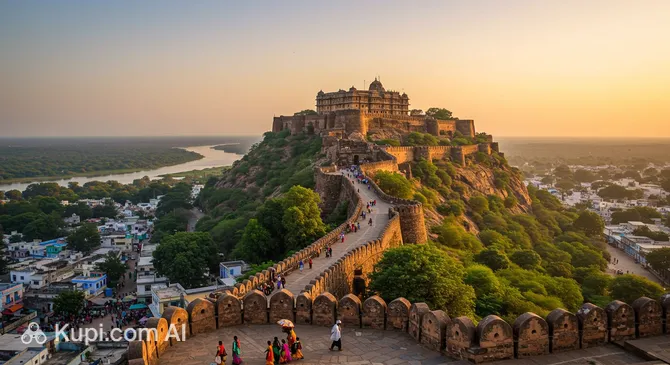
Raichur is a colorful city in the eastern part of the state of Karnataka in southern India, serving as an important administrative and commercial center for the region. Situated in a picturesque elevated basin between the sacred Krishna and Tungabhadra rivers, the city possesses a special atmosphere where the breath of antiquity intertwines with the rhythm of modern commercial life. With a population of about 232,000, Raichur retains the spirit of a provincial Indian hub, offering travelers an authentic experience far from the beaten tourist paths.
Raichur. Illustration.
Source: Kupi.com AI
The rich history of the city is reflected in its architectural heritage: at various times, it was under the rule of the powerful Kakatiya, Vijayanagara, and Bahmani empires. In 1489, Raichur even became the first capital of the independent Kingdom of Bijapur. Today, it is known as a major agricultural hub specializing in the production of cotton, rice, and oilseeds, as well as its proximity to the famous gold mines in Hatti.
For tourists, the city is primarily interesting for its fortifications and ancient temples. The main gem is the Raichur Fort, which rises above the plain and preserves epigraphic inscriptions from different eras. Visiting Raichur is an opportunity to see the real India, feel the hospitality of the locals, and touch the layers of history that have shaped the face of South India over the centuries.
Weather Overview
The climate in Raichur is typical for the tropical zone of South India and is characterized by three distinct seasons. The city is located in an elevated basin, which influences weather conditions: the air is quite dry for most of the year, but humidity increases significantly during the monsoon period. Before planning a trip, it is worth checking the city's weather to choose the most comfortable time for excursions.
Summer in Raichur begins in March and lasts until May, bringing intense heat — the thermometer often rises to +38°C...+40°C, and sometimes even higher. From June to September, the city is under the rule of the monsoons: this is when the main rainfall occurs, and the nature around it blooms. July and September are considered the wettest months, when heavy rains may temporarily limit walks to historical monuments.
The best time to visit is considered the winter period from November to February. During these months, pleasant and mild weather sets in with daytime temperatures ranging from +25°C...+30°C and cool nights. Expect warm, sunny skies and a near-total absence of precipitation, creating ideal conditions for exploring the ancient fort and strolling through local markets.
Average monthly temperature
Average monthly precipitation
Interesting Facts
Raichur is a city with an amazing history, full of hidden meanings and ancient artifacts. Here are a few facts to help you look at it in a new way:
Royal Name: The city's name comes from the word "Rayachooru," which translates from Kannada as "royal place." This name was first mentioned in inscriptions of the Hoysala dynasty dating back to the 12th century.
Gold Rush: The Raichur district is one of the few places in India with significant gold reserves. The famous Hatti mines, located 90 km from the city, are among the oldest and deepest gold mines in the world.
Traces of Emperor Ashoka: Unique minor rock edicts of Emperor Ashoka (3rd century BC) were found near the city in a place called Maski. It was here that an inscription was discovered confirming that "Devanampiya" from other edicts was indeed the great Mauryan ruler Ashoka.
Battle of Raichur: The city was the scene of the famous 1520 battle between the Vijayanagara Empire and the Bijapur Sultanate, which is considered one of the first examples of the mass use of firearms in India.
The First Capital: In 1489, Raichur officially served as the first capital of the independent Kingdom of Bijapur under the rule of Yusuf Adil Shah.
How to Get There
The transport accessibility of Raichur makes it a convenient hub for travelers exploring southern and central India. Despite the lack of its own airport, the city is well-integrated into the national transport network, especially thanks to its rail connections. When planning a trip, it is worth researching in advance how to get to the city in the most comfortable way, considering its distance from major metropolises.
The nearest major international air hubs are located in Hyderabad (Rajiv Gandhi International Airport) and Hubli. From Hyderabad, you can reach Raichur by taxi or train in 4–5 hours. It is better to book an airport transfer in advance through official taxi services or carrier apps.
The railway is the heart of the city's transport system. Raichur station is an important point on the Central Railway. Express trains from Bangalore (travel time 8–10 hours), Hyderabad (about 4–5 hours), and Mumbai stop here. Traveling by train is not only the most budget-friendly but also the most atmospheric way to move around India.
Station
Passenger traffic
Distance
Kurnool railway station
6
84 km
Kalaburagi Junction railway station
6
134 km
Hyderabad Deccan railway station
8
176 km
Secunderabad Junction railway station
10
182 km
Secunderabad Junction railway station
10
182 km
For those who prefer road transport, state and private bus services are available. A bus journey from Bangalore can take 10 to 12 hours depending on traffic on the national highways. Within the city, you can easily reach your destination from the railway station and bus stand via auto-rickshaws, which are on duty here 24/7.
Main Attractions
The main historical treasures of Raichur are centered around its military and spiritual past. Taking center stage is the majestic Raichur Fort, built in 1294 by the Kakatiya King Rudra. This citadel, located on a hill at an altitude of 88 meters above the surrounding plain, is a unique palace-fortress. Walking along its walls, you can see ancient inscriptions in Persian, Urdu, and Arabic, which testify to the turbulent succession of rulers, while the summit offers panoramic views of the entire city.
The city's spiritual heritage is represented by revered temples, among which the Narada Temple stands out. This site attracts pilgrims and tourists with its peaceful atmosphere and traditional architecture. Another important religious site is the Shripad Shrivallabha Dattatreya Devasthanam, associated with the name of Saint Shripad Shrivallabha, whose life left a deep mark on the region's culture.
Although Raichur itself is not positioned as a modern entertainment hub, its surroundings offer additional opportunities for explorers. Nearby settlements such as Maski and Manvi are known for their archaeological finds, including ancient edicts of Emperor Ashoka. Visiting these places allows for a deeper understanding of India's epigraphic wealth, spanning the period from the Mauryas to Muslim rule.
Local Cuisine
The culinary landscape of Raichur is steeped in the traditions of Karnataka with a noticeable influence from neighboring Andhra Pradesh. The foundation of the local diet is rice — Raichur is widely known for its export, so rice dishes here are always of excellent quality. The character of the city's gastro scene can be described as simple, hearty, and home-style delicious, focused on using local seasonal products.
Be sure to try classic South Indian breakfasts: masala dosa (thin crispy pancakes with a spicy filling), idli, and vaggie (a dish made from puffed rice). A unique feature of the local cuisine is the use of cotton oil in cooking, which is linked to the developed cotton farming in the region. Various versions of dal (lentil soup) and dishes with the addition of jaggery — unrefined cane sugar — are also popular.
As for drinks, the culture of aromatic filter coffee and strong tea with milk and spices prevails in Raichur. On hot days, locals prefer to refresh themselves with freshly squeezed tropical fruit juices or coconut water. The main dining establishments are concentrated around the central market and the fort — these are mostly authentic vegetarian cafes (hotels) and street food stalls where you can have a cheap and tasty snack in the company of locals.
Travel Tips
Raichur is a city with deep traditions and a unique rhythm of life. To ensure your journey is comfortable and leaves only pleasant impressions, we have prepared some practical tips.
Clothing and dress code: Choose light clothing made from natural fabrics (cotton, linen), as it can be very hot in Raichur. When visiting temples, be sure to cover your shoulders and knees, and be prepared to remove your shoes at the entrance. Comfortable closed shoes will be useful for walking around the fort area.
Getting around town: The best way to travel is by auto-rickshaws. They are available everywhere. Negotiate the price before starting your journey. During peak hours, there are traffic jams on the roads near the markets, so allow extra time for this.
Finances: Cash is the predominant form of payment in the city. Always carry a supply of Indian Rupees in small denominations for paying rickshaws and making purchases at markets. ATMs are available in the center and near the station, but cards are only accepted in large hotels and shops.
Health: Drink only bottled water from industrial manufacturers. Avoid ice in drinks at street cafes. In the hot months, always bring sunscreen and a hat.
Time for excursions: Visit Raichur Fort as early as possible in the morning (immediately after opening) to avoid the scorching midday sun and large crowds.
Communication: The main language here is Kannada, but many in the service sector understand basic English. Learn a couple of greeting phrases in the local language — it always wins the favor of the residents.
Safety: The city is generally safe, but after dark, it is better to stick to central areas. Keep an eye on your belongings in crowded markets and at the station.
What to avoid: Do not set off for remote rural areas without a guide or a local acquaintance. Also, try not to photograph locals without their prior consent.
May your introduction to Raichur be filled with amazing discoveries and the warm hospitality of this ancient land!
Entertainment & Nightlife
Entertainment in Raichur is predominantly quiet and traditional in nature. Since the city is primarily an administrative and commercial center, there are no noisy nightclubs or large concert venues. The evening life of the locals is centered around the central markets and small cafes, where the air is filled with the aroma of spices and freshly brewed tea. This is an ideal time for leisurely strolls as the daytime heat subsides and the city fills with the soft light of evening lamps.
The main form of leisure for city dwellers is cinemas showing the latest Bollywood and regional films — this is a great opportunity to immerse yourself in Indian mass culture. Also, the city regularly hosts temple festivals and street fairs, which turn into vibrant events with music and traditional performances. For more active nightlife and large-scale shopping, locals and tourists usually head to nearby Hyderabad or Bellary.
In terms of safety, Raichur is considered a typical provincial city. For evening walks, it is better to choose central, well-lit areas and territories near the fort. If you need to return to your hotel late at night, it is recommended to use auto-rickshaws, which are easily found on the main streets. The city's atmosphere lends itself to cultural and historical contemplation rather than wild parties until dawn.
Parks & Museums
The museum infrastructure in Raichur is minimally developed; however, the city itself is often called an open-air museum. The lack of large galleries is more than compensated for by the wealth of epigraphy and architectural details on the walls of ancient buildings. The main historical finds and collections of inscriptions are kept directly at the sites where they were discovered — in the fort and ancient temples, creating an effect of complete immersion in past eras.
Parks and green zones are not common in the city, which is typical for densely built-up Indian industrial centers. Nevertheless, the territory of Raichur Fort serves as a kind of recreational zone where you can take a break from the city noise among ancient ruins and enjoy relative coolness in the shade of old trees. Small municipal squares are found in the central districts, but they are mainly oriented toward the needs of local residents.
Nature lovers should pay attention to the banks of the Krishna and Tungabhadra rivers outside the city. Although there are no developed parks in the Western sense, these places attract with their natural beauty and the opportunity to observe rural Indian life against the backdrop of picturesque river landscapes. Within the city itself, landscaping remains at a basic level, emphasizing its practical, commercial status.
Getting Around
The public transport system in Raichur is simple and functional, fully meeting the needs of a provincial Indian hub. There is no metro or tram system here, and the main way to get around for tourists and locals is by auto-rickshaw. These nimble three-wheeled vehicles are ideal for navigating the narrow streets near the markets and the fort. You should always agree on the price of the trip in advance or ensure the driver turns on the meter (which rarely happens in the provinces).
For more economical trips, you can use local buses that connect different parts of the city. They can be overcrowded, especially during rush hours (from 7 to 10 AM and from 5 to 8 PM), but they allow you to experience true local color. You can also still find cycle rickshaws in Raichur, which are suitable for leisurely short-distance trips in the central part of the city.
If you plan to move between cities in the state, rail transport remains unrivaled in terms of convenience and price. Train tickets can be purchased at station ticket offices or through Indian Railways' online apps. Walking through the very center of Raichur is quite possible, but keep in mind the heavy traffic and dusty roads. Car-sharing or bicycle rental services are practically non-existent in the city, so taxis and rickshaws remain your main assistants.
Accommodation
Accommodation options in Raichur are primarily geared toward transit travelers, pilgrims, and business people. You shouldn't expect luxury five-star hotels here, but the city offers a decent selection of mid-range hotels and budget guesthouses providing the necessary comfort for resting after excursions.
The most convenient area to stay is considered the territory near the railway station and central shopping streets. Hotels in this area allow for quick access to major transport hubs and key historical attractions, such as the fort. Most hotels offer a basic set of services: air conditioning (which is important during the hot season), Wi-Fi in the lobby, and vegetarian restaurants on-site.
The price range in the city remains very affordable. For those planning a long stay, budget apartments can be found, although this segment is less developed. We recommend booking accommodation in advance, especially during local festivals or large fairs when the flow of visitors to Raichur increases significantly. You can book a room through popular Indian and international booking services.
Nearby Cities
Raichur serves as an excellent starting point for exploring the lesser-known but charming corners of northeastern Karnataka and adjacent states. The city's surroundings are rich in small settlements, each possessing its own rural charm and traditional way of life, offering tourists the chance to see India without embellishment.
Among the nearest destinations are Gattu and Makthal, which are within an hour's drive. These small towns are ideal for getting acquainted with local architecture and the rhythm of life in agricultural communities. It is also worth noting Sirvar, located 36 kilometers from Raichur, where you can observe traditional methods of processing rice and cotton.
City
Population
Distance
Ghattu
10,608
25 km
Upperu
12,562
34 km
Sirwar
19,295
36 km
Makthal
20,339
36 km
Medikonda
8,520
39 km
For longer trips from Raichur, it is convenient to reach Bellary (about 150 km), known for its powerful granite fortress, or the majestic Bijapur. Rail connections allow for easy planning of such outings. Exploring the surrounding towns will help you gain a complete understanding of the diversity of this region and find hidden historical monuments not marked in mass guidebooks.
Shopping & Souvenirs
Shopping in Raichur is first and foremost about visiting colorful local markets where trade follows the same rules as centuries ago. The city is not famous for huge shopping malls, but it is an important center for agricultural trade. Here you will find the best rice in the region, fresh cotton oil, and a variety of spices that locals buy in large quantities.
The main shopping area is considered to be the central market and the commercial streets adjacent to the railway station. Life is bustling here: shops sell textiles, traditional-style clothing, and cotton products for which the district is famous. This is an excellent place to purchase high-quality cotton fabrics or ready-made clothes at very affordable prices. It is also worth paying attention to local soap and cosmetic products based on natural oils produced in this region.
Items made by local craftsmen and small replicas of historical artifacts found during excavations in the vicinity are often brought back as souvenirs from Raichur. Most shops are open from morning until late evening with a short break during the hottest time of the day. Payment is made primarily in cash (rupees), although larger stores are beginning to accept bank cards. The Tax Free system is virtually non-existent in such provincial centers, so focus on the final prices on the receipt.