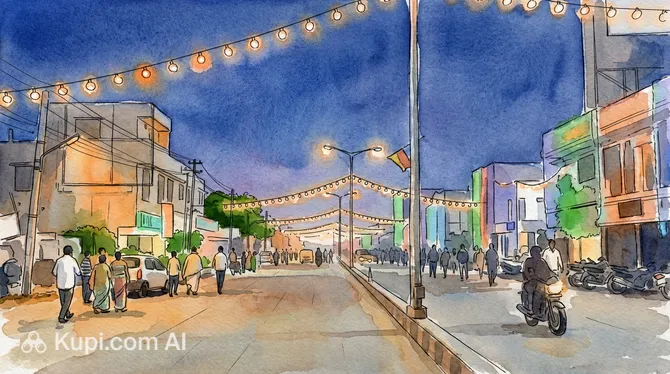
Located in the southern part of Karnataka, Tiptur is a distinctive agricultural and administrative hub in India. As the second-largest city in the Tumakuru district, it is often called the "City of Coconuts" or Kalpataru Nadu ("Land of the Wish-Fulfilling Tree"). Tiptur earned this poetic name thanks to its endless coconut plantations, which not only shape the region's picturesque landscape but also form the backbone of its thriving economy.
Tiptur. Illustration.
Source: Kupi.com AI
The city covers an area of about 8.2 km², with a population exceeding 222,000 including surrounding areas. Tiptur is steeped in the atmosphere of a traditional South Indian province, where life flows at the steady pace of agricultural seasons. The region's deep heritage is reflected in its name: the history of Tiptur traces back to the Kannada words "tipu" (weaving) and "tur" (place), recalling the city's glorious past as an important center for hand-weaving.
For tourists, Tiptur is primarily interesting for its authentic way of life, its massive copra and coir markets, and its proximity to the spiritual shrines of Karnataka. Visiting this city offers a chance to see the real, non-touristic India, enjoy the shade of ancient trees, and experience the hospitality of locals whose lives are inextricably linked to the gifts of the "palm of life."
Weather Overview
Tiptur is characterized by a tropical savanna climate, typical of the southern part of the Deccan Plateau. This means a clear division of the year into wet and dry seasons. The temperature regime in the city is quite stable, but travelers should take into account high humidity during the monsoon periods.
The most favorable time to explore the weather in Tiptur is the period from October to March. During these months, the temperature is comfortable (averaging around 22-24°C), and rain is rare, making walks through the coconut plantations as pleasant as possible. The summer months (April and May) can be quite hot, with daytime highs reaching 34-36°C.
The rainy season usually starts in May and lasts until October, with peak rainfall occurring in July and October. At this time, air humidity increases significantly, and frequent showers refresh the landscape, making the palm greenery even more vibrant. Thanks to the abundance of green spaces, air quality in Tiptur remains good, although roads can be dusty during the dry season.
Average monthly temperature
Average monthly precipitation
Interesting Facts
The city's name is derived from the Kannada words "tipu" (weaving) and "tur" (place), directly pointing to its historical past as a production center for silk, cotton, and wool.
Tiptur bears the honorary title of Kalpataru Nadu, which translates to "Land of the Wish-Fulfilling Tree"—referring to the coconut palm, which provides the locals with food, oil, and building materials.
The city is one of the state's largest exporters of copra (dried coconut meat), and local coir processing cooperatives are known far beyond the district.
Tiptur Railway Station has the unique code TTR and is a strategically important hub for transporting not only passengers but also vast quantities of agricultural products.
How to Get There
Tiptur is conveniently located 140 kilometers from the capital of Karnataka, Bengaluru, making it easily accessible for both independent travelers and those using public transport. The city serves as an important link between the region's major economic centers, offering various travel options.
The most popular and comfortable way to reach Tiptur is by rail. The Tiptur (TTR) railway station is integrated into the Southern Railway network and receives trains departing from Bengaluru. The train journey takes about 3-4 hours, allowing you to enjoy views of rural India.
Station
Passenger traffic
Distance
Mysore Junction railway station
8
106 km
Bhadravati railway station
1
106 km
Krantivira Sangolli Rayanna railway station
14
122 km
Krantivira Sangolli Rayanna railway station
14
122 km
Mangaluru Junction railway station
6
179 km
For those who prefer buses, the state company KSRTC provides regular services from Bengaluru and neighboring Tumakuru. The distance from Tumakuru is about 50 kilometers, and the trip along the NH48 highway usually takes 1 to 1.5 hours. The nearest major international airport is located in Bengaluru (BLR), from where Tiptur can be reached by taxi or intercity bus, with a travel time of about 4 hours depending on traffic.
While Tiptur is not a classic tourist center, it hides several surprising locations that reflect the natural majesty and spiritual depth of Karnataka. One of the most unusual attractions is Muniyappa's Banyan Tree. This giant living entity with a sprawling canopy and numerous aerial roots is a favorite resting spot for locals and impresses travelers with its sheer scale.
Religious shrines are an essential part of life in the region, drawing thousands of pilgrims. The Sri Sankareshwara Swamy Temple complex, located in Keregodi-Rangapura, deserves special attention. This place is famous for its peaceful atmosphere and ancient traditions of worship. Another significant spiritual center is the Paradesi Kendra Math in Rangapura, where one can catch a glimpse of the ascetic lifestyle and religious culture of the local communities.
Those wishing to feel the pulse of modern life in Tiptur should head to the central coconut and textile markets. Although these trading floors are not architectural monuments, they serve as a living museum of the regional economy. Here, you can witness the copra sorting process and the bidding that determines the prices of coconut products across the district, as well as get acquainted with the work of local weavers.
Local Cuisine
The gastronomic identity of Tiptur is inseparable from its main asset—the coconut. Local Karnataka cuisine takes on a special flavor here due to the widespread use of coconut milk, fresh copra, and aromatic coconut oil. Be sure to try coconut chutney at local eateries, which is served with almost every dish, as well as a hearty sambar enriched with grated coconut.
A typical breakfast in Tiptur is hard to imagine without traditional South Indian specialties: crispy dosa pancakes, steamed idli rice cakes, and fluffy puri served with a spicy vegetable gravy. Due to the region's developed production of peanuts and areca nuts, these are also frequently added to snacks and hot dishes, giving them a characteristically rich flavor.
As for beverages, the undisputed leader is South Indian filter coffee—strong, sweet, and very aromatic. On a hot day, the best refreshment is fresh coconut juice (todap), sold right on the roadsides near the plantations. Alcohol is not widely available in the city, so the gastronomic scene focuses on non-alcoholic drinks like lemonades and lassi.
Travel Tips
A trip to Tiptur will give you a unique experience of immersion in the rural life of Karnataka, and these practical tips will help make your journey as comfortable and safe as possible.
Clothing and Essentials: Choose light clothing made from natural fabrics, as a tropical climate prevails in the region. Be sure to bring a hat, sunscreen, and repellent. When visiting temples, follow the dress code: shoulders and knees should be covered.
Transport: For getting around inside the city, auto-rickshaws are your best bet. For longer trips, use trains or KSRTC buses. Remember that Indian roads can be congested, so plan your time with a buffer.
Finances: The primary currency is the Indian Rupee. In Tiptur, it is always best to carry a supply of cash, as cards are not accepted everywhere. ATMs are available in the center, but they may not work with some foreign cards.
Health and Safety: Drink only bottled water and avoid ice in drinks. There are pharmacies in the city, but it is better to bring specific medications with you. Be cautious in crowded places (like markets) and avoid walking alone in the outskirts after dark.
Communication: The main language is Kannada. Railway staff and those in larger shops understand English, but knowing basic phrases ("namaskara" — hello) will help win over the locals. It is better to purchase a SIM card in advance in Bengaluru.
Local Etiquette: Always remove your shoes when entering homes and temples. Indians value politeness and calmness; aggressive behavior is not welcomed here.
What to Avoid: Do not take photos of people without their permission, especially during religious rituals. Also, refrain from eating street food if your stomach is not used to it.
Additional Tip: The best time to visit Tiptur is from October to March, when the weather is most pleasant for walks through the coconut plantations.
May your acquaintance with this "coconut land" be filled with bright discoveries and the warmth of Indian hospitality!
Entertainment & Nightlife
The entertainment scene in Tiptur is quiet and traditional. You won't find noisy nightclubs or bars with loud music here—the city's life slows down after dusk, following the rhythm of an agrarian community. The primary evening leisure for locals consists of family trips to cinemas showing the latest Indian films and strolls through the central squares.
Festivals held regularly at local temples become the true centers of social life. These events are accompanied by colorful processions, traditional music, and fairs, turning the city streets into festive spaces. For travelers, this is the best way to experience the culture of Karnataka and see folk celebrations in their original form.
If you are looking for more conventional modern entertainment, such as large shopping malls or fine dining restaurants, it is worth planning a trip to Bengaluru or Tumakuru. In Tiptur itself, daytime is best spent exploring coconut plantations or relaxing in cozy local cafes, where you can leisurely observe the daily bustle of this commercial town.
Parks & Museums
In Tiptur, you won't find classic art galleries or large-scale historical museums—cultural life here is concentrated in the open air. The city's main "natural museum" is the endless coconut plantations that surround the residential areas in a dense green ring, creating a unique ecosystem and providing the region with clean air.
The role of central city parks in Tiptur is fulfilled by extensive temple complexes and recreation areas near water bodies. The area around the giant Muniyappa's Banyan Tree is considered the most popular spot for leisurely walks. This natural zone replaces an organized park for residents, offering coolness and shade even during the hottest hours. For the locals, this place also holds sacred meaning, turning ordinary relaxation into a kind of meditative experience.
Despite the lack of official museum exhibits, the spirit of the city's history can be felt in its old markets and weaver workshops. Each such place is a living page of Karnataka's history, telling the story of centuries-old traditions of manual labor and agricultural skill. Residents often use the grounds of local temples for recreation, making religious sites the main centers of social and cultural life in the city.
Getting Around
The transport system in Tiptur is typical for a compact Indian city and is focused on practicality. The main means of getting around the city streets are auto-rickshaws (tuk-tuks). This is the fastest and most convenient way to get from one part of the city to another, especially if you are heading to the market or the railway station. It is advisable to agree on the fare in advance, as meters are rarely used.
For travel between neighboring villages and towns within the taluk, residents actively use KSRTC state buses. Tiptur's bus station is an important transport hub connecting the city with Tumakuru and Bengaluru. Bus tickets are inexpensive, and routes cover even the most remote corners of the region.
Rail transport plays a key role in the city's life thanks to the Tiptur (TTR) station. Trains are the most reliable way to connect with metropolitan areas. Within the center of Tiptur (covering an area of about 8.2 km²), many people prefer to move on foot or by motorcycle. It is worth noting that during peak hours near the markets, traffic can be difficult due to the dense flow of carts and pedestrians, so allow extra time for your journey.
Accommodation
The accommodation in Tiptur is primarily geared toward business travelers, farmers, and trade representatives arriving for coconut auctions. You will find a wide range of budget guesthouses and lodges concentrated around the railway station and on central streets. The living conditions are modest but quite sufficient for a short stay of one or two nights.
Hotels in the city usually fall into the 1–2 star category, offering a basic set of amenities. There are no luxury resorts or international hotel chains in Tiptur itself; therefore, travelers accustomed to a high level of service are recommended to book accommodation in larger cities like Tumakuru or Bengaluru and visit Tiptur as part of a day trip.
If you plan to stay in the city for a longer period, you might consider renting an apartment through local intermediaries. When booking hotels, it is recommended to prioritize establishments closer to the center for quick access to markets and transport hubs. During peak agricultural fair seasons, it is better to arrange housing in advance.
Nearby Cities
Thanks to its favorable location on Karnataka's transport axes, Tiptur serves as an excellent starting point for exploring neighboring towns and historical sites. The region around the city is rich in ancient temples and authentic settlements perfect for day trips.
Just 23 kilometers away lies Turuvekere, known for its majestic Hoysala-era temples. Another interesting destination is Arsikere, where you can see the unique Ishwara Temple with its unusual star-shaped plan. If you are interested in modern infrastructure and shopping, an hour's drive east will take you to Tumakuru—the district's administrative center with a developed service network.
City
Population
Distance
Turuvekere
17 530
23 km
Chiknayakanhalli
29 553
23 km
Arsikere
80 000
25 km
Huliyar
16 192
36 km
Banavar
10 991
38 km
Exploring the surroundings of Tiptur allows for a deeper understanding of South Indian history and traditions, often hidden from the eyes of mass tourists. Every trip to nearby towns will grant you new impressions of the architectural mastery of ancient builders and picturesque rural landscapes.
Shopping & Souvenirs
Shopping in Tiptur is primarily about getting to know the products of local farmers and artisans. The city does not have huge shopping malls with global brands, but it is famous for its colorful bazaars. The main object of interest for a tourist is the central market, where the air is filled with the aroma of coconut oil and spices. It is the perfect place to witness the scale of trade in copra and areca nuts, which are the hallmarks of the region.
If you are looking for special souvenirs, pay attention to products made from coir (coconut fiber) and high-quality cold-pressed coconut oil. Tiptur also maintains its weaving traditions: in local cooperatives, you can purchase cotton and silk items created using ancient technologies. These items are durable and feature unique designs characteristic of South Indian craftsmen.
Shops and stalls in the city usually operate from early morning until late evening, taking a break during the hottest afternoon hours. Payment is most often made in cash in the local currency (Indian Rupees), although larger shops are beginning to accept digital payments. Strolling through the Tiptur market rows will allow you to not only make useful purchases but also immerse yourself in the lively bustle of an Indian agro-town.