Support

Man

About the Airport

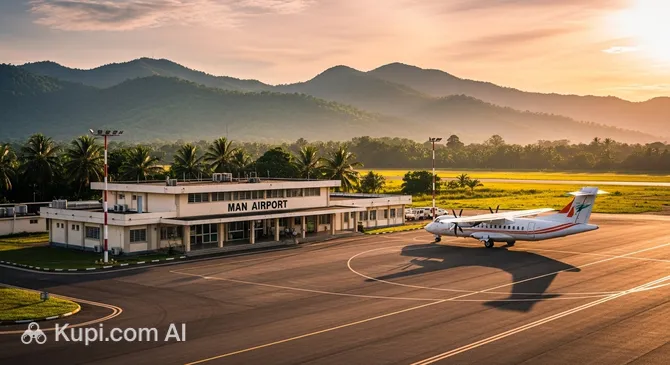
Man. Illustration.
Source: Kupi.com AI

Man Airport (MJC) serves as the aerial gateway to the picturesque Region of the 18 Mountains in western Côte d'Ivoire. Located near the city of the same name, this small and welcoming airport is a key point for travellers aiming to explore coffee plantations, waterfalls, and the unique culture of the Dan people. Despite its modest size, the airport plays a significant role in the country's transport system, providing a link to the economic capital, Abidjan, and granting access to some of the most beautiful landscapes in West Africa.

PropertyValue
IATA CodeMJC
ICAO CodeDIMN
CityMan
CountryIvory Coast
TimezoneAfrica/Abidjan
Top AirlinesAir Cote d'Ivoire
ScheduleOnline Timetable

The main advantage of Man Airport is its strategic location. It serves as a starting point for tourists wishing to visit the famous La Cascade waterfalls, Mount Tonkoui, and discover local craft traditions. The compactness of the terminal makes the check-in and security screening process quick and convenient, which is particularly appreciated after a long journey. The airport ensures regular connections with Abidjan, allowing travellers to easily combine business trips with exploring the natural treasures of Côte d'Ivoire.

Contact Information

Finding detailed and up-to-date contact information for a small regional airport like Man Airport (MJC) can be challenging. Below are general details and recommendations to help you navigate.

  • Official Airport Website: Man Airport (MJC) does not have its own official website. It is recommended to check all information regarding flight status, carriage rules, and services directly on the websites of the airlines operating flights to Man.
  • Information Desk Phone: There is no direct public phone number for the airport information desk. For all operational queries, it is best to contact your airline.
  • Airport Address: Aéroport de Man, Man, Côte d'Ivoire. The airport is located a few kilometres from the city centre.
  • Email: A dedicated email address for general passenger enquiries is not published.
  • Airport Social Media: The airport does not maintain official pages on social networks.
  • Lost Luggage Information: If your luggage has been lost or damaged, you should immediately contact your airline's Lost & Found service at the arrival airport.
  • Passenger Support Contacts: Passenger support regarding tickets, check-in, and flights is provided by airline representatives at the counters within the airport.

How to Get to the Airport

There are several ways to reach the airport of Man (Aéroport de Man, IATA code: MJC), located a few kilometres from the centre. The choice of the appropriate option depends on your budget, time, and comfort preferences. Since this is a small regional airport, the transport infrastructure here is simpler than in the major international hubs of Côte d'Ivoire.

Taxi and Hotel Transfer is the most convenient and popular way to get to the airport. The journey from the city centre takes approximately 20–30 minutes depending on traffic conditions. It is recommended to agree on the fare with the driver in advance, as taximeters are rarely used. This is the most direct and fastest option. For added convenience, many hotels in Man offer a transfer service to their guests. This method is more predictable in terms of price and time, though usually more expensive than a standard taxi. Check the availability and cost of the transfer when booking your accommodation.

Public Transport in the form of direct bus routes to the airport is generally absent. However, you can use local shared taxis, known as taxi-brousse, or minibuses that ply the main roads. This option is the most budget-friendly but also the most challenging for a tourist: you will likely have to alight on the main road and walk some distance to the terminal. This method is suitable for experienced travellers familiar with the local transport system and ready for an adventure.

Car Rental can be an excellent solution for those who value independence and plan to explore the picturesque region around Man. Local rental agencies can be found in the city. Having your own transport will allow you to get to the airport at any convenient time. Note that an international driving permit may be required for driving. Parking at Man Airport usually consists of a simple lot near the terminal where you can leave a car for a short or long period for a small fee.

Terminals and Map

Man Airport (MJC) is a small regional airport, which is its main advantage for travellers. It consists of one compact terminal that handles all flights — both arrivals and departures. Thanks to this, navigating here is very simple, even if you are visiting for the first time. You will not have to worry about long walks between terminals or searching for the right gate in confusing corridors.

The airport layout is extremely simple. All key zones — check-in counters, security screening area, a small waiting lounge, and baggage claim — are located in one building a short distance from each other. The arrival and departure zones are situated nearby, making movement through the airport intuitively clear and fast. Clear signs will help you easily find the necessary area.

Completing all pre-flight procedures at Man Airport usually takes significantly less time than in large international hubs. Nevertheless, it is recommended to arrive at the airport approximately 1.5–2 hours before the departure of a domestic flight. This time will be sufficient to check in for the flight, drop off luggage, and pass security screening without haste, even taking into account a possible influx of passengers from other flights.

The main advice for navigation is to follow the standard signs. Due to the modest size of the terminal, it is practically impossible to get lost here. Airport staff are always ready to help and direct you. Simplicity and speed are the key characteristics that make the experience at Man Airport comfortable and predictable.

Airport History

The history of Man Airport (MJC) is inextricably linked with the era of the formation of independent Côte d'Ivoire. After gaining sovereignty in 1960, the country actively developed infrastructure to strengthen economic and administrative ties between regions. The construction of the airfield in the city of Man was a strategically important decision, designed to "open up" the Dix-Huit Montagnes (Eighteen Mountains) region to the entire country, a region rich in natural resources but isolated due to difficult terrain.

From the moment of its opening, the airport became a key transport hub, ensuring reliable air connection with the economic capital, Abidjan. This gave a powerful impetus to the development of the region, known for its coffee and cocoa plantations. The air route significantly simplified logistics for business, the movement of civil servants, and the delivery of necessary goods, strengthening Man's position as the administrative and economic centre of the country's west.

Besides its economic role, the airport has played an invaluable part in the development of tourism. It became the aerial gateway for travellers striving to explore the unique nature of this land: the famous Mount Tonkoui, cascading waterfalls, and the distinctive culture of the local peoples. Although the airport has not undergone massive reconstructions characteristic of large international hubs, its infrastructure has been constantly maintained to ensure the safety and comfort of passengers.

Today, Man Airport continues to fulfil its historic mission — to be a reliable bridge connecting the picturesque mountainous heart of Côte d'Ivoire with the rest of the world. Its history is not so much a chronicle of records as it is a story of stable and vital work that makes one of the most beautiful yet hard-to-reach regions of the country open to guests and new opportunities.

Services and Facilities

Man Airport (MJC) is a small regional airport serving the city of Man and the western part of the country. Given its size, the range of services here is basic and aimed at satisfying the essential needs of passengers before departure.

Restaurants, Shops, and Lounges. The choice of dining and retail establishments within the terminal is limited. Usually, there is a small kiosk or café where you can buy snacks, water, and beverages. Here you can also find a modest selection of local souvenirs. A general waiting lounge is equipped for all passengers. Specialised VIP lounges are generally absent.

Internet and Charging Stations. Access to public Wi-Fi at the airport may be unstable or unavailable. Travellers are recommended to use mobile data. The number of power outlets for charging electronic devices is limited, so it is better to bring a portable power bank.

Financial and Medical Services. ATMs and currency exchange points are likely unavailable at the airport. It is recommended to conduct all financial transactions in the city beforehand. For emergencies, a first aid point is provided in the terminal.

Services for Passengers with Special Needs. Basic amenities may be available for passengers with children, such as changing tables in restrooms. Passengers with reduced mobility are provided with assistance in moving through the terminal and boarding the flight. To receive this service, it is necessary to contact the airline in advance and make a corresponding request.

Accommodation and Business Services. There are no hotels on the airport territory; the nearest hotels are located in the city of Man, which can be reached by taxi. Conference rooms or business centres are not provided at the airport.

Where to Eat

When planning a flight from Man Airport (MJC), it is important to consider that this is a small regional airport, and the choice of dining establishments here is quite modest. Opportunities for a snack are oriented towards the basic needs of passengers waiting for their flight, rather than gastronomic delights.

Typically, one small café or buffet operates within the terminal building. The assortment usually includes a standard set for a quick snack: sandwiches, pastries, crisps, chocolate, as well as hot and cold beverages — coffee, tea, bottled water, and soft drinks. This is a convenient option if you need to satisfy your hunger before departure without leaving the airport.

You should not expect a full hot lunch or dinner with multiple courses directly at the airport. You are unlikely to find restaurants with à la carte service here. If you have time, the best solution would be to eat at one of the establishments in the city of Man before arriving at the airport. There you can experience authentic Ivorian cuisine, for example, try alloco (fried plantain bananas) or kedjenou (stewed chicken or fish).

Specialised options, such as vegetarian, vegan, or gluten-free dishes, are likely not represented here. Passengers with special dietary requirements are strongly advised to bring food with them. The sole establishment is likely located in the general waiting area before the security zone (landside), and its opening hours are usually tied to the flight schedule. Prices at the airport are generally higher than in the city, so this should be taken into account when planning your travel budget.

Tips for Travellers

When planning a departure from the airport of Man, which serves domestic flights across Côte d'Ivoire, it is important to consider several points for a smooth journey. It is recommended to arrive at the airport at least 1.5-2 hours before departure. This time is sufficient to complete all pre-flight formalities without haste.

Check-in and security control procedures at regional airports usually proceed faster than at major hubs. Nevertheless, keep your passport and printed or electronic ticket ready. Online check-in, if available with your airline, will help save time. When choosing a seat on the plane, note that flights from Man are often operated on small aircraft. A window seat will offer you a farewell view of the region's picturesque landscapes, while an aisle seat allows you to stand up freely during the flight.

Rules for carrying hand luggage are standard: liquids in containers up to 100 ml must be packed in a transparent bag, and sharp objects are prohibited. Be sure to check the weight and dimension limits for hand luggage on your airline's website to avoid extra charges. If you are flying with a connection, clarify whether you will need to collect and re-check your luggage at the transit airport.

If during your travels in Côte d'Ivoire you purchased art objects, antiques, or certain types of agricultural products, it is worth clarifying the rules for their transport in advance. This is especially relevant if, after the domestic flight, you have a connection to an international flight at another airport — special permits may be required to export certain valuables from the country. To save money, book flight tickets and airport transfers in advance, and consider travelling light to avoid paying for excess baggage.

In case of a flight delay or cancellation, first contact your airline representative for information on the new departure time or alternative options. Remain calm and keep essentials at hand: water, a light snack, and a portable charger. Small airports cannot always boast a variety of cafés, so it is better to be prepared for the wait.

Reached the end of the page?

That means the route is fully explored