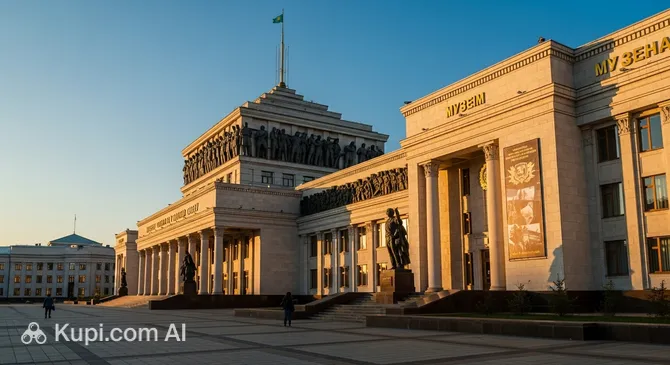
In the heart of Pavlodar lies a place that carefully preserves the memory of heroism and courage — the Museum of Military Glory. Opened in 2011 as a branch of the regional local history museum, it has become an essential cultural center dedicated to the history of the Great Patriotic War. The building is located on Academician Bekturov Street and attracts anyone interested in the historical heritage that Kazakhstan is proud of.
Museum of Military Glory. Illustration.
Source: Kupi.com AI
Traveler photos:
The museum's exhibition includes about 390 unique artifacts, including authentic weapons, combat orders, medals, and front-line letters yellowed by time. A special atmosphere is created by detailed panoramas of key battles, such as the Battle of Stalingrad, which allow you to literally touch history. Visitors can see the personal belongings of Pavlodar heroes and documents telling the difficult stories of the homeland's defenders.
The museum grounds also feature military equipment that became symbols of that era: the famous T-34 tank and artillery howitzers. One of the most touching parts of the exhibition is a reconstruction of the train car in which volunteers traveled to the front lines. This is a place where history comes alive through the personal tragedies and triumphs of ordinary people, making the museum a must-visit for all generations.
Contacts
For more information about special exhibitions or to book group tours, you can use the museum's contact details below:
A visit to the museum is an opportunity to immerse yourself in a detailed study of military history through authentic artifacts. Here, you should take a close look at the personal belongings of the legendary Manshuk Mametova, study the design of the iconic T-34 tank, and feel the harsh reality of soldiers' daily lives in the reconstructed dugouts and front-line train cars. Dioramas and panoramas of battles help visualize the scale of historical events.
For those who prefer active participation, the museum offers various educational programs and patriotic clubs, such as "Maidan Zholy." Schoolchildren and students can participate in the "School Museum and Excursion Bureau" or attend scientific conferences. Temporary thematic exhibitions, such as those dedicated to the Siege of Leningrad, and commemorative evenings featuring rare historical accounts are often held in the halls.
Don't miss the chance to see the collection of weapons and awards, as well as to learn about the work of the region's search parties. If your visit coincides with commemorative dates, you may witness solemn "Light of Memory" rallies or participate in thematic events. The museum is perfect for both a thoughtful solo visit and an educational family excursion.
Getting There
The museum is located in the central part of the city at Akademika Abikena Bekturova Street. Thanks to its convenient location, it is easily accessible from any part of the city. If you prefer to travel by taxi or your own car, use the intersection with Mira Street as a landmark — there is usually enough parking space in this area.
Public transport users should take buses or minibuses heading to the "Akademika Bekturova Street" or "Mira Street" stops. From the central bus station, the journey takes only about 10–15 minutes. If you are near the embankment or other central parks, the walk to the museum will take no more than 20–30 minutes.
For precise navigation, it is recommended to use modern map services by entering the address or coordinates: 52.3001687, 76.9482843. The museum building is easily recognizable and serves as an important landmark in this historical neighborhood.
Nearest city: Pavlodar
History & Facts
The Museum of Military Glory opened its doors in 2011, becoming a significant division of the G. N. Potanin Pavlodar Regional Museum of Local History. Its opening was an important step in preserving the memory of the Pavlodar region's contribution to history. Notably, the building was constructed on the site of an old wooden structure that was lost in a fire during the post-Soviet period.
The foundations of the collection were laid in the mid-20th century through the efforts of Dmitry Polikarpovich Bagayev, the founder of the main local history museum. Many exhibits were previously part of the general collection, but the creation of a specialized branch allowed them to be presented in a more complete and meaningful way. In 2015, the open-air exhibition was expanded with a unique object — an authentic freight car (teplushka), in which soldiers once traveled to the front.
Today, the museum's holdings include hundreds of items. Of particular value are the personal belongings of local heroes whose names are inscribed in the region's history. The museum does not just store objects; it continues the tradition of historical research, serving as a center for heritage and the continuity of generations.
Time Needed
For a standard tour of the museum's main exhibition, most visitors find 1 to 1.5 hours sufficient. This is enough time to carefully examine the personal belongings of soldiers, study battle panoramas, and look at the military equipment in the courtyard.
If you plan to visit the museum as part of an organized tour or intend to study archival documents and letters in detail, you should set aside about 2–2.5 hours. Additional time may also be needed if thematic lectures or temporary exhibitions are being held on the day of your visit.
Working Hours
The Museum of Military Glory welcomes visitors according to the following schedule: Tuesday to Sunday from 09:00 to 18:00. Please note that Monday is a day off. The institution operates without a lunch break, which is convenient for planning a visit at any time during the day.
As the opening hours may change during public holidays, it is recommended to check the official website or call ahead to ensure your trip goes as smoothly as possible.
Day
Opening hours
Monday
Закрыто
Tuesday
09:00–18:00
Wednesday
09:00–18:00
Thursday
09:00–18:00
Friday
09:00–18:00
Saturday
09:00–18:00
Sunday
09:00–18:00
Nearby
A walk around the Museum of Military Glory will allow you to delve deeper into the city's cultural code and see interesting monuments. The area is rich in quiet squares and monuments dedicated to outstanding figures of the region.
Below are sites located within walking distance or a short drive from the museum: