Support

Amboseli

About the Airport

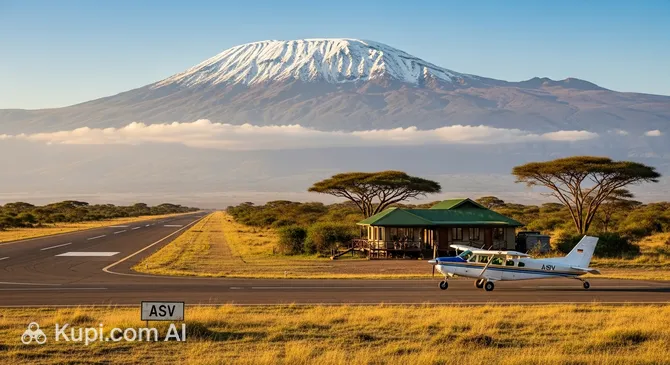
Amboseli. Illustration.
Source: Kupi.com AI

Amboseli Airport is not merely a transit point, but a true gateway to the world of wildlife, where the safari begins literally at the aircraft steps. Instead of the usual waiting halls and long corridors, you are greeted here by the majestic panorama of the African savannah, with the snow-capped peak of Mount Kilimanjaro serving as the main landmark. This small but cosy airfield allows tourists to save hours of tiring travel and instantly immerse themselves in the atmosphere of one of Kenya's most picturesque national parks.

PropertyValue
IATA CodeASV
ICAO CodeHKAM
CityAmboseli
CountryKenya
TimezoneAfrica/Nairobi
ScheduleOnline Timetable

Airport Features and Advantages

  • Scenic Approach: The flight to Amboseli is considered one of the most beautiful routes in Kenya. In clear weather, passengers are treated to a breathtaking view of Uhuru Peak — the highest point of Kilimanjaro — as well as the park's green swamps contrasting with the dry savannah.
  • Instant Immersion: The airport is located in the very heart of the reserve, close to popular lodges (such as Ol Tukai). Wild animals, including the famous Amboseli elephants, can often be seen while the aircraft is taxiing on the runway.
  • No Bureaucracy: Thanks to its compact size and specialisation in tourist flights, all arrival and departure procedures take mere minutes. There are no queues here typical of capital city hubs.
  • Convenient Logistics: The airfield serves as an excellent link for combined tours, making it easy to fly to other parks, such as Masai Mara or Tsavo, bypassing a return to Nairobi.

Contact Information

Amboseli Airport (ASV) is a small airfield primarily serving tourists arriving at the national park of the same name. It lacks many of the dedicated services found at major international airports. Most issues are resolved through the managing company — the Kenya Airports Authority (KAA) — or directly through the airline.

  • Official Website: Amboseli Airport does not have its own separate website. It is managed by the Kenya Airports Authority (KAA); current information can be found on their official portal: www.kaa.go.ke.
  • Help Desk Phone: For general enquiries, you can use the KAA head office contact numbers: +254 20 6611000 or +254 722 205061. For questions related to booking or flight schedules, you should contact your airline directly (e.g., Safarilink or Airkenya Express).
  • Airport Address: The airport is located within Amboseli National Park, Kajiado County, Kenya.
  • Email: The official Kenya Airports Authority e-mail for general enquiries is talktous@kaa.go.ke.
  • Social Media: News and updates regarding all Kenyan airports are published on the official KAA social media pages (X, Facebook). There are no separate accounts for Amboseli airfield.
  • Lost Luggage Information: For all issues related to lost or damaged luggage, you must immediately contact your airline representative. Airport staff do not handle such requests directly.
  • Passenger Support Contacts: Support regarding flights (date changes, flight cancellations, special services) is provided by the airline operating the flight.

How to Get to the Airport

The Amboseli Airport (ASV) is essentially an airstrip primarily serving tourists arriving for safaris in the Kenyan national park of the same name. Unlike city airports, the transport infrastructure here is specific, and getting to the airstrip or from it to your lodge requires prior planning.

Transfer from Lodge or Tour Operator

This is the most common and convenient method of transport. The vast majority of hotels, camps, and lodges located within or near the park organise pick-up and drop-off for their guests at the airport. Typically, this is a journey in a 4x4 safari jeep.

  • Travel Time: Depends on the location of your lodge and can range from 15 minutes to an hour or more.
  • Cost: Often the transfer cost is already included in the accommodation package or safari tour. If the service is paid for separately, the price can be quite high due to the remote location.
  • Features: The drive from the airstrip to the lodge is already the start of your adventure. You are very likely to see wild animals along the way, so keep your camera ready!

Car Rental

If you prefer to travel independently, you can rent a car. However, there are several important points to consider.

  • Vehicle Type: To move around Amboseli National Park, a 4x4 off-road vehicle is strictly necessary. The roads here are predominantly dirt tracks.
  • Rental Location: It is best to rent a car in major cities, for example, upon arrival in Nairobi. There are no rental offices in Amboseli itself.
  • Cost: Renting a 4x4 is not a cheap pleasure, to which fuel costs and park fees are added.

Taxis and Public Transport

Standard city taxis that can be called by phone or hailed on the street are absent in the national park area. The same applies to public transport — scheduled buses or trains do not run here. Any ground transport must be booked in advance through a tour operator or your lodge.

Airport Parking

There is no formal guarded parking at Amboseli Airport. There is an open area where safari jeeps wait for arriving tourists. Leaving a rental car here for a long period is not customary and is not recommended.

Key Recommendations

The best advice for a traveller heading to Amboseli is to arrange a transfer in advance with the hosting party (lodge or safari company). This will save you from unnecessary hassle, ensure safety, and allow you to enjoy the stunning views of Kenya from the very first minutes of your arrival.

Terminals and Map

The Amboseli Airport (ASV) is, in essence, a small regional airfield (or airstrip) mainly serving tourists arriving for safaris in the national park of the same name. Its structure differs radically from large international airports.

At Amboseli Airport, there is one small terminal in operation. It is a compact building designed to service passengers on domestic flights arriving from Nairobi and other parts of Kenya. There is no division into multiple terminals, so navigation is extremely simple and intuitive — it is practically impossible to get lost. All zones — check-in, waiting, and arrival pick-up — are located in one place or within walking distance of each other.

Procedures at the airport are very fast. Since flights are operated by small aircraft (such as Cessnas or similar), passenger traffic is low. Flight check-in and security screening usually take no more than 15-20 minutes. Nevertheless, it is recommended to arrive approximately 45-60 minutes before departure to complete all formalities without rushing.

The departure and arrival zones are effectively combined. After landing, passengers walk to the terminal building where representatives from lodges and safari operators are already waiting for them. The departure zone consists of a small waiting hall with basic amenities. The main feature of this airfield is its functionality: it is designed to transport you as quickly and comfortably as possible from the plane to the savannah, to the start of your African adventure.

Airport History

The history of Amboseli Airport (ASV) is inextricably linked with the development of tourism in Kenya and the establishment of the national park of the same name — one of the most famous in Africa. Unlike major international hubs, its history is not a tale of giant terminals, but a story of how a small airfield opened up an amazing corner of the wild to the world.

The first airstrips in Kenyan parks began to appear in the mid-20th century, and Amboseli was no exception. Initially, it was a simple dirt strip created in the 1960s for the needs of park rangers and early safari enthusiasts. Before its appearance, the journey from the capital, Nairobi, took many hours on difficult roads. The creation of the airfield radically changed the situation, making the famous elephant herds against the backdrop of Mount Kilimanjaro much more accessible to tourists from all over the world.

A key stage in the airport's history was the large-scale modernisation carried out by the Kenya Airports Authority (KAA) in the late 2000s. As part of the project, which began in 2008, the old gravel strip was replaced with a modern asphalt surface. At the same time, a new, albeit compact, terminal building was constructed, ensuring passenger comfort and safety. This reconstruction allowed flights to be received in any weather and raised service standards for small aircraft, such as the Cessna Caravan, which are the primary transport for safari flights.

The most interesting fact in the history of Amboseli Airport is its unique purpose. It cannot boast passenger traffic records, but it perhaps leads in the number of happy travellers seeing the African savannah from a bird's eye view for the first time. Its main "historical events" are not visits by officials, but the daily arrivals of flights with tourists whose dreams of meeting wildlife are about to become reality. In essence, the entire history of this place is a history of thousands of unforgettable adventures beginning immediately after landing.

Services and Amenities

Amboseli Airport (ASV) is essentially an airstrip serving the national park of the same name. Its primary task is to ensure the fast and convenient delivery of travellers to the starting point of their safari. Therefore, the infrastructure here is minimal and focused on functionality rather than long passenger stays.

At the airport, you will find a very simple waiting area, often consisting of a sheltered space with seats. A small kiosk may operate here, selling water, soft drinks, and light snacks. You should not expect full-service restaurants, cafés, or Duty Free shops. It is recommended to have a supply of water and snacks with you. There are no VIP lounges at the airport.

Technological amenities are also limited. There is no continuous Wi-Fi access, and the number of power outlets for charging electronic devices is extremely low or non-existent. Travellers are strongly advised to arrive at the airport with fully charged gadgets and to carry a portable power bank.

There are no banks, ATMs, or currency exchange points within the Amboseli Airport terminal. All financial matters, including exchanging money for local currency, should be resolved in advance in major cities such as Nairobi. Medical services are limited to a first aid kit. In the event of a serious situation, assistance will be coordinated through lodge staff or park services.

Specialised services for passengers with children (e.g., mother and child rooms) or for people with disabilities are absent. Assistance with boarding and disembarking is provided by staff where possible, but special needs should be communicated in advance to your airline or tour operator. There are no hotels directly on the airport grounds, as travellers usually depart immediately for their safari lodges or campsites located within the park. Business centres and conference rooms are also not provided.

Where to Eat

When planning a snack at Amboseli Airport (ASV), it is important to remember that this is a small regional airfield, the main task of which is serving tourists arriving at the national park. Consequently, the infrastructure here is quite modest and does not offer the wide variety of restaurants found in major international hubs.

Usually, a small café or kiosk operates on the airport grounds, where travellers can purchase basic drinks and snacks. The assortment typically includes bottled water, carbonated drinks, carton juices, as well as hot tea and coffee. For food, you can find packaged snacks such as crisps, biscuits, chocolate bars, and sometimes simple sandwiches. This is an excellent option for a quick snack while waiting for a flight.

Specialised dining options, such as vegetarian, vegan, gluten-free, or specific Halal meals, are practically impossible to find here. Passengers with strict dietary requirements are strongly advised to arrange food in advance and bring it with them. Prices in the local café are tourist-oriented, and its opening hours are directly tied to the flight arrival and departure schedule. Since the airport is very compact, all services are located in one small building in the common area.

Thus, Amboseli Airport is suitable for having a cup of Kenyan coffee and fortifying yourself with a sandwich. However, for a full lunch or dinner, you should rely on the restaurants at your lodge or hotel, where the choice of dishes, including traditional cuisine, will be incomparably wider.

Traveller Tips

Travelling through a small regional airport like Amboseli Airport has its own specificities. To ensure your trip goes smoothly, use our tips to help prepare for your flight and avoid unpleasant surprises.

Arrival Time at the Airport. Despite being a small airport, it is recommended to arrive at least 1.5-2 hours before the departure of a domestic flight. This will give you enough time to go through check-in and security screening without rushing, especially during peak season.

Check-in and Security. Procedures at small airports in Kenya usually proceed faster than at major international hubs. However, always keep your passport, tickets, and other necessary documents ready. Luggage is often weighed manually here, so be prepared for strict weight control.

Seat Selection on the Plane. Flights to national parks are often operated by small aircraft. If possible, choose a window seat. You may be treated to stunning views of the savannah or even Mount Kilimanjaro during take-off or landing.

Hand Luggage. Pay special attention to weight and size restrictions for hand luggage and checked baggage. On safari flights, these are very strict, and often only soft bags are permitted. Standard security rules also apply: liquids over 100 ml, sharp objects, and flammable items are prohibited.

Connecting Passengers. If you have a connecting flight, especially at Nairobi International Airport, allow sufficient time between flights (at least 3-4 hours). Check with the airline if you will need to collect and re-check your luggage.

Customs Control. If you are arriving on an international flight (via a hub), you will have to undergo customs inspection. Prepare your passport and visa (if required) in advance, and be ready to declare any valuables or large sums of cash being imported.

Saving Time and Money. To save money, book tickets in advance, especially during the high tourist season. The most important tip is to strictly observe baggage allowances, as excess weight fees on small flights can be very high. Bring a small water bottle (empty, to fill after security) and snacks, as the selection at the airport may be limited.

In Case of Flight Delay. Delays, especially due to weather conditions, do happen. Firstly, contact your airline representative for information. In a small airport, opportunities for long waits are limited, so having a charged power bank, a book, or downloaded films will be very useful. Travel insurance covering flight delays is also advisable.

Reached the end of the page?

That means the route is fully explored