Source: Kupi.com AI
| Characteristic | Value |
|---|---|
| IATA code | VNO |
| ICAO code | EYVI |
| City | Vilnius |
| Country | Lithuania |
| Time zone | Europe/Vilnius |
| Popular airlines | Air Baltic, LOT Polish Airlines, American Airlines, Lufthansa, Finnair |
| Schedule | Online timetable |
| Characteristic | Value |
|---|---|
| IATA code | VNO |
| ICAO code | EYVI |
| City | Vilnius |
| Country | Lithuania |
| Time zone | Europe/Vilnius |
| Popular airlines | Air Baltic, LOT Polish Airlines, American Airlines, Lufthansa, Finnair |
| Schedule | Online timetable |
To ensure your journey runs smoothly, it is always useful to have the airport contacts at hand. Below you will find the essential contact information for Vilnius International Airport.
Getting to Vilnius International Airport from the city centre is a simple and quick task. The airport is located just 7 kilometres from the heart of the Lithuanian capital, Vilnius, and offers travellers several convenient transport options suitable for any budget and comfort preference.
The most budget-friendly and popular method is public transport. Several bus routes stop directly at the passenger terminal. The express bus `3G` connects the airport with the centre and the northern part of the city, while routes `№ 1` and `№ 2` go to the railway station. There is also a night bus `№ 88N`. The bus journey takes on average 15–20 minutes. Additionally, a special train runs from the main Vilnius Railway Station to the airport. This is arguably the fastest option: the journey takes only about 7 minutes, and the train station is just a few steps from the Arrivals hall.
If you value comfort and are travelling with luggage, a taxi or ride-sharing service (such as Bolt or Uber) is an excellent solution. A trip from the city centre will take 10–15 minutes depending on traffic and will cost on average 10-15 Euros. For maximum convenience, especially if you are travelling with family or a large group, you can book a private transfer in advance. The driver will meet you at the designated location and assist with your luggage.
For travellers with their own or rented cars, the airport has a well-developed parking system. Drivers have access to several zones: from short-term parking (P2), ideal for quick drop-offs or pick-ups, to long-term parking (P3, P4), where you can leave your car for the duration of your holiday. Often, booking a parking space online on the official airport website can secure a substantial discount.
Thus, the choice of transport depends on your priorities. The train offers speed, the bus offers economy, the taxi offers comfort, and a personal car offers independence. In any case, the journey to Vilnius Airport will not be a tiring start to your travels.
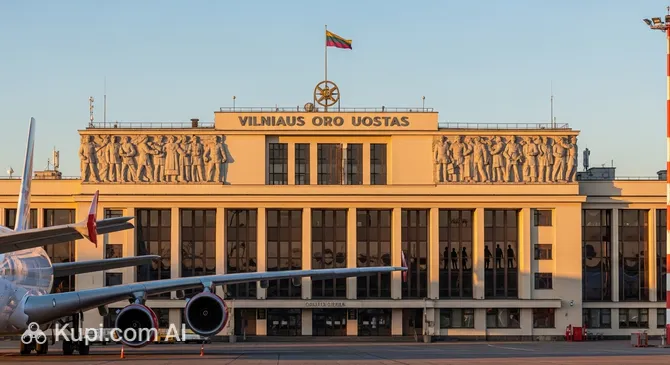
Vilnius International Airport (VNO) is a single passenger terminal complex consisting of several interconnected buildings from different eras. Although historically one can distinguish between the old terminal and new extensions, for passengers, it functions as one terminal. This structure makes the airport compact and easy to navigate.
The airport layout is logical and intuitive. The historic building, constructed in the 1950s, today serves primarily as the Arrivals zone. This is where you enter after passing passport control and collecting luggage. It is easily recognisable by its distinctive architecture. The Departures zones are located in more modern extensions adjoining the old building. All parts of the complex are connected by internal walkways, so there is no need to go outside or use transport to move between them.
The Departure zone is divided into two main parts: for flights to Schengen zone countries and for flights to other states (non-Schengen). After checking in on the ground floor, passengers proceed to the first floor for aviation security screening. After screening, you enter the general "airside" area with Duty Free shops, cafes, and boarding gates. Signs clearly direct passengers to the correct gates, separating Schengen and non-Schengen flows.
Procedures at Vilnius airport usually proceed quite quickly due to its small size. On average, you should allow about 30-45 minutes for check-in and screening during normal times. However, during peak hours or the tourist season, waiting times may increase. It is recommended to arrive at the airport 2 hours before a Schengen flight and 2.5-3 hours before an international flight outside the Schengen zone. This time will be sufficient to complete all formalities without rushing, enjoy a coffee, and reach your boarding gate.
The history of Vilnius International Airport (VNO) begins in 1932, when it opened as an airfield named Porubanek. Initially, it served domestic flights, connecting Vilnius with other cities such as Warsaw and Lviv. After World War II, the airport was rebuilt and, from 1944, became the city's main civil airport.
A significant milestone in its development was the construction of the new terminal building, completed in 1954. This building, designed in the Stalinist Empire style with high ceilings, columns, and stucco mouldings, is today an architectural heritage monument and is used as the Arrivals terminal. It still impresses travellers with its monumentality, creating a contrast with the modern structures.
After the restoration of Lithuania's independence in the early 1990s, the airport received international status and became a key transport hub for the country. Growing passenger traffic required further expansion, and in 2007, a new, modern passenger terminal was opened, fully complying with Schengen Agreement requirements. This significantly increased capacity and improved the level of comfort for passengers.
One of the most important events in the airport's recent history was the large-scale reconstruction of the runway in the summer of 2017. For 35 days, the airport was completely closed, and all flights were temporarily transferred to Kaunas. This complex project allowed for the modernisation of infrastructure and ensured flight safety for decades to come. Today, Vilnius Airport continues to develop, serving millions of passengers annually and confirming its status as the country's main aviation hub.
Vilnius International Airport (VNO) offers passengers all the necessary infrastructure for a comfortable journey. Here you will find numerous cafes and restaurants where you can have a quick snack or a full meal, enjoying dishes of local and international cuisine. The Departure zone features Duty Free shops offering a wide range of perfumes, cosmetics, beverages, and confectionery, as well as souvenir stalls with Lithuanian products.
For those who value enhanced comfort, the airport operates a business lounge where you can relax in a quiet atmosphere and enjoy snacks and drinks. Free Wi-Fi is available throughout the terminal, and numerous power outlets and charging stations allow you to stay connected. Financial services are represented by bank branches and currency exchange points, which is convenient for arriving tourists.
The airport is well-equipped for passengers with children: there are special mother and child rooms with changing tables and everything necessary for baby care. For travellers with reduced mobility, comprehensive support is provided, including escort through the terminal and assistance with boarding and disembarking — it is necessary to notify the airline in advance for this.
If you need to hold a business meeting, the airport offers conference hall rental services. In case of a long layover or an early flight, you can stay at one of the hotels located in the immediate vicinity of the terminal. There is also a medical point on the airport territory, ready to provide first aid if necessary.
At Vilnius International Airport (VNO), travellers will find various options for a snack or a full meal, catering to different tastes and budgets. Dining establishments are located both in the public area and in the Departure zone after security control, offering comfortable conditions for waiting for your flight.
In the general zone, accessible to all visitors before passing control, you will find several cosy cafes. This is an ideal place to have coffee with those seeing you off or to grab a quick bite upon arrival. Popular coffee shops are usually found here, offering a wide selection of beverages, fresh pastries, sandwiches, and desserts. Prices here are typically slightly lower than in the secure zone.
The majority of restaurants and lounges are located in the Departure zone (airside), after passport and aviation security control. Here the choice is significantly wider: from fast food outlets and pizzerias to à la carte restaurants and stylish lounges. You can enjoy a refreshing drink, try local specialities, or order a hot dish, such as pasta or a burger. For those in a hurry, takeaway sandwiches, salads, and yoghurts are always available.
Although it is difficult to find authentic Lithuanian restaurants in the airport, you can discover local gastronomic notes in some cafes. Look out for offers of local beverages or desserts made with local berries. For travellers with specific dietary needs, most establishments offer vegetarian options, such as salads and vegetable sandwiches. Coffee with plant-based milk is also common. Please note that the selection of gluten-free or Halal dishes may be limited, so it is advisable to check availability directly with the restaurant.
The opening hours of most establishments are adapted to the flight schedule, and many open early in the morning and close after the departure of the last aircraft. However, it is worth noting that only a few spots may be open at night. The price range at Vilnius Airport corresponds to the average European level for airports — be prepared for prices to be somewhat higher than in the city.
Vilnius International Airport is the main aviation hub of Lithuania. It is quite compact and modern, making it convenient for passengers. However, to ensure your journey begins and proceeds smoothly, it is worth considering a few useful tips.
Arrival Time at the Airport. For international flights outside the Schengen zone, it is recommended to arrive at the airport 2.5–3 hours before departure. If you are flying within the Schengen zone, 1.5–2 hours is usually sufficient. Completing online check-in in advance can save you time, but avoid arriving at the last minute, especially during peak seasons (summer, winter holidays) when queues can be longer.
Check-in and Security. Most airlines offer online check-in, allowing you to avoid queues at the counters. If you are travelling only with hand luggage, you can proceed directly to the security checkpoint. Security control at Vilnius Airport typically moves quickly. Prepare liquids in advance (containers up to 100 ml, packed in a transparent bag) and electronic devices to speed up the process.
Seat Selection. If the airline allows you to select a seat during check-in, consider your preferences. Window seats (A, F) are suitable for those who enjoy the views, especially during take-off and landing. Aisle seats (C, D) are convenient if you plan to get up during the flight. Emergency exit row seats offer more legroom but often come at an additional cost and with certain restrictions.
Hand Luggage. Standard EU rules apply here. It is prohibited to carry sharp objects, weapons, or flammable substances in hand luggage. All liquids must be in containers of no more than 100 ml and packed in a single transparent bag with a volume of up to 1 litre. Laptops, power banks (in hand luggage, not checked baggage), cameras, and personal items within your airline's allowance are permitted.
Transit Passengers. Vilnius Airport is not a major transit hub, so navigation here is simple. Follow the signs for "Connecting flights" / "Transfer". If your transfer takes place within the Schengen zone, you will likely not need to pass passport control again. If you are arriving from a non-Schengen country and flying onwards to the Schengen zone, be prepared for border control.
Customs Control. When entering Lithuania from non-EU countries, customs rules apply. If you have no goods to declare, use the "Green Channel". If you are carrying goods exceeding established limits (alcohol, tobacco, expensive items), you must pass through the "Red Channel". For flights within the EU, there is generally no customs control.
Saving Time and Money.
Flight Delays. In the event of a flight delay, contact your airline representative. Under EU rules, for lengthy delays, passengers are entitled to refreshments, meals, and in some cases, hotel accommodation. The airport has free Wi-Fi, power outlets for charging devices, and several cafes where you can wait for your flight in comfort. Having travel insurance can also help compensate for unforeseen expenses.
Have you reached the end of the page?
So the route has been studied inside and out