Support

Biratnagar Airport

About the Airport

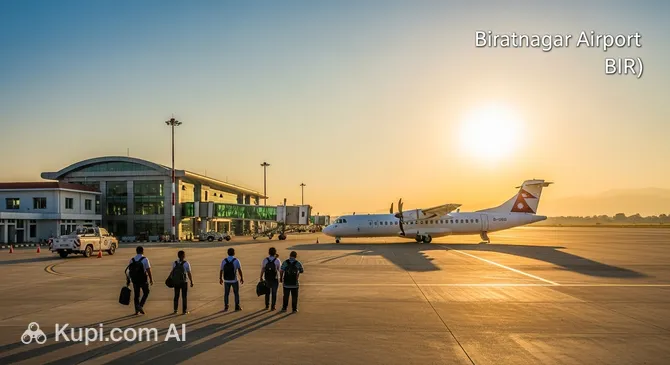
Biratnagar Airport. Source: Kupi.com Binoculars

Biratnagar Airport is not merely a transport hub, but the key aerial gateway to Eastern Nepal, opening the path to the tea plantations of Ilam and high-altitude adventures. Located in the vibrant industrial heart of the country, it serves as a bridge between the capital and the endless plains of the Terai. The airport is renowned for its activity and strategic importance, providing travellers with quick access to both business centres and the unique nature reserves of the region.

IATA Code BIR
ICAO Code VNVT
City Biratnagar
Distance to Centre 3-5 km
Status Domestic
Passengers per Year Over 400,000
Schedule Daily flights

Airport Features and Advantages:

Biratnagar Airport stands out among many other regional air harbours in Nepal due to its high level of technical equipment. It is one of the few airports in the country equipped to handle night flights, giving travellers greater flexibility when planning their itinerary. Additionally, it houses its own fuel depot, allowing it to service a large number of transit aircraft without delays.

Thanks to its location, the airport serves as a convenient hub for those planning mountain flights towards the Kanchenjunga and Makalu massifs. Its proximity to the Indian border (Jogbani point) makes it an important spot for cross-border travellers wishing to enter India or return to Nepal.

Contact Information

To obtain the most up-to-date information regarding the operations of Biratnagar Airport (BIR), it is recommended to use official communication channels. Below are the primary contact details.

  • Official Website: biratnagarairport.gov.np
  • Inquiry Service Phone: +977-21-415132
  • Address: Biratnagar Airport, Biratnagar City, Nepal
  • Email: biratnagar_cao@caanepal.gov.np
  • Social Media: The airport does not have active official pages on popular social networks. The most reliable information can be found on the official website.
  • Lost Luggage Information: For issues related to lost or damaged luggage, you should primarily contact the representative office of the airline you flew with directly.
  • Passenger Support Contacts: For general information and support, you may use the airport's main telephone number or email address.

How to Get to the Airport

Getting to Biratnagar Airport (BIR) from the centre of Biratnagar is quite simple, as the air harbour is located just a few kilometres from key city districts. Depending on your budget, time, and amount of luggage, you can choose from several options. On average, the trip from the centre takes about 15-25 minutes.

Taxis and Auto-rickshaws are the most popular and convenient way to reach the airport. You can easily find a taxi on the city streets or ask to book one at your hotel reception. It is strongly recommended to agree on the fare in advance, as not all vehicles are equipped with meters. A more budget-friendly alternative is a ride in an auto-rickshaw (often called "tempos" in Nepal), which also allows you to experience the local atmosphere. For maximum comfort, you can book a private transfer in advance.

Public Transport in the city is represented by local buses. This is the most economical way to travel, but it may not be the best choice for tourists with bulky luggage. Buses are often crowded, and their routes do not always pass in the immediate vicinity of the terminal entrance, which may require an additional short walk. This option is suitable for experienced travellers with light luggage.

For those travelling by personal transport, Biratnagar Airport has a car park. This is an open parking area located next to the terminal building, where you can leave your vehicle for both short and long periods. Parking rates are quite affordable. Regarding car rental, the practice of renting a car with a driver is more common in Nepal than self-driving, which serves as a convenient and safe option for moving around the region.

Terminals and Map

Biratnagar Airport (BIR) is a compact and functional aviation hub serving domestic flights across Nepal. Its structure is extremely simple, making navigation intuitive even for first-time visitors. The airport consists of one main terminal, where all passenger services are concentrated.

The airport layout is very straightforward: it is a single-story building where the arrival and departure zones are in close proximity to each other. Since there is only one terminal, you do not have to worry about transferring between them. Immediately upon entering the building, you will see the check-in counters of several local airlines. After completing check-in and dropping off luggage, passengers proceed to a single security screening point, followed by a general waiting hall (departure zone).

The departure zone is a small hall with seating where passengers await boarding announcements for their flight. The arrival zone is even simpler: after disembarking from the aircraft, passengers walk to the terminal and enter the baggage claim hall. All processes happen quickly and without the unnecessary bustle characteristic of large international airports.

Completing all formalities typically does not take much time. Flight check-in and security screening usually take from 15 to 30 minutes. Nevertheless, it is recommended to arrive at the airport approximately 1–1.5 hours before departure. This time will be sufficient to go through all procedures without rushing, especially considering that flight schedules in Biratnagar may change depending on weather conditions.

The main advice for navigation is simply to follow the signs, of which there are few due to the compactness of the building. All key points — from the entrance to the boarding gate — are within a few dozen metres of each other. It is practically impossible to get lost here, making travel through this airport maximally comfortable and fast.

Airport History

The history of Biratnagar Airport (BIR), one of the most vital aviation hubs of eastern Nepal, began in 1951. Initially, it was built with a grass runway and served as the main access point to this remote region, significantly reducing travel time compared to overland routes. Since its inception, the airport has played a key role in the economic and social development of the eastern part of the country.

One of the most dramatic and significant moments in the airport's history occurred on 10 June 1973. On this day, a Royal Nepal Airlines aircraft flying from Biratnagar to Kathmandu was hijacked by activists of the Nepali Congress party. The aim of the hijacking was to obtain funds to finance the democratic movement against the regime of that time. This incident, known as the first and only aircraft hijacking in the history of Nepal, forever inscribed Biratnagar Airport into the country's political history.

Over the years, the airport has undergone numerous improvements. An important milestone was the paving of the runway, which allowed it to accommodate larger and more modern aircraft. Infrastructure also gradually developed: a new terminal was built, and navigation systems were improved. Today, Biratnagar Airport is the busiest domestic airport in Nepal outside the Kathmandu Valley, serving dozens of flights daily.

In recent years, plans for large-scale modernization of the airport have been actively discussed and implemented with the aim of granting it regional international status. The project includes lengthening the runway, building a new modern international terminal, and installing the latest equipment. These ambitious changes are aimed at enabling the airport to receive direct flights from neighbouring countries, contributing to the further development of tourism and trade in the region.

Services and Amenities

Biratnagar Airport (BIR), being an important transport hub of eastern Nepal, offers passengers a basic set of services for a comfortable wait for their flight. Although the airport infrastructure is quite compact, everything necessary for a short stay is available here. In the terminal, you will find several small cafes and snack bars where you can order local dishes, tea, coffee, and soft drinks. Kiosks selling essential goods and souvenirs are also in operation.

A general hall is provided for waiting for boarding. Additionally, a VIP lounge with more comfortable conditions may be available; information on access is best clarified with representatives of your airline. Passengers can use free Wi-Fi, although its speed and stability may vary. There are power outlets in the terminal for charging electronic devices, but their number is limited, so it is useful to have a portable power bank with you just in case.

Banking services, such as currency exchange points, may be limited or unavailable at the airport. It is recommended to exchange money in advance in the city of Biratnagar. However, an ATM for cash withdrawals can usually be found in the terminal. In case of need, a medical unit is operating at the airport, ready to provide first aid.

For passengers with special needs, escort services and wheelchairs are provided upon prior request through the airline. Mother and child rooms may also be available for travellers with small children. There are no hotels within the terminal building itself, however, there are many hotels of various levels in the immediate vicinity and in the city of Biratnagar itself. Specialized business centres and conference halls are absent at the airport.

Where to Eat

Dining options at Biratnagar Airport (BIR) are quite modest, which corresponds to its status as a regional domestic airport. Nevertheless, passengers can find a few options to have a snack before departure.

In the main terminal, both in the public zone (landside) and after passing security control (airside), there are several small cafes and kiosks. Do not expect full-service restaurants or fast-food chains here. The assortment mainly consists of local snacks and simple dishes that are ideal for a quick bite.

Among the offers, you will likely find snacks popular in Nepal, such as samosas (fried pastries with vegetable filling), momo (steamed dumplings), and chow mein (fried noodles). This is a great opportunity to taste authentic flavours before departure. Packaged snacks, crisps, biscuits, and soft drinks, as well as hot tea and coffee, are also always available.

For a quick snack, a cup of aromatic Nepali tea with milk and spices (chiya) and a couple of samosas is perfect. If you are looking for something more substantial, a portion of fried noodles or rice would be a good choice. For a full lunch or dinner with a wider selection of dishes, it is recommended to eat at one of the restaurants in Biratnagar city before arriving at the airport.

It is important to note that options for passengers with strict dietary restrictions (vegan, gluten-free, Halal) are extremely limited or unavailable here. If you have specific dietary needs, it is safer to bring food with you. Prices in the airport cafes are moderate, and their operating hours are usually tied to the flight schedule — they open before the first departures and close after the departure of the last aircraft.

Traveller Tips

To ensure your journey through Biratnagar Airport goes smoothly, make use of these tips. This is a key transport hub for the eastern region of Nepal, and a little preparation will help avoid unnecessary hassle.

Arrival Time and Check-in: For domestic flights, it is recommended to arrive at the airport 1.5-2 hours before departure. Although the airport is not very large, queues for check-in and security can form during peak hours and the tourist season. Keep your ticket and identification (passport for foreign citizens) ready.

Seat Selection on the Plane: If you are flying to Kathmandu, try to get a window seat on the left side of the aircraft. When flying from Kathmandu to Biratnagar, conversely, choose the right side. In clear weather, breathtaking views of the snow-capped Himalayan peaks will open up to you — a spectacle not to be missed!

Hand Luggage: Standard security rules apply here as well: liquids in containers up to 100 ml packed in a transparent bag, no sharp objects or flammable substances. Please note that local airlines may have stricter restrictions on the weight and size of hand luggage than international carriers. Be sure to clarify these details on your airline's website.

Transfers and Customs: Biratnagar Airport mainly serves domestic flights, so it is not a major transit hub. If you have a self-transfer, allow sufficient time for baggage claim and re-check-in. Since these are domestic flights, customs control is not required.

Saving Time and Money: Book tickets in advance, especially during the high season. Carefully study baggage allowances to avoid extra charges for excess weight. There may be a limited selection of food and drinks at the airport, so you can bring a small snack and an empty water bottle, which can be filled after security screening.

Flight Delays: Flight delays and cancellations in Nepal are not uncommon, often due to changeable weather conditions (fog in winter, monsoon rains in summer). Be prepared for this: carry a portable charger, download movies or books to your phone, and maintain a positive attitude. Stay in touch with the airline representative for the most current information about your departure.

Reached the end of the page?

That means the route is fully explored