Support

Lukla

About the Airport

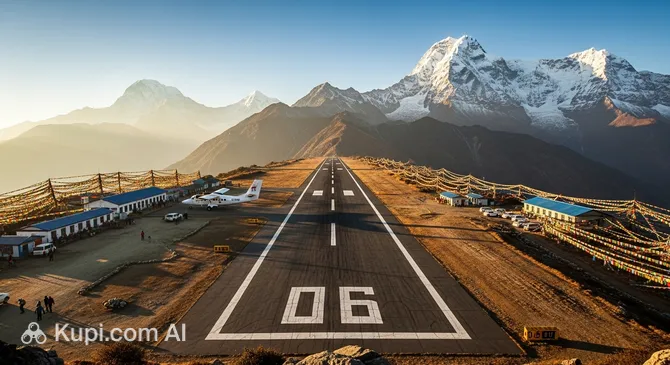
Lukla. Illustration.
Source: Kupi.com AI

Tenzing-Hillary Airport is not just a transport hub, but the legendary gateway to the foot of Everest, where every landing resembles a scene from an adventure movie. The runway here has a unique slope and is literally carved into the mountainside, turning a routine flight into a thrilling experience above the clouds. For tens of thousands of mountaineers and trekkers, this high-altitude airfield becomes the first, most exciting step towards their dream of the Himalayas.

PropertyValue
IATA CodeLUA
ICAO CodeVNLK
CityLukla
CountryNepal
TimezoneAsia/Kathmandu
ScheduleOnline Timetable

Airport Features and Highlights

Lukla Airport possesses a number of unique characteristics that make it one of the most recognizable and impressive pieces of aviation infrastructure in the world:

  • Unique Runway Geometry: The runway is only 527 metres long with a significant gradient of about 12%. This engineering solution is critical: aircraft land "uphill," which helps them brake faster, and take off "downhill," providing the necessary acceleration before the drop-off.
  • Strategic Importance: This is the fastest way to reach the Khumbu region and Sagarmatha National Park. A 30-minute flight from Kathmandu saves travellers about a week of walking that would be required if starting from Jiri or Salleri.
  • Visual Navigation: Due to the complex terrain and lack of space for installing radio beacons, landing and take-off are conducted exclusively under Visual Flight Rules (VFR). This requires the highest level of skill from pilots and makes the airport's operation completely dependent on visibility and wind.
  • Walking Distance: Unlike most airports in the world, there is no need to order a taxi after arrival. Stepping out of the terminal, you immediately find yourself on the streets of the village, surrounded by lodges, shops, and the start of trekking trails.

Contact Information

Tenzing-Hillary Airport in Lukla is a small aerial gateway to the Everest region, and its contact information differs from major international hubs. Most issues are resolved through the airlines operating the flights.

  • Official Website: The airport does not have its own separate website. General information is under the jurisdiction of the Civil Aviation Authority of Nepal (CAAN).
  • Information Desk Phone: There is no direct public phone number for the airport. For information on flights, bookings, or changes, it is recommended to contact your airline directly (e.g., Tara Air, Sita Air, Summit Air).
  • Address: Tenzing-Hillary Airport (LUA), Lukla, Solukhumbu District, Nepal.
  • Email: There is no specialized email address for general inquiries. For all questions, please contact the carrier's customer service.
  • Social Media: There are no official social media pages for the airport in Lukla.
  • Lost Luggage Information: In case of loss or damage to luggage, you must immediately contact your airline representative at the arrival airport. The airport does not have a centralized lost and found service.
  • Passenger Support Contacts: All passenger support, including assistance for people with disabilities and other special requests, is provided by the airlines operating the flight.

How to Get to the Airport

Planning a trip to Tenzing-Hillary Airport in the town of Lukla is a unique experience that differs greatly from travelling to any other airport in the world. It is important to understand that Lukla is a small village in the mountains of Nepal, to which no roads for cars lead. Therefore, the usual ways of getting to the airport are not applicable here.

Transport Features in Lukla:

There is no public transport in Lukla, such as buses, trains, or metro. You will also not find taxis, car rental services, or parking here. The entire village, including the airport, is a pedestrian zone. Movement is exclusively on foot along narrow streets. The distance from any hotel or guest house (lodge) to the airport terminal entrance can be covered in 5-15 minutes. It is a pleasant and easy walk that requires no cost.

How do people actually get to Lukla Airport?

The key point is that one does not "get to the airport from the city," but rather, as a rule, flies into it from other parts of Nepal. It is the main gateway for everyone heading to Everest Base Camp.

  • By Air: The vast majority of travellers arrive in Lukla on small aircraft from Tribhuvan International Airport in Kathmandu. The flight lasts about 30-40 minutes and is an exciting adventure in itself with incredible views of the Himalayas. It is worth noting that flights are highly dependent on weather conditions and are often delayed or cancelled. It is recommended to book tickets in advance and factor extra days into your itinerary in case of bad weather.
  • Trekking (Hiking): An alternative, more difficult and longer way is to take a bus or jeep from Kathmandu to one of the villages where trekking routes begin (for example, Jiri or Salleri), and walk from there to Lukla for several days. This option is chosen by those who want to follow the classic route of the first Everest expeditions and acclimatize better.

Thus, the question of "how to get to Lukla Airport" comes down to planning your arrival in the village itself. Once there, you will find that everything you need, including the airport entrance for departure, is within walking distance.

Terminals and Map

Tenzing-Hillary Airport in Lukla is radically different from the aviation hubs you may be used to. Forget about multi-level complexes and long corridors — here you will be met by one small terminal, which is a modest single-story stone building. This single terminal serves both departing and arriving passengers, performing all necessary functions in a very compact space.

The airport layout is extremely simple. Inside the terminal, there are several check-in counters, an area for basic security screening, and a small waiting room for departing passengers. There is no arrival hall as such: arriving passengers exit the aircraft and almost immediately find themselves on the main street of the village. There are no transfers between terminals because there is only one, and it is physically impossible to get lost here.

Check-in and screening procedures usually take minimal time, as the planes are small and there are few passengers. However, the key factor influencing time spent at the airport is unpredictable weather conditions. Flights in this region of Nepal are often delayed for several hours, and sometimes for several days. Travellers are strongly advised to be prepared for long waits and to factor extra days into their plans.

The main recommendation for navigation is to stay near the waiting hall and listen carefully to announcements from airline representatives, which are often made simply by voice. The entire airport is essentially the beginning or end of the village's main street, so all necessary infrastructure (lodges, cafes) is within walking distance. Your main task is not to miss your flight when a "weather window" for departure appears.

Airport History

Tenzing-Hillary Airport in the town of Lukla, known by the code LUA, is not just a runway, but a true legend and the main gateway for everyone dreaming of seeing Everest. Its history is inextricably linked with the name of Sir Edmund Hillary — one of the first conquerors of the world's highest peak. It was he who initiated the construction of the airport to facilitate the delivery of materials for his humanitarian projects in the Khumbu region and to support developing mountaineering in Nepal.

Construction began in 1964 and was carried out under incredibly difficult conditions. Initially, Sir Hillary wanted to purchase flatter farmland, but after being refused, he bought a plot on the mountain slope for 2,650 dollars. With the help of local Sherpas, he organized the work. An interesting fact: the original runway was not paved but compacted by foot, performing traditional dances to flatten the soil.

A key stage in the airport's history was the modernization in 2001, when the short runway was finally paved with asphalt. This significantly increased flight safety and allowed aircraft to be accepted even in less than ideal weather conditions. Another landmark event occurred in 2008: as a sign of respect to the pioneers, the airport was officially renamed Tenzing-Hillary Airport, immortalizing the names of Edmund Hillary and Sherpa Tenzing Norgay.

Lukla Airport is famous for its unique characteristics, which make it one of the most extreme in the world. It is located at an altitude of 2,845 metres, and the length of its runway is only about 527 metres. The strip has a noticeable gradient of 12%, which helps aircraft slow down faster upon landing (which is done uphill) and gain speed during take-off (which is directed towards the cliff). Due to the surrounding mountains, pilots have no opportunity to go around for a second attempt, turning every landing into a demonstration of supreme skill.

Despite its modest size, the airport in Lukla is one of the busiest in Nepal for domestic transport, especially during peak tourist seasons. It remains not only a vital transport hub but also a symbol of human courage and engineering thought, making the world's greatest peaks a little more accessible to adventurers from all over the planet.

Services and Facilities

Tenzing-Hillary Airport in Lukla (LUA) is a unique airfield serving as the starting point for expeditions to Everest. Its infrastructure is simple and functional, created to meet the basic needs of travellers rather than for long, comfortable waiting. Most services are concentrated not in the terminal itself, but in the adjacent village of the same name.

Dining and Shops. Inside the terminal, the choice is very limited: usually, it is a small kiosk with snacks, chocolate, and drinks. Full-fledged cafes, restaurants, and shops where you can buy equipment, souvenirs, and groceries are located a few steps from the airport, on the main streets of Lukla village.

Waiting Halls and Amenities. The airport has one general waiting hall for all passengers. VIP lounges, business centres, and conference rooms are absent. Access to Wi-Fi may be unstable and is usually paid. The number of power outlets for charging devices is extremely limited, so it is strongly recommended to carry a power bank.

Financial and Medical Services. There are no banks, ATMs, or currency exchange points within the airport building. All financial transactions are best done in advance in Kathmandu. Similarly, there is no specialized medical point in the terminal. Emergency assistance can be obtained at a small clinic in the village itself.

Services for Passengers with Special Needs. The airport and the surrounding area are not equipped for the comfortable movement of passengers with disabilities. Special services for passengers with children, such as mother and child rooms, are also not provided.

Accommodation. There are no hotels directly on the airport territory. However, the entire village of Lukla, located right next to the runway, consists of numerous lodges and guest houses offering accommodation for every taste and budget.

Where to Eat

When planning a trip through Tenzing-Hillary Airport, it is important to understand its uniqueness. The airport in Lukla is not a major international hub, but rather an aerial gateway to the mountains, so dining options here differ greatly from what you might be used to. The selection of establishments is very limited and is mainly concentrated not inside the tiny terminal itself, but in its immediate vicinity.

Instead of food courts and restaurants, you will find small lodges and tea houses located right at the airport entrance. They are part of the infrastructure of the town of Lukla. Here you can have a full breakfast before a morning flight or lunch while waiting for a departure, which may be delayed due to weather. All establishments are located in the "landside" area, as the departure area (airside) is just a small waiting room without any services.

What should you try? Of course, dishes of local Nepali and Sherpa cuisine.

  • For a full lunch, Dal Bhat is perfect — a traditional dish of rice, lentil soup, and vegetable curry. It is a hearty and nutritious option that will provide energy for trekking.
  • For a quick snack, choose Momo — Nepali dumplings with vegetable or meat filling, or a warming bowl of noodle soup called Thukpa.

Special dietary requests are harder to satisfy here. Vegetarian dishes, such as vegetable Dal Bhat or Momos with vegetables, are easy to find — this is the basis of the local cuisine. However, please note that certified gluten-free or Halal options are practically absent. Food prices in Lukla are higher than in Kathmandu due to the difficulty of delivering products, but remain quite affordable. Establishments open early in the morning to serve passengers on the first flights and close after all flights for the day are completed, usually in the afternoon.

Travel Tips

Tenzing-Hillary Airport in Lukla is not just a transport hub, but the starting point for one of the greatest adventures in Nepal. To ensure your flight goes as smoothly as possible, use these tips based on the experience of many travellers.

Arrive at the airport well in advance. This is the golden rule for Lukla. Weather in the mountains changes rapidly, and if a "window" with good conditions appears, airlines may send flights earlier than scheduled. It is better to spend an extra hour in the waiting room than to miss your plane. It is recommended to be at the airport at least 2-3 hours before departure.

Check-in and security features. Processes in Lukla are significantly simpler than in major international airports. Check-in can be somewhat chaotic, and luggage checks and personal screening are conducted manually. Keep your passport, ticket, and all necessary permits (trekking permits) handy to speed up the process.

Choose the right seat on the plane. For unforgettable views of the Himalayas when flying from Kathmandu to Lukla, try to get a seat on the left side of the aircraft. On the return flight from Lukla to Kathmandu, the best views open up from the right side. Note that in small planes, there is not always a formal seat allocation, so try to be among the first to board.

Strict luggage rules. Airlines flying to Lukla are very strict about luggage weight. Usually, the limit is about 10 kg for checked luggage and 5 kg for hand luggage. Take only the essentials in your hand luggage: documents, money, electronics, medicines, and a light jacket. Trekking poles and any sharp objects must be checked in.

Planning connections. There is no transit zone in the usual sense in Lukla. If you are flying from Lukla to catch an international flight from Kathmandu, allow a very large time buffer. Due to frequent flight delays and cancellations due to weather conditions, it is recommended to have at least one, or preferably two full days in Kathmandu before your next flight.

Customs control. Since Lukla Airport serves domestic flights, there is no international customs control here. However, upon exiting the airport, your permits for entering Sagarmatha National Park may be checked, so keep them ready.

Saving time and money. Book tickets well in advance, especially during peak season (spring and autumn). Travel light to avoid excess baggage fees, which can be substantial. By having all printed documents with you and arriving at the airport early, you will save nerves and time.

What to do if the flight is delayed? Flight delays in Lukla are more the norm than the exception. Be mentally prepared for this. Bring a book, a charged power bank, snacks, and water. Keep in touch with your airline representative. In case of multi-day delays, some travellers team up to charter a helicopter, but this is significantly more expensive.

Reached the end of the page?

That means the route is fully explored