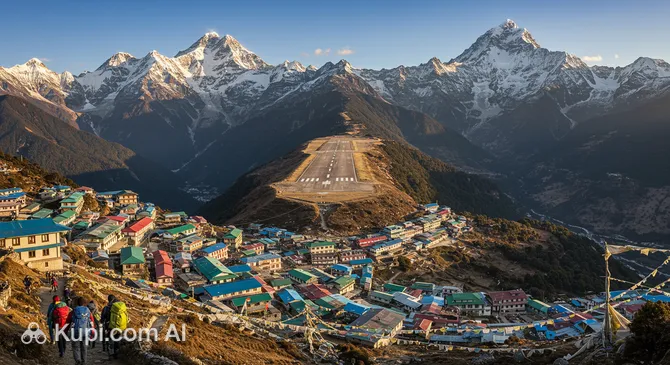
In Lukla, the concept of parks and museums takes on a different meaning compared to typical urban destinations. Here, the "parks" are the boundless Himalayan landscapes that surround the town, and the "museums" are the living cultural sites, monasteries, and stone-carved walls that preserve centuries of Sherpa history. Instead of ticketed galleries and manicured gardens, visitors are invited to explore a world where nature and spirituality are seamlessly funneled into the daily life of the mountains.
Nature as a National Park
While Lukla itself is a compact settlement, it sits on the doorstep of the Sagarmatha National Park, a UNESCO World Heritage site. Although the official park entrance is a day's walk away in Monjo, the town is enveloped by the same breathtaking ecosystem. The surrounding hillsides are covered in dense forests of pine, juniper, and, in the spring, vibrant blooming rhododendrons. This natural amphitheater serves as the ultimate green space, offering fresh mountain air and panoramic views of peaks like Karyolung and Nupla.
For a more accessible natural retreat, the banks of the Dudh Koshi River offer a raw and powerful display of nature. The river, fed by glacial meltwater, cuts through the valley below Lukla. A short hike down towards the river reveals lush vegetation, waterfalls, and suspension bridges that sway gently in the wind. It is a dynamic environment that replaces the tranquility of a city park with the roaring majesty of the Himalayas.
Monasteries as Cultural Galleries
Lukla does not possess formal museums in the Western sense, but its monasteries (Gompas) function as custodians of religious art and history. The Kemgon Gompa is the town's primary spiritual center and effectively serves as an art gallery. Inside, visitors can admire intricate thangkas (devotional paintings), colorful murals depicting the life of Buddha, and gilded statues. These artifacts are not just exhibits but active parts of daily worship, allowing you to witness the living heritage of the Sherpa people.
Another significant cultural site is the Kyongma Gompa, located slightly above the main village. This smaller, often quieter monastery offers a more intimate look at Buddhist traditions. The architecture itself is a testament to local craftsmanship, featuring heavy stone walls and elaborately carved wooden window frames. The serene courtyard provides a reflective space similar to a sculpture garden, where the only sounds are the fluttering of prayer flags and the chanting of monks.
Open-Air History
The streets of Lukla and the trails leading out of it are lined with Mani walls and Chortens (stupas), which act as open-air historical archives. These stone structures are stacked with thousands of slate tablets, each hand-carved with the mantra "Om Mani Padme Hum." They represent generations of devotion and artistic skill. Walking past them (always in a clockwise direction) offers a tangible connection to the spiritual history of the region, much like walking through a hall of ancient inscriptions.
For a glimpse into a greener, more pastoral side of the area, take a short walk to the neighboring village of Chaurikharka. Often bypassed by trekkers rushing to Namche, this area is rich with terraced fields, vegetable gardens, and traditional farmhouses. It feels like a vast agricultural park and offers a peaceful contrast to the busy airstrip, giving you a true sense of the fertile "green valley" life before the terrain turns to high-altitude rock and ice.