Support

Tribhuvan International Airport

About the Airport

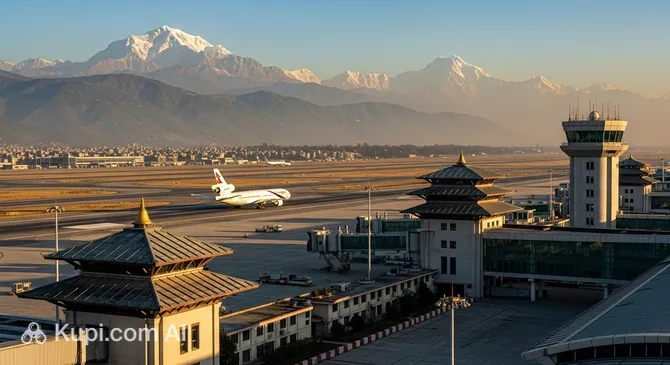
Tribhuvan International Airport. Source: Kupi.com Binoculars

Tribhuvan International Airport is not merely an air hub, but a true gateway to the heart of the Himalayas. Located in the picturesque Kathmandu Valley, it is the first to welcome travelers arriving in Nepal for adventure and spiritual enrichment. Even during landing in clear weather, breathtaking views of snow-capped peaks open up from the window, instantly setting the mood for an unforgettable journey. As the country's only international airport, Tribhuvan serves as the main transport hub from where expeditions to Everest and journeys through ancient cities begin.

IATA Code KTM
ICAO Code VNKT
City Kathmandu
Distance to centre about 6 km
Status international
Annual passengers about 9 million (2023)
Popular Airlines Nepal Airlines, Himalaya Airlines, Qatar Airways
Schedule Tribhuvan International Airport online flight board

The airport consists of two terminals: international and domestic. The latter serves flights to popular tourist spots in the country, such as Pokhara and Lukla — the starting point for trekking to Everest Base Camp. Despite its modest size compared to global hubs, Tribhuvan Airport is equipped with everything necessary for travelers. Here you will find currency exchange points, ATMs, souvenir stalls, and duty-free shops.

Passengers have access to several cafes where they can have a snack before departure, a mother and child room, and free Wi-Fi. For a more comfortable wait, you can use the VIP lounge. The main feature of the airport is its location at an altitude of more than 1,300 meters above sea level, which makes takeoff and landing particularly impressive. This aerial adventure in itself becomes a vivid memory of a trip to mysterious Nepal.

Contact Information

Below is the main contact information for Tribhuvan International Airport (KTM). We recommend checking the accuracy of the data on the official airport website before traveling.

  • Official website: www.tiairport.com.np
  • Inquiry service phone: +977 1 4113033
  • Address: Ring Road, Kathmandu 44600, Nepal
  • Email: info@tiairport.com.np
  • Social media: Information about the airport's official social media pages is best verified on its website.
  • Lost luggage information: In case of lost luggage, you must first contact your airline representative at the airport. Contact details for the Lost & Found counter can also be obtained by calling the inquiry service.
  • Passenger support contacts: For assistance and consultations on general issues, you can use the main airport telephone number.

Getting to the Airport

Getting to Tribhuvan International Airport from the centre of Kathmandu is not difficult, as it is located just a few kilometers from major tourist areas such as Thamel. However, due to the very dense and unpredictable traffic in the capital of Nepal, you should allow extra time for the journey. On average, the trip takes from 30 minutes to 1 hour, but during peak hours it can take longer. It is recommended to leave for the airport at least 3-4 hours before the departure of an international flight.

Taxi and transfer are the most convenient and common methods for tourists. You can order a car through your hotel, hail one on the street, or use local mobile apps such as Pathao or InDriver. The cost of the trip is moderate, but always agree on the price in advance with a street taxi driver to avoid misunderstandings. A pre-booked transfer will cost slightly more but guarantees a fixed price and comfort, which is especially relevant when traveling with large luggage.

The most budget-friendly option is local buses. Not far from the entrance to the airport territory, there is a public transport stop from where routes run to different parts of the city, including the Ratna Park bus station in the centre. This method is suitable for light travelers and those who want to immerse themselves deeper into local life. Be prepared that buses are often overcrowded, and the trip may not be the most comfortable.

If you value independence, you can rent a car. However, in Kathmandu, renting a car with a driver is more popular, which allows you to avoid the stress of navigating through chaotic city traffic. For those traveling by their own or rented transport, Tribhuvan Airport has paid parking where you can leave your car for the duration of the trip.

Terminals and Map

Tribhuvan International Airport in Kathmandu has a fairly simple and understandable structure, consisting of two main terminals: one for international flights and another for domestic ones. They are located in separate buildings, a few minutes' walk from each other, so no special transport is required to transfer between them.

The International Terminal serves all flights arriving in Nepal from abroad and departing from it. The terminal building is relatively small by global standards. In the arrival zone, you will have to go through visa control (if the visa was not arranged in advance), then passport control, collect luggage, and pass customs inspection. Check-in counters, immigration control, and security screening are located in the departure zone. Infrastructure includes several cafes, duty-free shops, and waiting lounges. Navigation is generally intuitive, but be prepared for queues, especially during the peak tourist season.

The Domestic Terminal is a hub for travel within the country. Flights to popular tourist centres such as Pokhara, Lukla (the gateway to Everest), Bharatpur, and others depart from here. This terminal is significantly smaller and simpler than the international one. Procedures here are faster, but it can also be very busy, especially in the mornings when most flights to mountain regions depart. There are basic amenities here, including small cafes and waiting areas.

For international flights, it is recommended to arrive at the airport at least 3 hours before departure. Registration and control processes may take time due to manual document checks and possible crowding. For domestic flights, it is usually sufficient to arrive 1.5-2 hours in advance. To make navigation easier, keep your boarding pass and passport handy, closely follow the signs, and do not hesitate to ask airport staff for help.

Airport History

The history of Tribhuvan International Airport is inextricably linked with the development of modern Nepal and the opening of the country to the whole world. Its journey began in 1949, when the first plane landed on a cow pasture known as Gauchar (which means "pasture"). Initially, it was a small airfield with a grass runway, intended for occasional flights.

An important stage in the history of the airport came in 1955, when it was officially named in honor of King Tribhuvan. Just two years later, in 1957, the grass strip was paved, and in 1964 the airport received international status, which opened the way for direct flights from other countries. Since then, the runway has been repeatedly lengthened and modernized to accommodate increasingly large aircraft.

The airport in Kathmandu became the starting point for thousands of mountaineers and explorers seeking to conquer the highest peaks of the world, including Everest. Many legendary Himalayan expeditions began right here, making the airport a symbol of adventure and great achievements. It played a key role in the establishment of Nepal as a major centre of world mountaineering.

Tribhuvan Airport demonstrated its immense significance during tragic events — the devastating earthquake of 2015. In those days, it turned into the country's main humanitarian hub, receiving rescue teams, medics, and tons of cargo from all over the world. This situation highlighted its strategic importance for the survival and recovery of the nation.

In recent years, the airport has gone through several stages of reconstruction, including the renovation of the runway, the expansion of the international terminal, and the improvement of infrastructure to increase passenger comfort and safety. Today, it remains the only international airport in Nepal, serving as a vital node that connects this amazing Himalayan country with the rest of the world.

Services and Amenities

At Tribhuvan International Airport, passengers have access to a set of services designed to make waiting for a flight more comfortable. Before departure or after arrival, you can have a snack in one of the cafes or restaurants, which serve both local Nepali cuisine and more familiar international snacks. Shops operate in the departure zone, including Duty Free with a standard assortment, as well as souvenir stalls where you can buy handmade items, famous Nepali tea, or cashmere shawls as a keepsake.

For those who value increased comfort, the airport has several lounges, including business lounges (for example, lounges from Radisson Hotel and Thai Airways). Guests are offered food and beverages, fresh newspapers, and a quieter atmosphere. Free Wi-Fi is available throughout the terminal, and charging stations for mobile devices are provided in the waiting halls so that you always stay connected.

To solve financial issues, bank branches and currency exchange points operate at the airport, which is especially convenient for tourists arriving in the country. In case of unforeseen health situations, a medical station operates within the terminal where first aid can be obtained. For business travelers, basic business services, such as work areas and access to office equipment, are usually provided in VIP lounges.

The airport is also equipped with facilities for passengers with special needs. Travelers with children can use mother and child rooms equipped for infant care. Passengers with reduced mobility are provided with wheelchairs and staff assistance when moving around the terminal — it is recommended to book this service in advance through the airline. Although there are no hotels directly in the airport building, there are many hotels of various levels in the immediate vicinity, many of which offer transfers for their guests.

Where to Eat

Dining options at Tribhuvan International Airport (KTM) are quite modest, but they allow you to satisfy your hunger before departure or immediately upon arrival in Kathmandu. The choice of establishments is not as large as in major global hubs, so do not expect gastronomic variety. The main cafes and restaurants are concentrated in the international terminal, mainly in the departure zone after passing control.

In the International Terminal (Departure Zone, after passport control)

After passing passport control and security screening, you will enter the main waiting area, where there is a small food court and several cafes. Here you can find:

  • Restaurants and Cafes: As a rule, there is at least one establishment offering hot meals here. The menu is usually mixed and includes popular international items: sandwiches, burgers, pizza, as well as basic Asian dishes, for example, fried rice or noodles.
  • Local Cuisine: This is the best chance to try Nepali dishes right at the airport. Pay attention to momos — famous local dumplings with meat or vegetable filling. Sometimes you can find Dal Bhat on the menu, albeit in a simplified version consisting of rice, lentil soup, and vegetable curry.
  • Coffee Shops: Several small outlets offer coffee, tea, pastries, and light snacks. This is an ideal option if time before boarding is limited.
In the International Terminal (Before passport control, public zone)

In the public zone (landside), accessible to all visitors, the choice is even more limited. Usually, a small cafe operates here where you can drink coffee or tea and buy packaged sandwiches or snacks. This is a convenient place to pass the time before check-in or wait for those arriving.

Dietary Preferences and Prices

The cuisine of Nepal is rich in vegetarian dishes, so finding meat-free options will not be difficult — vegetable momos or vegetarian chow mein (fried noodles) are available almost everywhere. Stricter dietary requests (vegan, gluten-free) may be more difficult, so it is better to clarify the ingredients of dishes with the staff. As for prices, be prepared that they are significantly higher than in the city. Lunch or even a cup of coffee will cost 2-3 times more expensive than in a cafe in the Thamel tourist district. Opening hours of establishments in the departure zone are usually synchronized with the schedule of international flights and serve passengers even at night.

Our Advice

If you have enough time, we recommend having a proper meal in one of the numerous establishments in the city before traveling to the airport. It will be both tastier and cheaper. However, if you want to have a snack immediately before departure, the cafes in the secure area after passport control will offer enough options to comfortably wait for your flight.

Travel Tips

Traveling through Nepal's main airport, Tribhuvan International Airport, requires some preparation. To ensure your trip starts and ends smoothly, use these tips. The airport can be quite chaotic, so arrive early: 3-4 hours before an international flight and at least 2 hours before a domestic one. This will give you enough time in case of queues and unforeseen delays.

The check-in and security control process in Kathmandu has its own peculiarities. Be prepared for several stages of checks, including a manual luggage search even before entering the terminal. Keep your passport and ticket handy, as you may be asked to present them several times. During security checks, there may be separate queues for men and women.

One of the most valuable tips for flying to Nepal is choosing the right seat on the plane. If you are flying to Kathmandu from the east (for example, from Bhutan or Southeast Asia), choose a seat on the left side. When flying out to the east, sit on the right side. It is from these sides that breathtaking views of the Himalayas, including Everest, open up.

Carry-on luggage rules are generally standard, but there are nuances. Power banks and lithium batteries must be in carry-on luggage only. If you are carrying trekking poles, you will likely be asked to check them in as luggage. On the way back, be careful with souvenirs: knives (even souvenir kukris) and liquids over 100 ml will not be allowed in carry-on luggage.

Passengers with transfers should note that Tribhuvan Airport is not a major transit hub, and infrastructure for this may be limited. Ensure you have enough time between flights, and check in advance if you need to collect your luggage and check in again. When passing through customs control, be prepared to declare expensive electronics, especially drones and satellite phones, which require special permits. Your trekking gear may also attract attention, but usually, problems do not arise.

To save time and money, order a taxi in advance through your hotel or use the Prepaid Taxi counter in the arrival hall to avoid inflated prices. Have small denomination Nepali rupees with you for small expenses. Free Wi-Fi is available at the airport, but its connection can be unstable.

Flight delays are a fairly frequent occurrence, especially on domestic routes due to changeable weather in the mountains. Arm yourself with patience, a book, or downloaded movies. In the international departure lounge, there are several cafes and shops, but the selection is limited. In case of a long delay, stay in touch with your airline representative for up-to-date information.

Reached the end of the page?

That means the route is fully explored