Support

Corvo Island Airport

About the Airport

Landing at Corvo Island Airport is not just the start of a journey, but the beginning of an immersion into a unique world. This air haven, one of the smallest in Europe, serves as the sole gateway to the tiniest and most secluded island of the Azores archipelago. There is no hustle of large terminals here, and every flight is a long-awaited event connecting a handful of locals and few tourists with the rest of Portugal. The airport acts as a vital artery for the island, providing it with everything necessary.
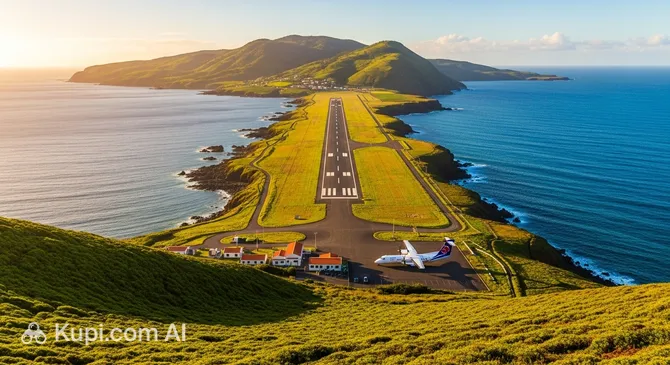
Corvo Island Airport. Source: Kupi.com Binoculars
IATA Code CVU
ICAO Code LPCR
City Vila do Corvo
Distance to centre less than 1 km
Status Domestic
Annual Passengers approx. 7,500 (2022)
Popular Airlines SATA Air Açores

The main feature of Corvo Island Airport is its scale and location. The short runway stretches right along the ocean coast, offering passengers breathtaking views during landing and take-off, although this sometimes makes flights dependent on weather conditions. The airport plays a key role in the life of the island, ensuring the delivery of mail, goods, and, of course, connection with the neighbouring islands — Flores, Faial, and Terceira.

There is only one terminal here, and it is very compact. Forget about long queues and complex layouts — check-in and boarding are quick and take place in an almost home-like atmosphere. For the traveller, this is a unique experience: you feel not just like a passenger, but like a guest on an amazing island lost in the Atlantic. Thanks to its location, you can reach the only settlement on the island, Vila do Corvo, from the airport in just a few minutes on foot.

Contact Information

Below you will find contact information for Corvo Island Airport (CVU), which serves the smallest of the Azores islands.

  • Official Website: The most complete and up-to-date information on airport operations, flight schedules, and available services can be found on the official portal of the airport operator of Portugal — ANA Aeroportos de Portugal, in the section dedicated to Corvo Airport.
  • Information Desk Phone: For general enquiries and information, you can use the phone number: +351 292 596 525.
  • Airport Address: Aeroporto do Corvo, Caminho do Aeroporto, 9980-029 Vila do Corvo, Ilha do Corvo, Açores, Portugal.
  • Email: A specific email for general enquiries is not published. It is recommended to use the contact forms on the ANA operator's website for communication.
  • Social Media: The small Corvo Airport does not have its own accounts. News and updates can be tracked on the official ANA Aeroportos de Portugal social media pages.
  • Lost Luggage Information: In case of loss or damage to luggage, you should first of all contact your airline's representative. It is the air carrier that is responsible for tracing and compensation.
  • Passenger Support Contacts: For general questions related to airport infrastructure, use the main phone number. For all questions regarding tickets, booking, check-in, and transport rules, please contact your airline directly.

How to Get to the Airport

Getting to Corvo Island Airport (CVU) is surprisingly simple, thanks to its unique location. The airport is located in immediate proximity to Vila do Corvo, the only settlement on the island. For most travellers, this means the best way to reach the terminal is a simple and pleasant walk.

Since Corvo Island is very compact, the distance from any point in Vila do Corvo to the airport can be covered on foot in 5-15 minutes. This is not only completely free but also allows you to enjoy the views and the peaceful atmosphere of the smallest island of the Azores archipelago. If you have light luggage, walking will be the most logical and pleasant choice.

If you have many suitcases or limited mobility, taxi services are available on the island. The trip from your hotel or guest house in Vila do Corvo to the terminal entrance will take just a couple of minutes. The cost of the trip will be minimal, likely at a standard short-distance rate. It is strongly recommended to arrange a transfer in advance, especially during the peak tourist season, to guarantee vehicle availability.

Car rental on Corvo is primarily a way to explore the island, rather than a means of transport to the airport. Several local rental agencies offer cars that can be picked up upon arrival. There is a small free car park at the terminal where you can leave a rental or private car. Given the modest traffic on the island, there are almost never issues with finding free spaces here.

It is important to know that there is no public transport system on Corvo Island, such as scheduled buses or trains — there is no need for it due to its miniature size. Air travel is the key to moving between islands. Most flights to Corvo arrive from the neighbouring island of Flores, from Santa Cruz Airport (FLW), which serves as the main transport hub for this corner of Portugal.

Terminals and Map

Corvo Island Airport (CVU) is one of the smallest and most cosy airports in the Azores, and its structure fully corresponds to the scale of the island. Travellers need not worry about complex navigation — everything here is simple and intuitive.

The airport operates only one small terminal, which serves both arriving and departing flights. Its compact dimensions are one of its main advantages. The departure and arrival zones are located in the same building, literally a few steps away from each other. Upon entering the terminal, you will immediately see the check-in counters. After passing check-in and security screening, passengers enter a small waiting lounge before boarding. The arrival zone consists of a simple hall with a baggage claim belt.

Due to the compactness and low passenger traffic, all pre-flight procedures, including flight check-in and security screening, are completed very quickly. Usually, this takes no more than 15-20 minutes. Nevertheless, it is recommended to arrive at the airport approximately one hour before departure to drop off luggage and pass control without rushing.

The main advice on navigation: do not worry, it is impossible to get lost here. All infrastructure is located in one room, and staff are always ready to help. This airport is a fine example of how a small space can be organised as efficiently and conveniently as possible for passengers, ensuring a quick and calm start or end to a journey on the secluded island of Corvo.

Airport History

The history of Corvo Island Airport (CVU) is, in essence, a history of overcoming centuries-old isolation. Located in the town of Vila do Corvo on the smallest and most remote island of the Azores archipelago, it became a true lifeline for local residents. The small runway was inaugurated on 28 September 1983, which became an epochal event for all of Portugal. Until that moment, communication with the island was carried out exclusively by sea, which was long, unreliable, and heavily dependent on the whims of the weather.

Initially, it was a simple airfield (aeródromo) with a dirt strip, capable of receiving only very small aircraft. A key stage of development was 1993, when a large-scale reconstruction was carried out. The runway was paved with asphalt and extended to its current 800 metres, and a small passenger terminal and control tower were built. It was from this moment that the airfield received full airport status and was able to establish regular air connections with other islands of the archipelago, primarily Flores, Terceira, and Faial, operated by SATA Air Açores.

In subsequent years, specifically in 2005, the airport underwent further modernisation to meet modern safety and navigation standards. Despite its modest size, Corvo Airport holds no records for passenger traffic, but its main achievement is ensuring a vital link with the outside world. It plays a key role in the delivery of mail, medicines, fresh produce, and, of course, in the development of tourism on the island.

Among interesting facts — Corvo Airport is one of the smallest commercial airports in Europe. Flights here are considered some of the most scenic, but at the same time challenging due to the short runway and frequent strong crosswinds. For pilots, landing at Corvo is a test of skill, and for passengers, it is an unforgettable adventure with breathtaking views of the island's volcanic landscape.

Services and Amenities

Corvo Island Airport (CVU) is the smallest airport in the Azores, serving the most secluded island of the archipelago. Given its compact size and small passenger flow, the range of services here is basic but sufficient for waiting comfortably for a flight. It is important to understand that this is not a major international hub, but rather an air gateway to a quiet and picturesque island of Portugal.

The terminal building has one common waiting lounge for all passengers. A small café also operates here, where you can order drinks, sandwiches, and light snacks before departure. There are no duty-free shops or a wide selection of souvenir stalls at the airport, so it is better to take care of purchases in advance in the town of Vila do Corvo. For the convenience of travellers, free Wi-Fi is usually available, and there are several points for charging electronic devices.

Specialised services, such as VIP lounges, bank branches, or currency exchange points, are absent at Corvo Airport. The availability of an ATM should be checked on-site, but it is more reliable to carry a sufficient amount of cash. The airport is equipped to receive passengers with reduced mobility; however, the need for special assistance (for example, provision of a wheelchair) should be notified to your airline in advance. Mother and child rooms may be available for passengers with small children, but there are no separate play areas.

There are no hotels directly within the airport territory, which is not surprising, as the town of Vila do Corvo itself, where all accommodation options are concentrated, is a few minutes' walk away. Conference rooms and business centres are also not provided by the airport infrastructure. In general, Corvo Airport copes excellently with its main task — ensuring reliable air connection, offering passengers the essentials for a short wait for their flight.

Dining

When planning a flight through Corvo Island Airport (CVU), it is important to consider that this is a very compact regional airport serving the smallest island of the Azores archipelago. Consequently, dining options here are quite limited and designed for passengers waiting for their flight.

In the airport's single terminal, there is usually one small café. It is located in the general area before security control (landside), so it is accessible to both departing and arriving passengers as well as visitors. This establishment is the main and, typically, the only option for a snack within the airport grounds.

The assortment here is focused on quick and light snacks. You will be able to order:

  • Coffee, tea, and soft drinks.
  • Sandwiches, toasts, and snacks.
  • Local pastries, for example, traditional Portuguese Pastel de Nata or other sweets.
  • Chips, chocolate, and other packaged snacks.

This place is excellent for having a cup of coffee before departure, but one should not count on a full lunch or dinner. Prices here are standard for small airports, possibly slightly higher than in the town. The opening hours of the café are directly linked to the flight schedule — it opens shortly before departure and may close soon after.

Specialised dietary dishes (vegetarian, gluten-free, Halal) are likely absent from the menu. If you have strict dietary restrictions, it is recommended to bring food with you. For a more substantial meal, it is better to visit one of the few restaurants in the town of Vila do Corvo before travelling to the airport.

Travel Tips

Travelling through Corvo Island Airport (CVU) is a unique experience, as it is the smallest airport in the Azores. To ensure your trip goes smoothly, use our tips developed specifically for this compact and scenic aviation hub in Vila do Corvo, Portugal.

Arrival Time and Check-in. Despite the modest size of the airport, it is recommended to arrive approximately 1.5–2 hours before departure. This time will be ample to go through all procedures without rushing. Although queues are rare here, it is better to be safe. To save time, use online check-in if your airline provides such an option.

Security Control and Seat Selection. Security checks here are quick and lack the hustle characteristic of large airports. Hand luggage rules are standard for the EU: liquids in containers up to 100 ml must be packed in a single transparent bag. When choosing a seat on the plane, we strongly recommend taking a window seat. Flights between the islands of the Azores archipelago are famous for breathtaking views of volcanic landscapes and the Atlantic Ocean.

Transfers and Customs. Corvo Airport mainly serves direct flights to other islands, so it is not a transit hub. If you have a transfer planned in a larger airport, for example, in Ponta Delgada, allow sufficient time between flights. Since all flights to Corvo are domestic (within Portugal), there is no customs control upon arrival. You will only have to pass it if your further route lies outside the Schengen area.

Saving and Useful Tips. To save money, book tickets in advance, especially during the summer season. Given that infrastructure at the airport is minimal (there is no large selection of shops or cafés), it is worth bringing a light snack and an empty water bottle, which can be filled after passing security. This will help avoid extra expenses and wait for the flight in comfort.

In Case of Flight Delay. The weather in the Azores can be unpredictable, and flight delays, especially to small islands, are not uncommon. If your flight is delayed, first of all, contact the airline representative for information. Remember your rights as a passenger in the EU (EC Regulation 261/2004), which may provide for the provision of drinks, meals, and even accommodation depending on the length of the delay. Be prepared for the fact that waiting facilities in the airport itself are limited.

Reached the end of the page?

That means the route is fully explored