Support

Luis Muñoz Marín International Airport

Airports in the city

About the Airport

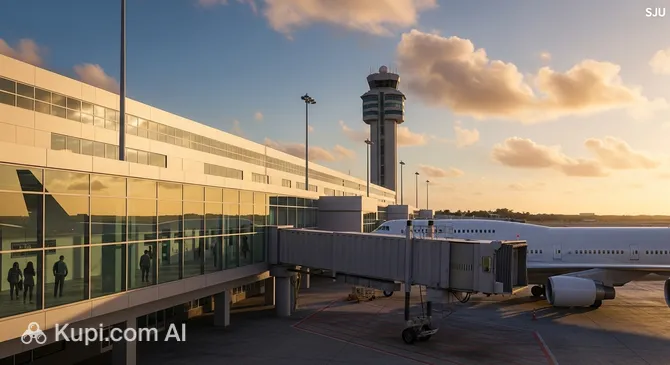
Luis Muñoz Marín International Airport. Source: Kupi.com Binoculars

Welcome to Luis Muñoz Marín International Airport — the main air gateway to Puerto Rico and the busiest airport in the Caribbean. Located just a few kilometres from the capital city of San Juan, it serves as the starting point for exploring the island's tropical charm. The airport is named after the first democratically elected governor of Puerto Rico and acts as a vital transport hub connecting the island with US cities, Latin America, and Europe. Every year, millions of travellers begin their Caribbean adventure right here, enjoying modern service and a welcoming atmosphere.

IATA Code SJU
ICAO Code TJSJ
City San Juan
Distance to Centre ~12-13 km
Status International
Annual Passengers Over 13.2 million (2024)
Popular Airlines JetBlue Airways, Frontier Airlines, Spirit Airlines
Schedule Online Schedule "Luis Muñoz Marín International Airport"

Luis Muñoz Marín Airport offers passengers everything needed for a comfortable journey. Here you will find diverse shops, including Duty-Free outlets, dining options for every taste — from fast food establishments to restaurants featuring Caribbean cuisine, as well as cosy cafes. For passenger convenience, free Wi-Fi is available throughout the airport territory, along with ATMs, currency exchange points, and luggage storage. The airport is also a major hub for airlines such as JetBlue and offers flights to dozens of destinations, making it an ideal starting point for travel throughout the Caribbean region and beyond.

Contact Information

  • Official Website: www.aeropuertosju.com
  • Help Desk Phone: +1 787-253-2329
  • Airport Address: Av. Aeropuerto, Carolina, 00979, Puerto Rico. Please note that the airport is located in the city of Carolina, adjacent to San Juan.
  • Email: To contact the administration, it is recommended to use the contact form on the airport's official website.
  • Social Media: The airport maintains active social media pages where you can follow news and updates. For example, on Facebook: facebook.com/AeropuertoSJU.
  • Lost Luggage: If your luggage has been lost or damaged, you should first contact your airline's representative office. For items left within the airport terminals (excluding checked luggage), please contact the airport's Lost and Found service.
  • Passenger Support Service: Information desks are located within the airport terminals. You can also use the help desk phone number for inquiries.

How to Get to the Airport

Getting to Luis Muñoz Marín International Airport from San Juan is possible via several convenient methods, the choice of which depends on your budget, amount of luggage, and travel plans. The main options include public transport, taxis, car rentals, and private transfers.

The most budget-friendly method is the AMA city bus. Routes T5 and D53 connect the airport with key districts, including Isla Verde, Condado, and Old San Juan. The trip is inexpensive but may take between 45 to 60 minutes. This option is best suited for travellers with light luggage, as space on buses is limited. Please note that there is no direct rail or metro connection to the airport.

For greater comfort and speed, you can use taxis or ridesharing services (such as Uber), which are widely available in the city. The journey from the centre of San Juan to the airport takes about 15–30 minutes, depending on traffic. Fixed fares often apply for taxis to tourist zones, which is convenient for budget planning. Additionally, many hotels offer their own shuttles, and private transfers can be booked in advance for large groups or families.

If you plan to explore the island, car rental is an excellent choice. Counters for all leading international and local rental companies are located at Luis Muñoz Marín Airport. This allows you to pick up a car immediately upon arrival or return it directly before departure. For those arriving at the airport in their own vehicle, both short-term and long-term parking facilities with reasonable rates are provided.

Terminals and Map

Luis Muñoz Marín International Airport (SJU) is distinguished by a well-thought-out and passenger-friendly structure. In fact, it is one large terminal complex divided into three main sections, or terminals: A, B, and C. A key feature is that they are all interconnected, allowing travellers to easily move between them on foot without needing to go outside.

The airport layout is organised in a classic manner, making navigation intuitive. The Departures Zone, with airline check-in counters and security checkpoints, is located on the upper level of the building. The Arrivals Zone, housing baggage claim belts and exits to taxis, buses, and car rentals, occupies the lower level. Signs in English and Spanish will help you find your way.

Each terminal has its own characteristics. Terminal A is the most modern part of the airport, primarily serving JetBlue flights. It has its own security checkpoint. Terminals B and C were recently renovated and now form a unified space, especially after passing security control. They serve the majority of other major carriers, such as American Airlines, Delta, United, Iberia, and Southwest. This is where the bulk of shops, cafes, and restaurants are concentrated.

Moving between terminals is straightforward. Before passing security, you can freely walk from one end of the building to the other. After security control, passengers departing from Terminals B and C can move seamlessly between them, providing access to all boarding gates and services in both zones. Transferring from Terminal A to B/C is also possible but takes some time.

For check-in and security screening, it is recommended to arrive at the airport at least 2 hours before departure for domestic destinations (including flights to the USA) and 3 hours before international flights. During peak seasons, especially in winter and on holidays, queues can be longer, so it is better to arrive with time to spare. To avoid getting lost, check in advance which terminal your airline operates from and head to the corresponding check-in counters.

Airport History

The history of the main airport of Puerto Rico, located near San Juan, begins in the mid-20th century. It was officially opened on May 22, 1955, under the name Isla Verde International Airport, replacing the old Isla Grande Airport as the island's primary aviation centre. The new complex was designed to accommodate the growing flow of tourists and quickly became one of the most modern in the Caribbean.

Luis Muñoz Marín International Airport. Source: Kupi.com Binoculars

In the first decades of its existence, the airport became a key hub for Pan American World Airways (Pan Am), which contributed to its rapid development and transformation into an important transit node between North America, South America, and Europe. The growth in passenger traffic required constant expansion: new terminals were built, and runways were lengthened to accommodate increasingly large aircraft.

A significant event in the airport's history was its renaming. On February 18, 1985, it received its current name — Luis Muñoz Marín International Airport, in honour of the first democratically elected governor of Puerto Rico. This decision highlighted the national significance of the facility and its role in the development of modern Puerto Rico. In the 1980s and 1990s, the airport experienced another boom, becoming a major base for American Airlines, which defined its status as the main regional hub for many years.

Throughout its history, the airport has been modernised repeatedly. In recent decades, large-scale renovations of Terminals A, B, and C have been carried out, infrastructure has been improved, and modern technologies for passenger service have been implemented. Today, Luis Muñoz Marín Airport consistently ranks among the busiest airports in the Caribbean in terms of passenger traffic, continuing to play a central role in the island's economic and tourism life.

Services and Amenities

Luis Muñoz Marín International Airport (SJU) offers its guests a wide range of services to make their stay as comfortable and productive as possible. Here, every traveller will find everything necessary, from diverse dining establishments to comfortable rest areas. You can enjoy both local cuisine and familiar options in numerous cafes and restaurants. For shopping enthusiasts, the doors of Duty-Free shops, souvenir stalls, and boutiques are open, where you can purchase everything from traditional local goods to exclusive perfumes.

To stay connected, take advantage of the free Wi-Fi available throughout the terminal areas. Dedicated stands and outlets are provided in waiting areas for charging gadgets. If you value enhanced comfort, several VIP lounges are at your service, including The Lounge San Juan. Here, in a quiet atmosphere, you can relax, have a snack, enjoy refreshing beverages, and work away from the noise of the main hall.

Financial matters can be easily resolved at the airport: ATMs and currency exchange points are available. For travellers with children, mother-and-child rooms equipped with changing tables are provided. In case of unforeseen health situations, a first aid medical station operates within the terminal. The airport is also fully adapted for passengers with reduced mobility, offering ramps, elevators, and special assistance upon request.

For those requiring a full rest between flights, a hotel offering comfortable rooms is located directly opposite one of the terminals. Business travellers can utilise the business centre services and rent conference rooms for meetings, making the airport a convenient venue not only for travel but also for work.

Where to Eat

At Luis Muñoz Marín International Airport in San Juan, travellers can expect a worthy selection of establishments for every taste and budget. Here you can grab a quick bite before departure or enjoy a leisurely lunch, savouring your final moments in Puerto Rico. Most cafes and restaurants are located after passing security control (airside), but there are also several excellent options in the public zone (landside).

For those wishing to enjoy local cuisine, the airport offers several authentic establishments. Be sure to visit El Mesón Sandwiches — a popular Puerto Rican chain offering hearty sandwiches, or Viena Mía, where you can try traditional dishes like mofongo. These places are a great way to taste local flavours before flying out. They are located in different terminals, primarily in the departure zones.

If you prefer familiar dishes, numerous international chains are at your service. In Terminals B and C, you will find Burger King and Domino's Pizza for a quick and filling snack. Coffee and pastries can be picked up at numerous Starbucks points. For a more substantial lunch in the public zone (landside), before security control, The Cheesecake Factory operates, known for its large portions and diverse menu.

Passengers with a long layover or those wishing to relax before their flight will appreciate full-service restaurants. For example, Air Margaritaville in Terminal A offers a Caribbean atmosphere, tropical beverages, and American cuisine. Most establishments operate from early morning until late evening, aligning with flight schedules, and some points serving drinks and snacks may be open 24 hours.

Prices at the airport are generally higher than the city average. A quick snack will cost approximately 15-20 USD, while a full lunch in a restaurant starts from 30 USD and up. Regarding special dietary needs, many cafes offer vegetarian salads, sandwiches, and fruit cuts. However, the selection of gluten-free, vegan, or Halal dishes may be limited, so it is best to verify ingredients with staff on-site.

Travel Tips

To ensure your journey through the main airport of Puerto Rico goes as smoothly as possible, use these proven tips. The airport in San Juan is a modern and busy hub, so a little preparation will help save time and stress.

Arrival Time and Check-in. It is recommended to arrive at the airport at least 2 hours before departure for domestic flights (including flights to the US mainland) and 3 hours before international ones. To avoid queues, complete online check-in and print your boarding pass in advance. If travelling only with hand luggage, this will allow you to head straight to the security checkpoint. For convenience, you can use the expedited screening program TSA PreCheck if you are a member.

Security Screening and Hand Luggage. Remember standard security rules: liquids in hand luggage must be in containers no larger than 100 ml and packed in a transparent bag. Laptops and other large electronics usually need to be removed from bags for scanning. To speed up the process, prepare these items in advance and remove outer clothing, belts, and metal accessories.

Customs Control Specifics. An important point: flights between Puerto Rico and the US mainland are considered domestic. This means that upon arrival in the US, you do not need to pass passport and customs control. However, when departing from San Juan to the mainland, all bags pass through a US Department of Agriculture (USDA) inspection to check for prohibited plants and products. Standard border and customs control procedures apply to all international destinations.

Tips for Economy and Comfort. Prices for food and drinks at the airport can be high. Bring an empty water bottle that can be filled after passing security, and pack non-perishable snacks. When choosing a seat on the plane, if flying during the day, select a window seat to admire the stunning views of the Caribbean Sea during takeoff and landing. An aisle seat will provide more legroom and the ability to stand up freely.

Transfers and Flight Delays. If you have a connecting flight, check the gate number on the information screens immediately upon arrival — it may have changed. In case of a flight delay, contact your airline representative to learn about rebooking options and possible compensation (for example, meal vouchers). Remain calm and clarify your rights as a passenger.

Reached the end of the page?

That means the route is fully explored