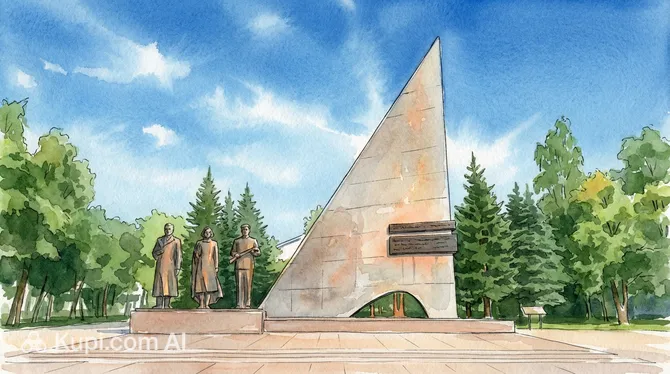
On the picturesque banks of the Northern Dvina in the city of Arkhangelsk stands a majestic memorial complex dedicated to the memory of Northern soldiers. The centerpiece of this composition is the Eternal Flame Memorial — a sacred symbol commemorating the feat of the region's residents during the Great Patriotic War. This monument is rightfully considered one of the main historical and spiritual landmarks visited by almost every traveler to Russia who arrives in the North.
Eternal Flame Memorial. Illustration.
Source: Kupi.com AI
Traveler photos:
The architectural ensemble is striking in its austerity and scale. Its dominant feature is a 19-meter concrete stele, the shape of which resembles a furled banner. At its base, in a bronze bowl, a flame burns eternally. Near the fire stand massive four-meter figures of a sailor, a female warrior, and a soldier, personifying the unity and resilience of the defenders of the Motherland.
The memorial is located on Peace Square (Ploshchad Mira) and is clearly visible not only from the embankment but also from the decks of ships passing along the river. Piercing words about the tens of thousands of Northerners who gave their lives for freedom are carved into the granite slabs of the stylobate. This is a place where history meets modernity, reminding us of the importance of peace and the memory of generations.
Contacts
The memorial is an open public site, so it does not have its own information service or official website. For general inquiries, you can contact the city administration or the local tourist information center.
When visiting the memorial, the main experience is one of quiet contemplation. It is customary here to honor the memory of heroes, observe the expressive faces of the bronze defenders, and feel the solemn silence of the site. The monument provides excellent opportunities for commemorative photos — the combination of the stele's austere architecture and panoramic views of the wide Northern Dvina creates truly profound shots.
A walk through Peace Square allows you to combine a historical excursion with relaxation by the water. We recommend visiting this place at sunset: in the rays of the setting sun, the reflections of the flame on the bronze look particularly expressive, and the river takes on soft hues. If you are lucky enough to be here on holidays, you can witness solemn wreath-laying ceremonies and honor guards.
After visiting the monument, you can continue your cultural program at the nearby "Mir" cinema or simply walk along the embankment, enjoying the fresh river air and the rhythm of the port city. This place is ideal for those seeking inspiration and peace amidst the bustle of everyday city life.
Getting There
Finding the memorial is very simple — it is located on the Northern Dvina Embankment at Peace Square (Ploshchad Mira). This is one of the most visited spots in the city, so any local can point you in the right direction. If you are in the city center, a pleasant walk along the river will take no more than 20–30 minutes.
For those who prefer public transport, buses and shuttle taxis (marshrutkas) heading to the "Ploshchad Mira" or "Naberezhnaya" stops are suitable. From the main railway station, the trip takes about 15–20 minutes. You can also always use popular taxi services to reach the square quickly from any part of the city.
If you are traveling by car, there are parking spaces near the square on the embankment. Those arriving in the city by river transport will be able to appreciate the majestic view of the stele directly from the deck of the vessel as it approaches the piers.
Nearest city: Arkhangelsk
History & Facts
Behind the monumental appearance of the landmark lies the work of outstanding masters. The idea for its creation belongs to the architect Vadim Kibirev, who worked in collaboration with sculptors Valentin Mikhalyov and Yuri Chernov. The foundation stone of the future monument was laid on a symbolic date — May 9, 1965, and the grand opening took place four years later, in 1969.
The creation process was truly a community effort: the star for the flame was cast at the local "Krasnaya Kuznitsa" factory, while the massive bronze figures were made in Leningrad and delivered to the city by a special train. Architect Kibirev sought to convey the unyielding will and power of the people who protected their land through the scale of the composition.
Over time, the memorial complex was supplemented with new significant details. In 1991, the ashes of the Unknown Soldier, brought from the Murmansk region, were buried here. In 1995, the ensemble was joined by an additional stele immortalizing the names of Northerners who were Heroes of the Soviet Union. Today, this site is the region's main spiritual center of remembrance.
Time Needed
For a thoughtful inspection of the memorial itself, reading the commemorative inscriptions, and taking photographs, 30–45 minutes is usually sufficient. This is enough time to feel the atmosphere of the place and examine the details of the bronze sculptures.
If you plan to combine your visit with a walk along the Northern Dvina Embankment and a rest by the river, you should set aside about 1 hour. During the warmer months, it is pleasant to linger here longer, watching the flow of the water and the passing ships.
Working Hours
The memorial is a public open-air monument and is therefore open to visitors 24 hours a day. You can come here at any convenient time, whether it is early morning or late evening.
The site is open without breaks or days off, 24 hours a day, 7 days a week. Entry to the square is free.
Open 24 hours
Nearby
The memorial's location on the main embankment makes it an excellent starting point for further exploration of the city. A walk through the surrounding area will allow you to see both touching modern monuments and old architectural structures that shape the unique appearance of this northern port.