-
Clothing and items for the season:
Krasnokamensk has a sharply continental climate: summers are warm, sometimes hot, and winters are freezing with little snow.
- In summer (June-August), bring light clothing made of natural fabrics, but don't forget a sweater or windbreaker for evening walks, as evenings can be cool. A sun hat and sunscreen are a must.
- In winter (November-March), you will need very warm outerwear (a down jacket designed for severe frosts or a fur coat), an ushanka hat or another warm hat, a scarf, mittens or warm gloves, thermal underwear, and insulated winter boots with non-slip soles.
- In the transition seasons (April-May, September-October), the weather is changeable, so dress in layers: t-shirt, sweater, mid-season jacket.
- Comfortable shoes are your best friend at any time of year; since the city is industrial, they will be indispensable for walks, including those in the surrounding areas.
- Don't forget standard Russian power adapters for electronics (Europlug, Type C/F) if your devices have different plugs.
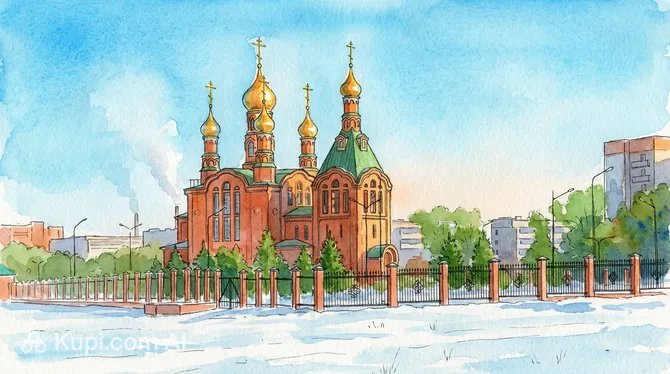
- When visiting Orthodox churches (if planned), women are recommended to wear a headscarf and clothing that covers the shoulders and knees (skirt or dress), and men should be without headwear and not in shorts.
-
Getting around the city:
The main form of public transport in Krasnokamensk is the bus, which connects different districts. Routes and schedules can be checked at stops, by asking locals, or through online maps (e.g., Yandex Maps or 2GIS, if they cover the city).
Taxis are a convenient way to get around, especially if you have luggage or are traveling in a group. Both local taxi services and popular Russian aggregators (e.g., Yandex Go) may operate in the city. Check for app availability upon arrival or use the phone numbers of local taxi companies.
Renting a car is unlikely to be necessary for moving within Krasnokamensk itself, as the city is quite compact. However, if you plan independent trips around the Zabaykalsky Krai, it might be an option, but it's better to look for car rental points in the region's larger cities.
-
Financial matters:
The local currency is the Russian ruble (RUB).
Currency exchange (if arriving from abroad with foreign currency) can be done at bank branches. It is recommended to do this at official points to avoid fraud.
Bank cards of the Russian "Mir" payment system are accepted in most shops, cafes, and service points. Note: international Visa, Mastercard, American Express, and other cards issued outside of Russia will highly likely not work due to current restrictions. Check the current situation before your trip.
ATMs are available at bank branches and some large retail outlets. It is recommended to always have some cash on hand, especially for small purchases, paying for public transport, or in case of technical issues with terminals.
An approximate daily budget (excluding accommodation) might be 2000-4000 rubles per person (food, local transport, small souvenirs). This is a very rough estimate and depends on your preferences.
Tipping in Russia is not strictly mandatory but is welcomed in cafes and restaurants (usually 5-10% of the bill if you liked the service and want to thank the staff). In taxis, you can round up the amount.
-
Health and safety:
There are pharmacies in the city; some may operate 24/7 or have emergency counters. However, if you take any specific prescription medications, it is better to bring them with you in reserve along with the doctor's prescription.
Medical care for Russian citizens is provided under the OMS policy. Foreign tourists are strongly advised to have medical insurance covering treatment costs and emergency care for the entire duration of their stay. The city has hospitals and clinics.
Krasnokamensk is generally a peaceful city. Observe standard precautions: watch your belongings (especially in public places and transport), do not leave valuables unattended, and do not display large sums of money. Avoid walking alone in poorly lit and deserted places after dark, especially on the outskirts or in industrial zones, if you are unfamiliar with the area.
-
Communication and language:
The official language is Russian. The prevalence of English or other foreign languages is low, especially among the older generation and outside of the tourism sector (which is not highly developed in Krasnokamensk). Try to learn a few basic phrases in Russian: "Hello" (Zdravstvuyte), "Goodbye" (Do svidaniya), "Thank you" (Spasibo), "Please/You're welcome" (Pozhaluysta), "Yes" (Da), "No" (Nyet), "How much does it cost?" (Skol'ko stoit?), "Where is...?" (Gde nakhoditsya...?), "I don't understand" (Ya ne ponimayu). Having a phrasebook or a translator app on your phone will be useful.
A local SIM card (e.g., MTS, Beeline, MegaFon, Tele2) can be purchased at mobile operator stores upon presentation of a passport. This will provide you with mobile internet and the ability to make local calls at better rates.
Wi-Fi is available in most hotels and some cafes. Quality and speed may vary.
Useful apps for navigation and finding information about organizations include Yandex Maps or 2GIS (check current coverage for Krasnokamensk).
-
Local etiquette and traditions:
It is customary to greet with a handshake (especially between men, even upon first meeting). Addressing strangers and elders with the formal "Vy" (the polite form of "you") is the accepted norm of politeness.
In public places (transport, shops, cultural institutions), behave with restraint, do not make noise, and do not talk loudly on the phone. In transport, it is customary to give up seats to the elderly, pregnant women, and passengers with small children.
Local residents in small cities like Krasnokamensk may be reserved at first but are usually hospitable and ready to help if approached politely. Show respect for their city, its history, and traditions, and you will likely encounter a friendly attitude.
Smoking in public places (including stops, cafes, restaurants, entrances) is restricted by law. Consuming alcoholic beverages on the streets and in public places (except specially designated areas) is prohibited.
-
What to avoid:
- Excessive criticism or negative remarks about local industry, the city's history, or the standard of living. Krasnokamensk is a city with a strong identity, much of it tied to its main enterprise and complex history of development. Such conversations may be taken personally by local residents or seen as disrespectful.
- Photographing industrial facilities without special permission or in prohibited areas. Given the city's specifics (formerly a center of the uranium industry with ZATO status), some territories and objects may have special security regimes. If in doubt, it is better to refrain from filming or clarify the possibility with officials.
-
Additional Tip: Immerse yourself in history and enjoy the local flavor!
Krasnokamensk is a young city but with a very rich and unique history. To better understand its spirit and significance, be sure to visit the Krasnokamensk Museum of Local Lore. This will help you see the city not just as an industrial center but as a place with its own destiny, labor achievements, and character. Also, pay attention to the operating hours of shops and institutions—they may differ from what you're used to in large metropolises (for example, there might be a lunch break). Don't hesitate to communicate with locals (within reason, of course)—it's the best way to learn something truly interesting and non-touristy.