Support

Mammoth Museum

About

If you want to peer into the deep past of our planet, the Mammoth Museum is a must-visit destination on your travel map. Located in the city of Yakutsk, this specialized scientific and cultural center is the only place in the world entirely dedicated to studying the mammoth fauna of the Ice Age. Within the northern latitudes of modern Russia, a colossal number of paleontological finds are concentrated, and this museum has become their primary guardian.
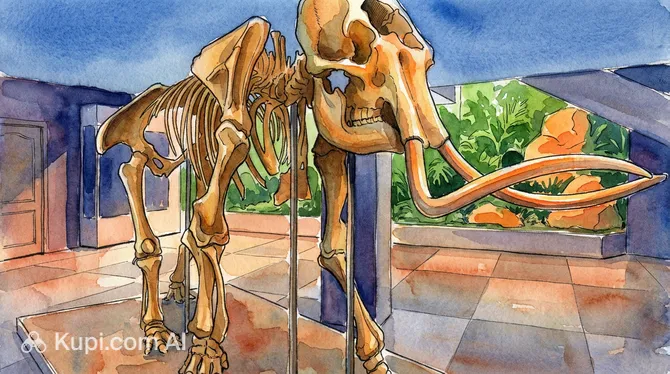
Mammoth Museum
Mammoth Museum. Иллюстрация. Источник: Kupi.com AI

The museum's collection is impressive in its scale and uniqueness: it houses more than 2,000 bone remains of ancient animals. Guests can see not only expertly reconstructed skeletons of mammoths, woolly rhinoceroses, and prehistoric bison but also truly incredible exhibits—fragments of carcasses with preserved soft tissues. Thanks to Yakutia's permafrost, these finds have reached us in striking preservation after tens of thousands of years.

The museum is part of the North-Eastern Federal University and serves as an important base for international scientific research. It is not just an exhibition of antiquities, but a living testament to an era when giant creatures roamed the snowy plains of Siberia. Visiting this site offers a rare opportunity to appreciate the grandeur of nature and see the fruits of the meticulous work of Yakutian paleontologists.

Contacts

To confirm details before your visit, you can use the museum's official contact information. The staff is always ready to assist with information regarding group tours and special exhibitions.

How to contactContact
Addressул. Кулаковского, 48, Якутск, Респ. Саха (Якутия), Россия, 677000
Phone+7 411 236-16-47
Websitewww.s-vfu.ru

What to Do

Visiting the exhibition is like a real journey back in time, where the main attractions are the complete skeletons of ancient giants. You can examine in detail the mighty tusks of mammoths, the fearsome horns of woolly rhinoceroses, and the massive bones of bison. A highlight for visitors is the freezer units: they house unique finds with preserved soft tissues, such as fragments of the Malolyakhovsky mammoth or a mummified ancient lemming that is over 50,000 years old.

Be sure to take advantage of the guided tour services. A professional guide will tell the stories behind the legendary finds—from the Adams mammoth found in the 18th century to younger specimens like the Oymyakon and Khroma mammoth calves. You will learn how these creatures lived in the harsh conditions of the Ice Age, what they ate, and why they eventually disappeared from the face of the Earth.

For families with children, a visit to the museum will be an exciting educational adventure. Photography is allowed next to the majestic exhibits, letting you capture memories of meeting the "kings" of the ancient tundra. Thematic display cases and interactive stands help visualize what the ecosystem of North-Eastern Siberia looked like many millennia ago.

Getting There

Finding your way to this paleontological treasure is easy, as the museum is located in the central part of the city at 48 Kulakovskogo St. It is situated within the campus of the M.K. Ammosov North-Eastern Federal University. If you are staying in the city center, the museum is easily accessible by public transport or even on foot, allowing you to enjoy the atmosphere of the republic's capital.

From Yakutsk Airport, the journey by taxi or bus takes about 30–40 minutes. If you are arriving in the city via the railway station (located in Nizhny Bestyakh), the journey, including the crossing and local transport to the center, will take a bit longer, but the route from the city's transport hubs to Kulakovskogo Street by bus takes no more than 20 minutes. For navigation convenience, you can use modern maps with Place ID ChIJz_EWJ0NK9lsR5YOchY9xZXM.

When planning your trip, be sure to account for Yakutia's famous climate. In the winter months, when temperatures drop significantly below zero, it is advisable to book a taxi directly to the entrance to minimize time spent in the cold. Parking spaces are available near the university building if you decide to use a rental car.

Ближайший город: Yakutsk

History & Facts

The establishment of this unique scientific center in 1991 was a major milestone for the region. The museum was initiated by the first Yakutian mammoth expert, Pyotr Alekseevich Lazarev. Before this, almost all valuable finds discovered in the permafrost were sent to central institutes in Moscow or Saint Petersburg. Creating its own museum allowed Yakutian scientists to conduct research on-site and preserve this national heritage in Yakutsk.

The history of paleontological discoveries in this region dates back centuries. As early as 1799, the famous Adams mammoth was found in the Lena River delta—the first mammoth skeleton to reach scientists. Yakutia is rightfully considered the "homeland of mammoths": approximately 75% of all known global burial sites of mammoth fauna with preserved soft tissues have been discovered here.

Over the past decades, the museum's collection has been enriched with sensational exhibits, including fragments of the Malolyakhovsky mammoth carcass, a mummified hoofed lemming over 50,000 years old, and the remains of an ancient Verkhoyansk horse. In 2011, the museum officially became part of the North-Eastern Federal University, providing a new impetus for international scientific projects and field work.

Today, the museum is not just a tourist attraction but also a cutting-edge laboratory. Here, researchers study ancient animal DNA and reconstruct the Ice Age ecosystem. Since 2012, the museum's laboratory has proudly borne the name of its founder, P.A. Lazarev, continuing the tradition of studying our planet's mysterious past.

Time Needed

To leisurely immerse yourself in the Ice Age atmosphere and carefully examine all 17 themed display cases, a typical visitor will need between 1 and 2 hours. This is plenty of time to get acquainted with the main exhibits, including the majestic skeletons, and listen to an informative tour by the museum staff.

If you are passionate about paleontology or plan to study the information boards and photographic materials in detail, your visit might last a bit longer. The museum is compact but densely packed with unique artifacts, so everyone will find something fascinating without having to spend an entire day on the tour.

Working Hours

When planning your visit to the world of the Ice Age, please note the opening hours. The museum welcomes visitors from Tuesday to Friday, 10:00 AM to 5:00 PM (10:00 to 17:00), with a lunch break from 1:00 PM to 2:00 PM (13:00 to 14:00).

Please note that Monday, Saturday, and Sunday are closing days. It is recommended to check the current schedule on the university's official website before your trip, as the schedule may change during public holidays or scientific conferences.

DayWorking hours
понедельникЗакрыто
вторник10:00–13:00, 14:00–17:00
среда10:00–13:00, 14:00–17:00
четверг10:00–13:00, 14:00–17:00
пятница10:00–13:00, 14:00–17:00
субботаЗакрыто
воскресеньеЗакрыто

Nearby

After immersing yourself in the prehistoric era at the Mammoth Museum, it is worth exploring other interesting spots in the city. The university surroundings and central squares of Yakutsk are rich in monuments and cultural sites that help you better understand the history and traditions of this harsh but hospitable land.

A stroll through nearby squares and parks will reveal unique monuments dedicated to both prominent figures of the republic and legendary pioneers. Below is a list of interesting sites located within a few kilometers of the museum:

NameDistance
KTV Night Club0.7 km
Muus Khaya0.9 km
Aberdeen Pub1.2 km
Kubik Restaurant1.8 km
Reka Ozeroles1.9 km
Tuimaada Shopping and Entertainment Center1.9 km
Central Park of Culture and Recreation2.1 km

Reached the end of the page?

That means the route is fully explored