Support

Sishen Airport

About the Airport

Sishen Airport
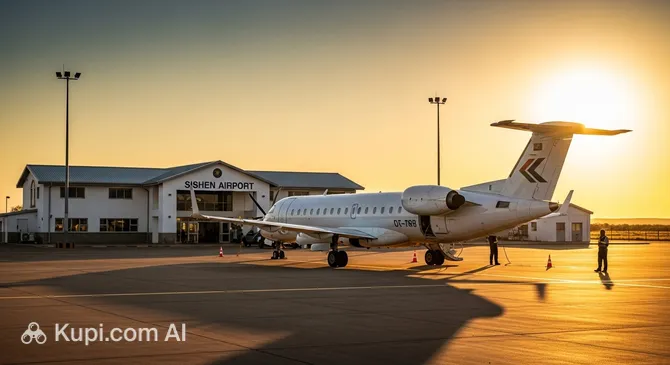
Sishen Airport. Source: Kupi.com AI

Sishen Airport (Sishen Airport) is a small but strategically important air hub in the Northern Cape province, serving as the main gateway to the "iron capital" of South Africa. Located amidst rugged and picturesque landscapes, it provides a vital link for business travellers and employees of one of the world's largest iron ore mines. For tourists, this airport can be the starting point for exploring the unique nature of the Kalahari Desert and the oasis town of Kathu. Despite its compact size, the airport offers high safety standards and service efficiency, saving travel time compared to ground transport.

AirportSishen Airport
IATASIS
ICAOFASS
CitySishen
TimezoneAfrica/Johannesburg
ScheduleOnline board

Features and Advantages of the Airport:

Sishen Airport is primarily oriented towards the needs of the mining industry and business tourism, which defines its specific character. It is located just a 10–15 minute drive from the town of Kathu, which is famous for its magnificent golf course and dense Camel Thorn forests.

Among the key advantages of the air hub are:

  • Convenient Location: Proximity to the Sishen mine and the town minimises transfer time.
  • Regular Connections: The airport receives daily flights from Johannesburg, ensuring a stable link with the country's economic centre.
  • Compactness and Speed: Thanks to the small terminal, check-in and security procedures are very fast, without the queues typical of major hubs.
  • Access to Attractions: It is a convenient entry point for those planning a journey deep into the Northern Cape or towards the border with the Kalahari Desert.

The terminal is equipped with basic amenities for waiting for a flight. Travellers should note that the airport operates on a limited schedule adjusted to flight times, so arriving too early serves no purpose.

Contact Information

  • Official Airport Website: Sishen Airport does not have its own separate website. For up-to-date information on flights and services, it is recommended to visit the official pages of the main carriers: Airlink or CemAir.
  • Information Desk Phone: There is no unified terminal information service. For operational questions, it is best to call the local Airlink office at the airport: +27 53 739 2715 or the CemAir call centre: +27 861 236 247.
  • Airport Address: Sishen Airport (SIS), R380 (Deben Road), Kathu, 8446, Northern Cape, South Africa. (The airport is located approximately 10–15 minutes' drive from Kathu city centre).
  • Email: There is no direct email for terminal administration available to passengers. It is recommended to use the contact forms on the airline websites: customercare@flyairlink.com or tickets@cemair.co.za.
  • Airport Social Media: The airport itself does not have official accounts. News can be tracked on the social networks of the management company, Kumba Iron Ore, or the air carriers.
  • Lost Luggage Information: Airlines are responsible for locating items. If you flew with Airlink or CemAir, contact their representative at the counter in the arrivals hall or call the numbers listed above.
  • Passenger Support Contacts: Support is provided directly by airline staff at the check-in counters before departure.

How to Get to the Airport

The transport infrastructure around Sishen Airport has its own specificities due to its location in the Northern Cape province. Since the airport predominantly serves the town of Kathu and the mining complex, there is not the variety of public transport customary for metropolises. The main focus is on road transport.

Transfers and Taxis

This is the most reliable way to get to the town if you do not plan to drive yourself. It is important to note that hailing a car from the curbside at the terminal is practically impossible.

  • Pre-booking: It is strongly recommended to book a transfer in advance through your hotel or guest house in Kathu. Most accommodation facilities provide this service for their guests.
  • Local Services: Private taxi companies operate in the region, but their fleet is limited. It is better to obtain driver contacts at the information desk upon arrival or in advance via the internet.
  • Cost: A trip to the centre of Kathu usually costs between 150 and 300 ZAR, depending on the time of day and vehicle class. The travel time will be just 10–15 minutes.

Car Rental

For travelling around the Northern Cape, a personal vehicle is not a luxury but a necessity. International and local rental agency counters (e.g., Avis or Budget) are present at Sishen Airport. This is an ideal option for tourists wishing to visit nature reserves or head into the Kalahari Desert.

  • Recommendation: Due to the small size of the fleet at the airport, cars should be booked at least a week before arrival.
  • Roads: The airport is connected to the town by a high-quality paved road, the R380. Navigation here is simple; it is difficult to get lost.

Public Transport

Public transport in the conventional sense (buses, minibuses, trains) does not run to the airport. There is no railway station for passenger transport here, and the municipal bus system in the region does not cover the route to the terminal.

Parking

A secure parking zone is equipped on the airport territory. It is located in immediate proximity to the terminal building, so long walks with luggage will not be required.

  • Parking Type: Open-air, but some spaces are equipped with canopies for protection against the scorching sun, which is critical in the summer months.
  • Payment: Rates are moderate; both hourly and daily payment options are available.

Alternative Airports

If there are no tickets for direct flights to Sishen or the schedule does not suit you, you can consider flying to neighbouring major hubs and continuing the journey by rental car. The nearest options are:

  • Upington Airport — located approximately 190 km away. The drive will take about 2–2.5 hours. This is a good option if you plan to visit the Augrabies Falls.
  • Kimberley Airport — located 215 km away (about 2.5 hours drive). Convenient for those who want to see the famous "Big Hole".
  • Bram Fischer International Airport in Bloemfontein — a more distant option (360 km), but offers a greater number of connecting flights.

Terminals and Map

Sishen Airport (SIS) represents a classic example of a small regional airport, where compactness and functionality are paramount. Here you will not find confusing labyrinths of corridors or multi-level transitions. All infrastructure is concentrated in one small building, making navigation intuitive even for first-time flyers.

Terminal Structure

The airport complex consists of a single passenger terminal, which serves both departing and arriving flights. This single-storey building, divided into functional zones, allows passengers to complete all necessary formalities in a matter of minutes.

  • Check-in Zone: Located immediately at the terminal entrance. Here you will find airline counters (predominantly Airlink and CemAir). Due to low passenger traffic, queues here are a rarity.
  • Security Zone: The security checkpoint is literally a few steps from the check-in counters. The equipment meets all modern standards, but the procedure itself is much faster than in major international hubs.
  • Departure Lounge: A small but comfortable space equipped with seating for passengers. The hall is fitted with an air conditioning system, which is particularly relevant in the hot climate of the Northern Cape.
  • Arrivals Zone: Represents a separate exit through which passengers enter the building from the airfield.

Navigation and Service Features

The main feature of Sishen Airport is the absence of jet bridges ("airbridges"). Boarding and disembarking are carried out in the traditional manner: walking across the apron. The aircraft stops in immediate proximity to the terminal building, and the walk to the entrance takes less than a minute. This adds a special charm to the journey, allowing you to breathe in the Kalahari air immediately upon landing.

Processing Times

Thanks to the intimate scale of the airport, passengers do not need to arrive 2–3 hours before departure, as is customary in Johannesburg or Cape Town.

  • Check-in and Luggage Drop: Usually takes from 5 to 15 minutes.
  • Pre-flight Security: Completed in 2–5 minutes.
  • Recommendation: Arriving at the airport 45–60 minutes before departure is considered optimal. This time is ample for all formalities without unnecessary haste.

Tips for Travellers

Since the airport is very small, there are no transit zones or Duty Free shops. Food options are also limited, so if you are travelling with children or have specific dietary preferences, it is recommended to arrange a snack in advance. Navigation inside is simple: all signs are duplicated in English, and staff are always ready to suggest directions, as the entire hall is visible from end to end.

Airport History

The history of Sishen Airport (SIS) is unlike the chronicle of a typical city air hub. Here you will not find stories about the first postal biplanes of the early 20th century. The fate of this airport is inextricably linked with the red dust of iron ore and the industrial boom in the Northern Cape region. It is a classic example of how industrial necessity generates infrastructure that is subsequently used by tourists as well.

Foundation and Early Years

The airport's inception dates back to the early 1970s. It was during this period, parallel to the massive expansion of mining at the Sishen mine (one of the largest open-pit iron ore mines in the world), that the town of Kathu was founded. Initially, the airfield was created exclusively as a departmental facility. Its main task was the transportation of engineers, geologists, and executives of the state corporation ISCOR (later becoming part of Kumba Iron Ore) from South Africa's administrative centres directly to the mining site.

Development Stages and Transition to Commerce

For a long time, Sishen remained a closed facility, accepting only charter flights and private company aircraft. However, as the town of Kathu grew—nicknamed the "town under the trees"—a need arose for regular connections for ordinary residents and contractors.

  • 1990s and 2000s: The airport began to open up to a wider circle of passengers. The necessity for regular flights became obvious, as driving from Johannesburg or Cape Town took too much time.
  • Arrival of Carriers: A key stage was the conclusion of agreements with regional airlines, particularly with Airlink. This turned the private airstrip into a fully-fledged transport hub, available for booking through global systems.

Modernisation and Reconstruction

Since the owner of the airport is the mining company Kumba Iron Ore (a subsidiary of Anglo American), funding for the facility has always been stable. Unlike municipal airports dependent on budgets, Sishen was modernised based on corporate safety standards.

In recent decades, significant works have been carried out:

  • Runway Strengthening: The runway was reconstructed and strengthened to accommodate modern jet liners, such as the Embraer E-Jet, which replaced noisy turboprop aircraft.
  • Navigation Update: Modern lighting and navigation equipment was installed, allowing flights to be performed in difficult weather conditions characteristic of desert regions (dust storms, heat).
  • Terminal: The terminal building is maintained in pristine condition, offering a level of comfort corresponding to business aviation standards.

Interesting Facts

Despite its modest size, Sishen Airport has several unique features distinguishing it from other small airports in South Africa:

  • Private Status: It is one of the few airports in the world that, being the private property of a mining company, is fully integrated into the national network of regular passenger transport.
  • Geographical Paradox: The airport is located in immediate proximity to a unique Camel Thorn forest, which is a protected natural heritage site, and simultaneously next to a giant industrial quarry. Upon approach for landing, passengers see the contrast between pristine nature and the power of human engineering.
  • Impact on the City: The existence of the airport became one of the factors allowing Kathu to become one of the fastest-growing towns in South Africa, despite its remoteness from the coast and capital cities.

Services and Facilities

The infrastructure of Sishen Airport fully corresponds to its status as a compact regional hub. There is no luxury here typical of international hubs, but there is everything necessary for a comfortable short-term stay before departure. Since the terminal is oriented towards business people and mining industry employees, the service here is distinguished by functionality and efficiency.

Restaurants, Cafes and Shops

Passengers should not count on gastronomic variety or retail therapy. Dining and retail services here are kept to a minimum:

  • Dining: A small kiosk (snack bar) operates in the terminal, where you can buy coffee, soft drinks, sandwiches, and light snacks. There are no full-service restaurants with hot cuisine at the airport.
  • Shops: Duty Free outlets are absent, as the airport serves only domestic flights. The assortment is limited to press and basic travel goods available at the kiosk.
  • Tip: If you have time before your flight, it is better to have lunch in the town of Kathu before heading to the airport.

Waiting Halls and VIP Service

Due to the small size of the terminal, there is practically no division into service classes in the waiting area.

  • General Hall: Spacious, clean, and air-conditioned. There is usually enough seating for all passengers even with a full flight load.
  • VIP Lounges: Separate airline lounges or commercial business lounges for the general public are not provided. However, considering the fast check-in and boarding process, the need for long waits rarely arises.

Connectivity and Finance

  • Wi-Fi: Wireless internet is available in the terminal building. As a rule, it is free for passengers, allowing you to stay connected or deal with work matters while waiting for boarding.
  • Charging Stations: There are few specialised stands for charging gadgets, but accessible power outlets can be found in the waiting hall. It is recommended to carry a portable charger (Power Bank).
  • Banking Services: There are no full bank branches or currency exchange points at the airport. An ATM is installed for withdrawing cash (Rands). If you need to exchange currency, this must be done in advance in major cities or banks in Kathu.

Medical Assistance and Safety

Although the airport does not have its own clinic or pharmacy, the high safety standards adopted in the mining region extend to the air hub as well.

  • First Aid: Airport staff are trained in first aid. In emergencies, medics are promptly summoned from the town or the nearest mine.
  • First Aid Kit: Basic necessities are available from security staff or at check-in counters.

Services for Passengers with Children

Sishen is not the most adapted airport for a long stay with toddlers, but basic needs are accounted for.

  • Mother and Child Room: Changing tables are provided in the restrooms.
  • Entertainment: There are no children's play areas, so parents should take care of books or toys in their hand luggage in advance.

Accessible Environment

The single-level layout of the terminal makes it convenient for passengers with reduced mobility.

  • Movement: The building lacks stairs and thresholds that hinder wheelchair movement. Toilets are equipped accordingly.
  • Boarding the Aircraft: Since there are no jet bridges, boarding is carried out from the apron. Airport staff are always ready to assist with boarding (special ramps or ambulifts are used if necessary, but this point is best clarified with the airline in advance).

Hotels and Accommodation

There are no hotels directly on the airport territory. The nearest accommodation options are located in the town of Kathu (10–15 minutes' drive). Travellers can choose one of the popular options:

  • Gamagara Lodge: A popular choice among business tourists, offering comfortable rooms and conference halls.
  • Kathu Inn: A more budget-friendly but cosy accommodation option.
  • Urban Hotel Kathu: A modern hotel with good service and a restaurant.

Conference Halls

There are no equipped business centres or meeting rooms in the terminal building itself. The airport functions exclusively as a transit node. Business meetings are usually held either at company premises (Sishen mine) or in hotel conference halls in Kathu.

Where to Eat

The gastronomic map of Sishen Airport (SIS) is as concise as the terminal itself. Passengers accustomed to the food courts of international hubs should adjust their expectations in advance: here you will not find fast-food chains, exquisite lounges, or numerous cafes. The dining infrastructure is adapted for short waiting times and offers only basic service.

Cafes and Food Points

In the airport's single terminal, one small coffee kiosk (snack bar) operates. This is a universal point serving all passengers, regardless of the airline.

  • Assortment: The menu is based on freshly brewed coffee, tea, bottled water, and sweet sodas. Food offerings include pre-packaged sandwiches, muffins, chips, chocolate bars, and biscuits.
  • Hot Meals: A full kitchen preparing hot dishes (soups, steaks, pasta) is absent at the airport.

Local Flavour: What to Try

Even in such a limited format, one can find the taste of South Africa. The kiosk often sells traditional meat snacks that are ideal for a snack on the road:

  • Biltong: Famous South African spiced dried meat. It is an excellent source of protein and the most popular souvenir that can be eaten right in the waiting lounge.
  • Droëwors: Thin dried sausages, resembling salami, but with a characteristic local taste of coriander and cloves.

Dietary Catering

Due to the modest assortment, possibilities for adhering to strict diets are limited.

  • Vegetarians: Cheese sandwiches, pastries, nuts, and chocolate are available.
  • Vegans and Fasting Menu: The choice is extremely sparse (usually chips, salted nuts, or fruit, if available). It is recommended to bring food with you.
  • Halal and Kosher: There are no specialised certified dishes, but most packaged snacks in South Africa carry Halal certification (look for the SANHA or MJC mark on the packaging).
  • Gluten-Free: There are no special pastries; natural snacks (nuts, dried fruits) or biltong (be sure to check the composition on the packaging) will be safe options.

Prices and Payment

The price range is average, with a small mark-up typical for airports.

  • A cup of coffee will cost approximately 30–45 ZAR.
  • A sandwich or muffin — about 40–60 ZAR.
  • Payment is accepted in both cash (Rands) and bank cards.

Opening Hours and Location

The kiosk is located in the general area (Landside), but access to it is convenient even for passengers who have passed check-in, as the waiting lounge is in immediate proximity.

  • Schedule: The establishment opens about an hour before the first departure and closes shortly after the departure of the last flight. At night and during intervals between flights, the kiosk may not operate.

Recommendations for Passengers

For a quick snack: Coffee and a pack of biltong are the best choice to perk up before boarding.

For a full lunch: It is strongly recommended to eat before arriving at the airport. The town of Kathu is just a 15-minute drive away and offers excellent options, for example, the restaurant at the Sishen Golf Club or establishments in the Kathu Village Mall, where you can order steaks, salads, and hot dishes in a relaxed atmosphere.

Traveller Tips

Travelling through Sishen Airport differs from the experience of flying through major metropolises. There is no hustle and bustle here, but there are nuances, knowledge of which will make your trip through South Africa's "iron province" as comfortable as possible. Here are some practical tips compiled taking into account the specifics of this regional hub.

Optimal Arrival Time

Unlike Johannesburg or Cape Town, you do not need to arrive several hours in advance here.

  • Golden Standard: Arriving 60 minutes before departure is the ideal option. This time is enough to calmly check in luggage and pass security, even if there is a group of shift workers ahead of you.
  • Critical Minimum: Check-in counters close strictly 30–40 minutes before departure (depending on the airline). You cannot be late: the plane will not wait, and the next flight might only be tomorrow.

Hand Luggage Specifics and "SkyCheck"

Since flights to Sishen are often operated on small regional aircraft (e.g., Embraer ERJ-135/140), the overhead bins in the cabin are very compact. A standard "cabin size" suitcase may simply not fit.

  • Valet / SkyCheck Service: Be prepared for your hand luggage (if it is on wheels or bulky) to be requested at the aircraft steps. A special tag will be affixed to it, it will be placed in the hold, and upon arrival, you will receive it back immediately upon exiting the aircraft, without going to the luggage carousel.
  • Valuables: Be sure to remove laptops, documents, power banks, and fragile electronics from the bag before handing it over at the steps.

Seat Selection and Window Views

A flight to the Northern Cape is also an excursion.

  • What to Watch: Upon approach for landing, stunning views of the contrasting landscape open up: red Kalahari sands, green patches of Camel Thorn forests, and giant open-pit mine quarries.
  • Tip: Choose a window seat. The wings on regional aircraft are small and do not significantly obstruct the view.

Check-in and Security

  • Online Check-in: It is strongly recommended to check in online via the airline app (Airlink or CemAir). This will save time, and you can proceed straight to security if flying without luggage.
  • Security Check: The procedure is standard but strict. Given the industrial nature of the region, security staff pay close attention to metal objects and tools in luggage.

Customs and Documents

Sishen Airport serves only domestic flights.

  • Passport Control: Absent. You will only need an identity document (passport) for verification with the ticket upon boarding.
  • Customs: There are no "green" or "red" channels. However, if you are carrying specific mining equipment or rock samples, have accompanying documents with you, although this is not relevant for ordinary tourists.

Tips for Transit Passengers

Sishen is a final destination, not a hub. Most likely, you are flying here with a transfer in Johannesburg (O.R. Tambo).

  • Connection: If you are flying from abroad on a single ticket, your luggage will usually be checked through to the final destination. But upon arrival in Johannesburg (the first point of entry into South Africa), you will have to collect your suitcases, pass customs, and check them in again at the "Domestic Transfers" counter. Allocate at least 2–2.5 hours for the transfer in Johannesburg.

Saving Money and Time

  • Transfer — The Main Expense: The biggest mistake tourists make is not booking a taxi in advance. "Catching" a car on the spot is difficult and expensive. Arrange a transfer with your hotel — this is often cheaper and more reliable.
  • Food and Water: Prices at the airport's only kiosk are higher than in town. Buy water and a snack at a supermarket in Kathu before leaving.
  • Internet: Use the free Wi-Fi in the terminal to avoid using mobile data while roaming, but note that the speed may be modest.

What to Do in Case of Flight Delay

In the summer months (December–February), delays are possible due to thunderstorms or extreme heat (when the air becomes too thin for take-off with a full load).

  • Content to Go: There are no televisions or entertainment centres in the waiting lounge. Download films, books, or music to your gadget in advance.
  • Comfort: The terminal has powerful air conditioning. If you are sensitive to cold, keep a light jacket handy, even if it is +35°C outside.
  • Contacting the Airline: In case of flight cancellation, go immediately to the representative's counter. There are no hotels near the terminal, and accommodation/transfer issues need to be resolved promptly.

Reached the end of the page?

That means the route is fully explored