Located in the heart of the Free State province, Welkom is one of the most unusual examples of urban planning in South Africa. Founded in the mid-20th century during the gold rush, it grew into a major industrial center while maintaining a surprising harmony for an industrial city. Today, Welkom is the second-largest city in the province, attracting attention with its clear layout and atmosphere of a stable working hub.
Geographically, the city sits on a high-altitude plain at about 1,350 meters above sea level. Its interesting history began in 1947 when a rich gold deposit was discovered on the St Helena farm. Since then, Welkom's life has been inextricably linked to the extraction of precious metals and uranium, which has shaped its modern appearance and economy.
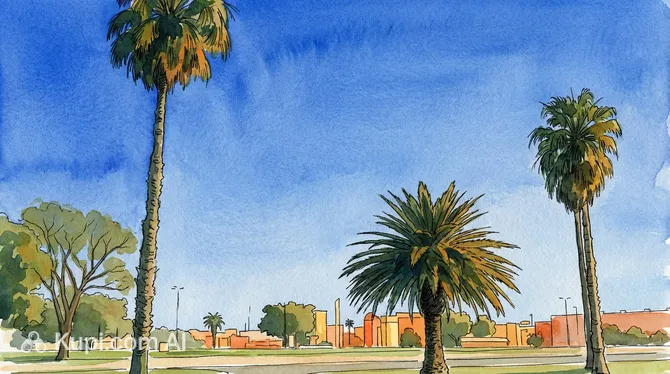
Welkom. Illustration.
Source: Kupi.com AI
The city's uniqueness lies in its layout: the center of Welkom is designed in a horseshoe shape around a 4.5-hectare park area. Due to the abundance of traffic circles that replace traffic lights here, the city is affectionately called "Circle City." While Welkom remains primarily an industrial giant, its parks, wide streets, and proximity to gold mines create a special character that will interest those who want to see South Africa from its industrial and business side.
Weather Overview
The climate of Welkom is characterized as temperate continental, typical for the high-altitude plateaus of the Free State province. The city is at a significant elevation, which makes the air dry and clear. Temperature regimes here are distinct: hot summers give way to cool and very dry winters.
In the summer months (November to February), daytime temperatures often rise to +28...+30°C. This is when the main rainfall occurs, most often in the form of spectacular afternoon thunderstorms that quickly bring cool relief. Winter (June to August) is characterized by sunny days with temperatures around +18°C and cold nights when the thermometer can drop to 0°C or below. Detailed weather in Welkom by month will help you better plan your wardrobe.
The best time to visit is considered spring (September-October) and autumn (April-May), when the mildest and most comfortable temperatures set in. It should be noted that due to the proximity of industrial zones and mines, there may be dust in the air during windy weather; however, the city's thoughtful planning and abundance of parks help minimize this discomfort.
Average monthly temperature
Average monthly precipitation
Interesting Facts
A city without traffic lights: Welkom is often called "Circle City" because of its unique traffic system—there are practically no traffic lights here; they are replaced by numerous traffic circles designed to ensure smooth traffic flow.
A name with deep meaning: The name of the city translates from Afrikaans as "Welcome." it was borrowed from the farm where the first gold mining lease was granted in 1941.
Growth rate: Following the discovery of gold, Welkom grew so rapidly that its pace of development in the mid-20th century was compared to that of Johannesburg.
Sporting heritage: On the outskirts of the city lies the Phakisa Freeway, built to international standards, which has hosted rounds of the Motorcycle Grand Prix.
Meticulous planning: Welkom is considered one of the few cities in the world that was fully designed on paper before construction began, allowing for a convenient infrastructure with an abundance of green zones.
How to Get There
Welkom's accessibility is largely determined by its position in the center of the country. The city is not a major aviation hub, so most travelers prefer to get here by land. Detailed route information can be found in the how to get to Welkom section.
The city's own airport, Welkom (IATA: WEL), has one runway; however, it does not currently serve regular commercial flights. The airfield is mainly used for private aviation, mining company charters, and medical flights. The nearest major airport with scheduled service is in Bloemfontein, from where you can drive to Welkom in about two hours.
Railway connections in the region are quite well-developed, but it is worth noting that mostly freight trains serving the needs of mines and industrial enterprises pass through Welkom station. Passenger trains on the Johannesburg – Cape Town line stop in neighboring towns, so the railway is rarely considered by tourists as a primary way to travel.
Station
Passenger traffic
Distance
Bloemfontein railway station
6
136 km
Maseru Station
1
161 km
Kimberley railway station
3
212 km
Johannesburg Park Station
7
236 km
Marlboro
5
250 km
The car remains the most convenient means of transportation. Welkom is connected to major metropolises by high-quality roads: a trip from Johannesburg takes about 3.5–4 hours via the N1 and N12 highways, and from Bloemfontein, the journey is approximately 140–160 km via the N1. Intercity buses from well-known carriers also run between cities.
Main Attractions
Despite its status as an industrial hub, Welkom offers guests several unique sites that provide a deeper understanding of the region's history. The main attraction for tourists is the Gold Museum, which features a rich exhibition dedicated to precious metal mining methods, the history of local mines, and the flora and fauna of the Free State. It is an excellent place to see how the city grew and developed thanks to the "gold rush."
One of the architectural features is the central administrative and shopping district, planned in a horseshoe shape. Here you can stroll through the extensive central park, which serves as the city's green "lungs." History buffs will be interested in visiting numerous monuments, such as the Aandek Monument, erected at the site of the first gold discovery, and the Voortrekker Memorial.
For those who prefer nature, the Flamingo Pan is located on the outskirts of the city. This natural lake often becomes home to large flocks of flamingos, offering picturesque views that contrast with the industrial landscape of mining headgears. Also worth mentioning is the Phakisa Freeway—once a famous Grand Prix track, which, although used less frequently now, remains an important symbol of the city's sporting heritage.
Local Cuisine
Welkom's gastronomy is a true feast for meat lovers, which is unsurprising for a region where livestock farming is a cornerstone of the economy. Local cuisine relies heavily on Afrikaner traditions. Be sure to try the famous braai (South African barbecue), where boerewors—spicy beef farmer's sausages—take center stage.
Another classic dish worth tasting is potjiekos. This is meat and vegetables slow-cooked in a cast-iron pot over coals. Pap—a thick maize porridge often topped with spicy sauces—is frequently served as a side dish. For a snack, biltong is perfect—dried cured meat with spices, prepared in Welkom according to traditional recipes.
The dining culture here is centered around family restaurants and steakhouses located in shopping areas. Locals value large portions and quality ingredients. It is customary to wash down a hearty lunch with local beer or refreshing ginger beer. If you want something more refined, restaurant wine lists always feature excellent wines from the vineyards of the Free State and the Western Cape.
Travel Tips
Welkom is a hospitable city, but its industrial specifics require tourists to follow certain rules to ensure the trip is as comfortable and safe as possible.
Clothing and Gear: Given the continental climate, bring light clothing made of natural fabrics for summer and warm items for winter evenings when temperatures can drop to zero. Comfortable shoes are mandatory if you plan mine tours or walks in parks.
Transport: For complete freedom of movement, rent a car. Public transport is oriented toward workers, so it may be inconvenient for tourist purposes.
Personal Safety: Be vigilant and avoid walking on the outskirts of the city and in unlit areas after sunset. During the day, the city center (Matjhabeng) is quite safe for walking.
Valuables: Do not leave valuables in plain sight inside your car and do not display expensive equipment in crowded places. This is a standard rule for many cities in the region.
Currency and Payment: The primary currency is the South African Rand (ZAR). Cards are accepted almost everywhere, but it is always useful to have some cash for tips and purchases at small markets.
Health: It is better not to consume tap water untreated—prefer bottled water. Also, don't forget sunscreen, as the sun is very active at high altitudes.
Communication: English is widely spoken and understood by everyone, although the local population also actively uses Afrikaans and Sotho. Knowing a few phrases in Afrikaans (e.g., "Dankie"—thank you) will be met with warmth.
Etiquette: In South Africa, it is customary to greet everyone politely. Be friendly and respect the labor of local residents, as Welkom is primarily a city of workers.
By following these simple tips, you can truly enjoy the unique atmosphere of the "Gold City" and its hospitality.
Entertainment & Nightlife
Entertainment in Welkom is generally quiet and steady, catering primarily to local residents and industrial workers. Most activity is concentrated in commercial centers and large hotels. Here you can find cozy pubs and bars where miners and businesspeople relax after a day's work. The atmosphere in these establishments is usually laid-back, without a strict dress code, and prices remain quite affordable.
For evening leisure, the city has cinemas and bowling alleys located in the shopping districts. Welkom's nightlife does not feature a wide variety of clubs, so travelers often head to nearby Bloemfontein for vibrant parties and major concerts. Nevertheless, local establishments offer a great opportunity to get acquainted with the local social culture and try craft beverages.
Daytime entertainment includes walks in the central park or attending sporting events. In the surrounding areas, some guesthouses organize game drives, allowing tourists to see Africa's wildlife without traveling far from civilization. Welkom is a place for those who appreciate a peaceful holiday and a comfortable urban environment.
Parks & Museums
The city's main cultural treasure is the Gold Museum. This is a must-visit for anyone who wants to understand how a modern metropolis grew from scratch among the plains. The museum's exhibition covers all aspects of the region's "golden life": from geological samples and the tools of the first prospectors to modern mining technologies. Additionally, there is an interesting collection dedicated to local nature and ethnography.
As for green spaces, Welkom fully lives up to its nickname, the "Garden City." Its central park, covering 4.5 hectares, is a unique example of landscape design. It is designed to be accessible from any point in the city center. It is an ideal place for peaceful walks in the shade of trees, where you can escape the city noise amidst well-kept flowerbeds and historical monuments.
For nature lovers, the Flamingo Pan is a real discovery. This natural lake on the outskirts of the city serves as an important migration point for birds. In certain seasons, you can observe hundreds of pink flamingos here, creating an incredibly beautiful contrast with the industrial silhouettes of mines on the horizon. Although there are few museums in the city itself, their quality and the uniqueness of the park areas make Welkom a memorable place.
Getting Around
The transport system of Welkom was designed with an emphasis on the convenience of traveling by private car. The most striking feature of the city is the almost complete absence of traffic lights—they are replaced by numerous traffic circles. Thanks to this, traffic remains calm even during peak hours, and the risk of traffic jams is minimal.
Public transport is mainly represented by private minibuses (minibus taxis). They run along major routes, connecting residential suburbs with the center and industrial zones near the mines. It is worth noting that the schedules for such buses are not always fixed, and during shift changes, the transport can be overcrowded.
For tourists, the most convenient way to get around remains renting a car or using taxi services. Welkom is quite a compact city, and within residential areas, moving on foot or by bicycle is quite comfortable; however, for trips between districts and to attractions on the outskirts, a car will be indispensable. There are many parking spaces in the city, and they are usually free or very inexpensive.
Accommodation
The hotel sector in Welkom is primarily geared toward business travelers and specialists coming to work in the mining industry. You are unlikely to find massive chain hotels here, but the city is famous for its cozy guest houses (B&Bs) and apartments for long-term stays.
The most popular accommodation options are located in quiet suburbs, which provide a high level of security and comfort. Many guest houses offer not only breakfast but also the opportunity to arrange dinner or even a mini-safari in the surrounding area. Accommodation prices in Welkom remain moderate compared to Cape Town or Pretoria, while the service is often characterized by warmth and attention to detail.
For tourists planning a visit, it is recommended to book accommodation in advance, especially if the trip coincides with major business forums or sporting events at the Phakisa track. When choosing a place to stay, look for the availability of parking and proximity to the main shopping malls, which are the centers of social life in the city.
Nearby Cities
Welkom is a convenient starting point for exploring the Free State province, offering travelers access to neighboring towns, each with its own unique character. Trips around the surrounding area allow you to see the diversity of South African life—from quiet farming settlements to bustling administrative centers.
About 140 km to the southwest is Bloemfontein—the country's judicial capital. This "City of Roses" is worth visiting for its magnificent botanical gardens, the National Museum, and extensive shopping opportunities. Just 60 km from Welkom is Kroonstad, a picturesque town on the banks of the Vals River, famous for its fishing and water sports opportunities.
Very close by are small mining towns such as Odendaalsrus and Virginia. They allow you to get even closer to the region's industrial heritage. Trips to these places won't take much time, as they are located within 15–20 km of Welkom.
City
Population
Distance
Odendaalsrus
63 743
13 km
Virginia
66 208
16 km
Allanridge
19 337
28 km
Ventersburg
11 260
39 km
Kroonstad
103 992
60 km
Exploring the outskirts of Welkom is a great way to diversify your journey, discovering new horizons and enjoying the vastness of the South African plains.
Shopping & Souvenirs
Shopping in Welkom is organized as conveniently as possible thanks to the city's well-thought-out layout. The main shopping hub is the central horseshoe-shaped zone, where administrative buildings and large stores are concentrated. Here you will find everything you need: from popular brand clothing to household appliances. In addition, almost every suburb has its own small commercial center within a 10–15 minute walk.
If you are looking for something special as a gift, pay attention to jewelry. Given the city's status as a gold mining center, local jewelry shops offer high-quality pieces made from precious metals. Leather goods and traditional South African treats, such as biltong dried meat, which can be bought at specialized butcher shops here, also make excellent souvenirs.
Markets in Welkom are more local in nature and focused on fresh produce and daily necessities. Shops usually open from 9:00 to 17:00 or 18:00 on weekdays, and close earlier on Saturdays—around 13:00. In large shopping centers, the working hours are more flexible. Bank cards of international systems are widely accepted, but it is better to have some cash in rands for purchases at small markets.