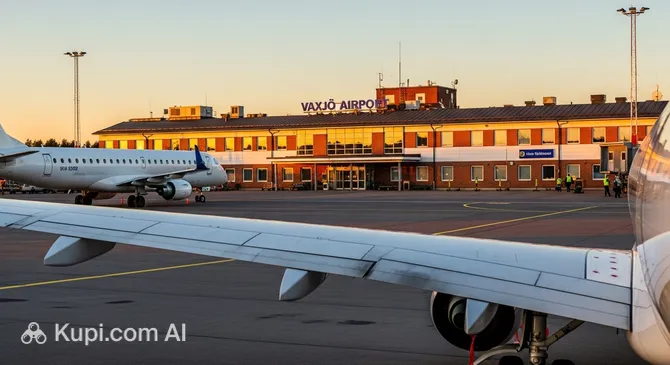
Vaxjo Smaland Airport is not merely a transit hub, but a welcoming gateway into the heart of Sweden's greenest and most forested region. Situated amidst dense forests and mirror-like lakes, it immediately immerses travellers in an atmosphere of Scandinavian tranquillity and renowned Swedish design. This compact haven is ideal for those wishing to begin their exploration of the "Kingdom of Crystal" (Glasriket) or the homeland of Astrid Lindgren without the hustle and bustle of massive capital city hubs.
| Characteristic | Value |
|---|---|
| IATA code | VXO |
| ICAO code | ESMX |
| City | Vaxjo |
| Country | Sweden |
| Time zone | Europe/Stockholm |
| Popular airlines | FLEX FLIGHT APS |
| Schedule | Online timetable |
Airport Features and Advantages
The main pride of Vaxjo Airport is its environmental focus. As the city of Växjö is often referred to as "the greenest city in Europe," the airport strives to match this high status. Technologies utilizing biogas and renewable energy sources are actively implemented here, making it one of the most environmentally friendly regional airports in Scandinavia. For conscious travellers, this is a significant plus, allowing for the minimization of the journey's carbon footprint.
Another undeniable advantage is the unprecedented speed of service. Thanks to the terminal's compactness, the journey from the car park to the boarding gate takes mere minutes. Car parking spaces are located literally a few steps from the entrance doors, eliminating the need for shuttles or carrying luggage for long distances. This is the ideal choice for those who value their time and prefer to arrive at the airport shortly before departure, avoiding unnecessary stress.
Despite its small size, the airport plays the role of an important charter hub for residents of southern Sweden. Many direct flights to popular Mediterranean resorts operate from here. For tourists arriving in Sweden, the airport is convenient due to its strategic location: it is situated in the centre of the Småland province, providing quick access to both nature reserves and cultural attractions, including famous glassblowing workshops and theme parks.