Support

Funafuti

About

Funafuti serves as the bustling capital and the most populated atoll of the beautiful island nation of Tuvalu. Far from the crowded metropolises of the world, this unique destination offers a serene and authentic Polynesian atmosphere. It is not merely a single island but a collection of islets ringing a spectacular, turquoise lagoon known as Te Namo. As the administrative and economic center, it is home to approximately 6,000 residents, representing more than half of the country's total population.
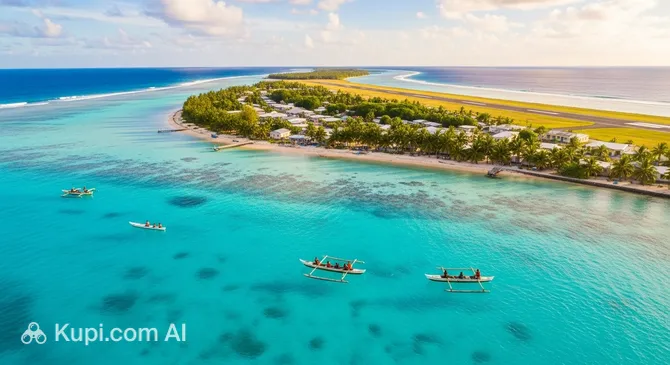
Funafuti. Source: Kupi.Binoculars

Geographically, the atoll is distinctive for its narrow strip of land, which in some places is only about 20 meters wide, allowing visitors to see the ocean on one side and the lagoon on the other. The tropical climate ensures warm weather year-round, perfect for enjoying the pristine waters. While the town feels modern in its function, a glimpse into the history of Funafuti reveals a rich past, including its strategic role during World War II, which has left a lasting mark on the local landscape.

One of the most fascinating features of the city is the Funafuti International Airport runway. Due to limited space, the airstrip is unfenced and transforms into a communal park in the late afternoons when no flights are scheduled; locals gather here to play rugby, volleyball, or simply socialize as the sun sets. Nature lovers will be drawn to the Funafuti Conservation Area, a marine park on the western side of the lagoon that offers some of the best snorkeling and diving opportunities in the Pacific, teeming with colorful fish and sea turtles.

Whether you are looking to explore untouched marine environments or experience a culture where community and simplicity are cherished, Funafuti welcomes you with open arms. It is a place where time seems to slow down, inviting travelers to relax and connect with the natural beauty of the South Pacific.

Weather Overview

Travelers to this Pacific atoll can expect a steady tropical climate characterized by consistent warmth throughout the year. The temperature shows remarkably little variation, generally staying between a comfortable minimum of roughly 26°C and a maximum of 28.7°C. This stability makes the island a warm destination regardless of the season, ensuring that the waters of the lagoon remain inviting at any time.

Rainfall is a very frequent companion in this region, so it is wise to be prepared for showers. The data indicates that rain occurs often, with "wet days" ranging from 23 to 29 days per month; for instance, months like January and August can see precipitation on nearly a daily basis. To help plan your packing list and activities around these patterns, you can consult the detailed guide to the weather in Funafuti. Despite the high frequency of wet days, the warm temperatures ensure that the climate remains tropical and lush.

Interesting Facts

Beyond the azure waters and palm-fringed beaches, Funafuti conceals a collection of intriguing stories that surprise even the most seasoned travelers. From its role in proving evolutionary theories to its unique geographical quirks, the atoll is far more than just a scenic tropical destination.

  • The "David's Drill" Landmark: In the 1890s, Funafuti became the center of a global scientific debate when the Royal Society of London selected it to test Charles Darwin's theory of atoll formation. Scientists drilled a borehole more than 300 meters deep into the coral to find the volcanic base Darwin predicted. The historic site of this experiment, known as "David's Drill," can still be found on the island today, marking a significant spot in geological history.

  • The Paradox of Growing Land: While often highlighted for its vulnerability to rising sea levels, Funafuti has shown remarkable geological resilience. Scientific studies analyzing satellite imagery over the past four decades have revealed that the total land area of the atoll's islets has actually increased by nearly 3%. This surprising expansion is due to natural wave energy shifting sediment and coral debris onto the coast, physically reshaping the islands even as the tides rise.

  • WWII "Borrow Pits": The island's geography bears the permanent scars of World War II. To build the massive airstrip that is now the international airport, US troops excavated large amounts of earth from the main islet, creating deep depressions known as "borrow pits." For decades, these were unusable, water-filled craters, but a recent major engineering project has filled them with sand dredged from the lagoon, finally reclaiming this precious land for the local community.

  • A Capital, Not a City: Visitors often look for the "city center" of Funafuti only to realize it doesn't exist in the traditional sense. Officially, the entire atoll is the capital of Tuvalu, not just a single town. The administrative buildings are located in the village of Vaiaku, but the "capital" is effectively a continuous, relaxed community spread along a narrow strip of land that is often no wider than a single road.

How to Get There

Reaching this remote Pacific paradise is an adventure in itself, with air travel being the primary and most practical option for international visitors. Due to its isolated location, connections are limited, so planning ahead is essential. For a complete overview of routes and travel tips, you can consult our detailed guide on how to get to Funafuti.

The atoll is served by its own aviation hub, the Funafuti International Airport (IATA: FUN), which is located right in the heart of the community. Unlike most capital city airports that require a long commute, this facility is situated centrally in Funafuti, just 0.4 km from the main administrative and residential areas. Because of this unique proximity, the transfer to your accommodation takes only a few minutes by taxi or shuttle; many places are even within comfortable walking distance. The airport handles a small volume of passengers annually, reflecting the exclusive and tranquil nature of the destination.

For clarity, here is a summary of the main airport:

Airport Name City Passenger Traffic Km from City
Funafuti International Airport Funafuti Small 0.4

While flying is the standard method of entry for tourists, it is worth noting that there are no railway services on the atoll. The only other way to reach the islands is by sea, typically via supply ships or private yachts, though these options are far less common and take significantly longer than air travel.

Main Attractions

Exploring Funafuti offers a rare opportunity to witness a way of life deeply connected to the ocean. While the atoll does not boast grand monuments or expansive theme parks, its attractions are rooted in natural beauty, unique history, and vibrant local culture. Visitors here can discover everything from protected marine sanctuaries to world-renowned collectible items.

One of the absolute highlights is the Funafuti Conservation Area. Spanning 33 square kilometers of reef, lagoon, and islets on the western side of the atoll, this marine park is a haven for biodiversity. Tourists can hire a local boat to visit pristine, uninhabited islets such as Fualopa or Tepuka. It is the perfect spot for snorkeling and diving, offering crystal-clear waters teeming with colorful tropical fish, manta rays, and nesting sea turtles, all undisturbed by mass tourism.

For a touch of local culture and artistry, the Tuvalu Women’s Handicraft Centre is a must-visit. Located near the airport, this center showcases the exceptional weaving skills of Tuvaluan women. Visitors can purchase authentic, high-quality souvenirs, including intricate mats, traditional fans, and beautiful shell necklaces. It provides a wonderful chance to interact with local artisans and support the community economy directly.

Stamp collectors and history enthusiasts will find the Tuvalu Philatelic Bureau fascinating. Tuvalu’s postage stamps are famous worldwide for their beauty and rarity, often serving as a significant export for the nation. The bureau offers a glimpse into this unique industry, where you can view rare issues and purchase stamps or first-day covers as distinctive mementos of your journey to one of the world's least-visited countries.

Finally, no trip is complete without spending an evening on the Funafuti Airstrip. While it functions as the international airport, the lack of fencing and low traffic turns it into the island's largest public park after hours. Joining the locals here at sunset is a quintessential Funafuti experience; you can watch rugby matches, join a game of volleyball, or simply stroll along the tarmac while enjoying the cool ocean breeze and the communal atmosphere.

Local Cuisine

The culinary experience in Funafuti is defined by simplicity, freshness, and a deep connection to the ocean and the land. Due to the atoll's isolation and sandy soil, the local diet relies heavily on what can be caught in the lagoon or grown in traditional pits. Visitors should not expect haute cuisine or international fast-food chains; instead, the food scene offers a genuine taste of island life, where organic ingredients and traditional cooking methods take center stage.

Seafood is, unsurprisingly, the staple of every meal. The waters around the atoll teem with tuna, mahi-mahi, and snapper, which are often caught daily and served within hours. A must-try dish is the local version of raw fish, marinated in lime juice and rich coconut cream, often accompanied by onions and chili. Cooked dishes frequently feature fish grilled over open fires or simmered in savory broths. Another delicacy is Palusami, made from young taro leaves wrapped around onions and coconut cream, then baked until soft and creamy.

Vegetable staples are distinct and rooted in Tuvaluan culture. The most important crop is Pulaka (swamp taro), a giant root vegetable grown in compost-filled pits dug down to the freshwater lens. It has a starchy texture and is traditionally roasted or mashed. You might also encounter breadfruit and bananas, which are fried, boiled, or turned into sweet puddings known as fekei, bound together with the ever-present coconut cream.

When it comes to beverages, the coconut tree is the ultimate provider. Fresh coconut water, known locally as pi, is the standard thirst quencher. For something sweeter, locals collect Kaleve (toddy), the sap tapped from the cut flower of the coconut tree. This sweet syrup is drunk fresh or boiled down into a molasses-like sugar. If left to ferment, it becomes Kao (or sour toddy), a potent local alcoholic drink that is often shared during social gatherings.

The dining scene in Funafuti is small and intimate. There are only a handful of restaurants, most of which are attached to guesthouses or the main hotel. These venues typically serve a mix of local favorites and Chinese-influenced dishes, which are popular throughout the Pacific. Friday nights are often a highlight, with some establishments hosting buffet dinners that allow tourists to sample a wider variety of traditional foods in a festive, communal atmosphere.

Travel Tips

Visiting Funafuti is a journey to the heart of Tuvalu, one of the world's most remote and peaceful nations, but its isolation requires a bit of extra planning. To help you settle into the relaxed island rhythm without a hitch, here are some essential practical tips for your stay.

  1. Pack for Humidity and Modesty. The climate is hot and tropical, so bring lightweight, breathable fabrics like cotton or linen to stay cool. While swimwear is fine for picnics on uninhabited islets, the local culture is conservative; you should cover your shoulders and knees when walking through the village or visiting churches. Don't forget reef shoes to protect your feet from sharp coral, and bring a Type I power adapter (the same as used in Australia and New Zealand).

  2. Rent a Motorbike to Get Around. There is no public bus or train system on the atoll. The most popular and convenient way to explore is by renting a scooter or motorbike from a local guesthouse. Taxis are available but do not have meters, so it is best to agree on a fare before starting your journey. The main road runs the length of the islet, making navigation very simple.

  3. Cash is King. The official currency is the Australian Dollar (AUD). Credit cards are rarely accepted outside of the main government hotel and perhaps the travel agency. There are very few ATMs on the island, and they can occasionally run out of cash or be out of service. It is highly recommended to bring sufficient cash with you to cover your entire stay to avoid any complications.

  4. Prepare a Medical Kit. While the Princess Margaret Hospital provides basic medical care, supplies can be limited. Bring a sufficient stock of your own prescription medications, as well as a basic first-aid kit containing antiseptics, painkillers, and insect repellent. Drink only bottled or boiled water, and be cautious of the strong tropical sun—high SPF sunscreen is a must.

  5. Expect a Digital Detox. English is an official language and is widely spoken, so communication is rarely an issue. However, internet connectivity via satellite can be slow and expensive compared to global standards. You can purchase a local SIM card from Tuvalu Telecom for data, but it is best to download offline maps and entertainment beforehand and embrace the chance to disconnect.

  6. Respect the "Faka-Tuvalu" (Tuvaluan Way). Locals are incredibly friendly and warm. A smile and a greeting of "Talofa" (Hello) go a long way. When entering a home or a church, always remove your footwear. Sunday is strictly observed as a day of rest and worship; avoid loud activities, working, or playing sports until the evening to show respect for local customs.

  7. Mind the Runway Siren. The Funafuti International Airport runway is an open public space most of the time, but safety is paramount. If you hear a loud siren or fire truck alarm, it means a plane is approaching. You must clear the runway area immediately. Crossing the tarmac during flight operations is strictly prohibited and dangerous.

  8. Shop Before Sunday. Most shops and businesses close for a "siesta" during the hottest part of the day (usually 1:00 PM to 3:00 PM) and are closed entirely on Sundays. Plan your grocery shopping and errands for the morning or late afternoon on weekdays and Saturdays to ensure you aren't left without supplies.

By keeping these practicalities in mind, you can focus on what really matters: enjoying the stunning lagoon and the genuine hospitality of the people. Funafuti is a place where patience is rewarded, offering a tranquil escape that feels worlds away from the stress of modern life.

Entertainment & Nightlife

Entertainment and nightlife in Funafuti are reflective of the island’s laid-back, community-oriented lifestyle. Visitors should not expect neon-lit strips, high-tech nightclubs, or 24-hour party zones. Instead, the evening scene is intimate, casual, and centered around socializing with friendly locals over a cold drink. The atmosphere is incredibly welcoming, with a "come as you are" dress code that perfectly matches the tropical heat—shorts and flip-flops are the standard attire everywhere.

The hub of activity is primarily located in the village of Vaiaku, where the administrative center and the main hotel are situated. The most popular venue for both travelers and expatriates is the bar at the Vaiaku Lagi Hotel. It offers a relaxed setting where you can enjoy a beer or a cocktail while looking out over the lagoon. On Friday nights, this spot often becomes the social heart of the island, hosting a buffet and sometimes live music or a disco night that draws a mixed crowd of locals and visitors.

For a more authentic glimpse into local life, you might visit smaller establishments like Matagi Gali Bar. These venues are typically unpretentious and lively, often blasting a mix of reggae, island pop, and remixes. Another unique aspect of Funafuti’s nightlife is the traditional "fatele" or community dance nights held in the island's meeting halls (maneapa). While not a club in the western sense, these gatherings involve rhythmic drumming, singing, and dancing that can go late into the night, offering a vibrant cultural experience that is open to respectful observers.

Practicalities for a night out are simple but important. Most bars and venues close relatively early, often around midnight, and strict alcohol sales restrictions may apply on Sundays. Cash is essential, as credit cards are rarely accepted at smaller bars. Getting around is safe and easy; most places in Vaiaku are within walking distance, but you can also hop on a rented motorbike. The streets are generally very safe for walking at night, though you should be mindful of uneven paths and the occasional stray dog. Taxis are available but should be arranged in advance if you plan to be out late.

During the day, entertainment options are almost exclusively nature-based, as the atoll lacks shopping malls, movie theaters, or amusement parks. The "entertainment" is the environment itself: swimming in the turquoise lagoon, picnicking on the uninhabited islets of the conservation area, or watching a game of local cricket (Kilikiti). For a quiet afternoon, you can visit the small community library or simply relax by the water, embracing the slow, peaceful pace that defines life in Tuvalu.

Parks & Museums

In Funafuti, the concept of parks and museums is defined not by grand manicured gardens or glass-walled exhibitions, but by the living environment and the vibrant community spirit. The entire atoll functions as an open-air sanctuary, where the turquoise lagoon replaces paved walkways and local meeting houses serve as custodians of living history and art.

Key Parks and Green Spaces

The most significant natural area is undoubtedly the Funafuti Conservation Area (Kogatapu). Established to protect the fragile marine ecosystem, this zone encompasses nearly 33 square kilometers of ocean, reef, and six uninhabited islets on the western rim of the atoll. It serves as the nation's primary "national park," offering a pristine environment where visitors can observe nesting seabirds, sea turtles, and coconut crabs in their natural habitat. It is an essential destination for anyone wishing to experience the raw, untouched beauty of the Pacific environment.

Uniquely, the city's most popular recreational "park" is the Funafuti International Airport Runway. In a land-scarce nation, this strip of tarmac transforms every evening into a massive communal playground. While it is an active airstrip, the absence of flights after sunset allows it to function as a central green space where families picnic, children play volleyball, and residents jog. It offers a fascinating insight into how the local community adapts to its geography, turning infrastructure into a social hub.

Museums and Galleries

While there is no national museum in the traditional sense, the Tuvalu Women’s Handicraft Centre acts as the premier cultural gallery of the city. Located near the airport, this venue displays the intricate artistry of Tuvaluan women, who are renowned for their weaving skills. Visitors can view and purchase delicate fans, mats, and baskets made from pandanus leaves and cowrie shells. It is more than a shop; it is a living exhibition of a craft passed down through generations, preserving the artistic heritage of the islands.

Another key cultural institution is the Tuvalu Philatelic Bureau. For decades, Tuvalu has produced some of the world's most sought-after postage stamps, and this bureau serves as a repository of that history. Philately enthusiasts and curious tourists alike can view archival collections of rare and colorful stamps that depict local flora, fauna, and historical events. It provides a unique lens through which to view the country's history and its connection to the wider world.

Historical and Architectural Sites

History buffs should visit the site of David's Drill. This modest concrete marker commemorates the scientific expeditions of the late 19th century intended to prove Darwin's theory of coral atoll formation. Although it is a simple site, it represents a pivotal moment in the history of geology. Architecturally, the Teone Church stands out with its modern, airy design adapted for the tropical climate, serving as a central landmark and a testament to the deep religious faith of the community.

Authentic Experiences

For a glimpse into a more traditional way of life, consider a boat trip to Funafala, an islet located at the southern end of the lagoon. Unlike the main settlement, Funafala has no electricity or cars and offers a serene, park-like atmosphere where you can walk among traditional thatched structures and lush vegetation, experiencing the tranquility of old Tuvalu.

Getting Around

Navigating Funafuti is a unique experience that reflects the relaxed and intimate nature of island life. Travelers accustomed to complex networks of subways, trams, or scheduled city buses will find a very different rhythm here. The city does not have a formal public transport system; there are no trains, metros, or large municipal buses running on fixed routes. Instead, getting around is informal, personal, and refreshingly simple, relying mostly on small-scale alternatives that suit the atoll's narrow geography.

The closest equivalent to public transportation is the local taxi service. These are privately owned vehicles, often unmarked standard cars or vans, that operate throughout the main islet of Fongafale. Taxis are generally available during the day and early evening, but they do not use meters. Prices are typically fixed for specific distances or zones—usually a very affordable flat rate for a trip anywhere within the main village area. It is standard practice to confirm the fare with the driver before you step inside to avoid any confusion.

For those who prefer more independence, renting a motorbike or scooter is the most popular choice and arguably the best way to see the city. You will see locals of all ages traveling on two wheels, and joining them allows you to explore at your own pace. Rental services are not found in large commercial agencies but are typically offered by guesthouses, hotels, or small family-run businesses. Bicycles are also available and are a fantastic, eco-friendly option given the flat terrain and short distances.

When it comes to payment, the system is strictly cash-based. There are no travel cards, mobile apps, or ticket machines in Funafuti. You will need to pay your taxi driver or rental provider directly in Australian Dollars (AUD), which is the currency used on the island. It is highly advisable to carry small denominations, as drivers may not always have change for large notes. Since there are no validation machines or turnstiles, the process is as simple as handing over the cash at the end of your ride or at the start of your rental period.

While land transport is limited, water transport plays a crucial role in connecting the capital to the surrounding islets of the conservation area. Water taxis or chartered boats are available for hire at the main wharf. These are essential for visiting the pristine, uninhabited parts of the atoll. Like land taxis, these are privately operated, and fares should be negotiated and agreed upon in advance, often depending on the distance and waiting time.

A few practical tips will ensure a smooth experience. Traffic on the main road is slow and generally safe, but keep an eye out for pedestrians, dogs, and pigs that often share the thoroughfare. If you need a taxi early in the morning or late at night—for instance, to catch a flight—it is best to book one in advance through your accommodation, as hailing one on the street during off-hours can be difficult. Ultimately, the town is compact enough that walking is often the most pleasant option, allowing you to soak in the ocean views on one side and the lagoon on the other as you move between attractions.

Accommodation

Accommodation in Funafuti is limited and reflects the unpretentious, community-focused nature of the island. Travelers will not find sprawling luxury resorts, international hotel chains, or high-rise apartments here. Instead, the options are modest, comfortable, and generally offer a genuine "home away from home" experience. The selection primarily consists of small, family-run guesthouses, often referred to as lodges, and one main government-operated hotel.

The most convenient and popular area to stay is the village of Vaiaku on the main islet of Fongafale. This is the administrative heart of Tuvalu, where the government buildings, the bank, and the airport are located. Staying here places you within walking distance of the main shops, the wharf, and the lagoon. Since the atoll is quite narrow, almost every accommodation option offers views of either the ocean or the lagoon, allowing the sea breeze to act as natural air conditioning.

The most prominent establishment on the island is the Vaiaku Lagi Hotel. As the only government-owned hotel, it serves as the center for official functions and visiting delegations. It is situated right on the edge of the lagoon, offering rooms with spectacular views of the turquoise water. While it is the closest thing to a standard hotel in the country, amenities are basic compared to international standards, but the location is unbeatable for watching sunsets.

For a more intimate experience, travelers often choose one of the many family-run guesthouses or lodges. These establishments typically offer fewer than a dozen rooms, ensuring personalized service and a chance to interact with local families. Facilities usually include air conditioning, private bathrooms, and communal kitchens where guests can prepare simple meals. Staying in a lodge is a fantastic way to gain insight into the local lifestyle and enjoy the warm hospitality for which Tuvaluans are known.

Booking and Practical Tips:

  • Book Well in Advance: Due to the small number of rooms available on the entire atoll, accommodation can fill up quickly, especially when there are government conferences or visiting officials. It is highly recommended to secure your reservation weeks or even months before arrival.
  • Contact Directly: Major online booking platforms often do not list properties in Funafuti, or the availability might not be updated in real-time. The most reliable way to book is to contact the hotel or guesthouse directly via email or phone.
  • Payment Methods: While the main hotel may accept credit cards, most smaller lodges and guesthouses operate on a cash-only basis. Be sure to bring enough Australian Dollars (AUD) to cover your stay, as ATM services can be unreliable.

Pricing generally falls into the mid-range category. Budget backpacker hostels with dorms are virtually non-existent, and ultra-luxury options are not available. However, the cost usually includes a comfortable, clean room and often a simple breakfast, providing good value given the remote location.

Nearby Cities

For those looking to explore the surroundings, Funafuti serves as an excellent base for day trips to several interesting nearby locations:

Funafala Islet is a serene destination located at the southern rim of the lagoon, accessible by a scenic boat ride of about one hour. Unlike the main settlement, Funafala is home to a small, traditional community where modern conveniences are minimal, offering visitors a rare chance to experience the authentic, slower-paced Polynesian village lifestyle amidst lush vegetation and quiet beaches.

Amatuku Islet, situated to the north of the main island, provides a fascinating mix of history and education. It is the site of the Tuvalu Maritime Training Institute, where young sailors are trained, and it houses the country's oldest surviving building—a coral-lime storage shed dating back to the early 20th century. A visit here offers a unique insight into the nation's deep-rooted seafaring heritage.

Shopping & Souvenirs

Shopping in Funafuti is a low-key and authentic experience that reflects the island's remote location and simple lifestyle. You will not find sprawling shopping malls, designer boutiques, or bustling high streets here. Instead, the retail scene is dominated by small, family-run convenience stores, known locally as "fusi," and specialized centers dedicated to local craftsmanship. For visitors, shopping is less about consumerism and more about discovering unique cultural treasures and interacting with the friendly local community.

Main Shopping Areas and Streets

The commercial heart of the atoll is concentrated in the village of Vaiaku on the main islet of Fongafale. There is essentially one main road that runs through the settlement, and this is where you will find the majority of businesses. A stroll along this road will take you past the main general stores, the bank, and the few specialized shops available. Because the island is so narrow, everything is easily accessible, and "going shopping" usually involves a short walk or a quick motorbike ride down this central artery.

Shopping Malls

Travelers should be aware that there are no shopping malls or department stores in Funafuti. The retail concept here is based on functionality and community needs. The largest stores are the cooperative supermarkets (Fusi) which stock imported groceries, canned goods, basic clothing, and household essentials. These stores are fascinating for visitors who want to see what products make their way to this isolated nation, but they are not destinations for leisure shopping.

Markets

While there isn't a large central food market, the Tuvalu Women’s Handicraft Centre functions as the most important marketplace for visitors. Located near the airport, this is the premier spot to see and buy locally made goods. It is a vibrant hub where women from the outer islands sell their artisanal creations. For food, you might occasionally find small roadside stalls selling fresh fish caught that morning or local produce like bananas and coconuts, but these are informal and sporadic rather than organized markets.

Souvenirs

Despite the limited retail options, Funafuti offers some of the most unique souvenirs in the Pacific. The most popular items are traditional handicrafts, particularly the intricate fans, mats, and baskets woven from pandanus leaves. Tuvaluan women are also famous for their "pule" (shell) necklaces, which are meticulously crafted and make for beautiful, authentic gifts. Another must-visit for collectors is the Tuvalu Philatelic Bureau. Tuvalu's postage stamps are world-renowned for their design and rarity, making them a lightweight and culturally significant souvenir to bring home.

Opening Hours and Payment

Business hours in Funafuti are dictated by the island's relaxed rhythm. Most shops open around 7:30 AM or 8:00 AM and close by 6:00 PM or 7:00 PM. A crucial detail for tourists to remember is the daily "siesta" break; many smaller businesses close between 1:00 PM and 3:00 PM to avoid the midday heat. Furthermore, almost all shops are strictly closed on Sundays in observance of the Sabbath. In terms of payment, Cash is King. The currency is the Australian Dollar (AUD). Credit cards are rarely accepted outside of the main hotel and travel agency, so ensure you carry sufficient cash for your purchases.

Tax-Free

There is no tax-free shopping or VAT refund scheme available for tourists in Tuvalu. Prices displayed in stores are final, and bargaining is generally not part of the local shopping culture, except perhaps in very informal settings.

Reached the end of the page?

That means the route is fully explored