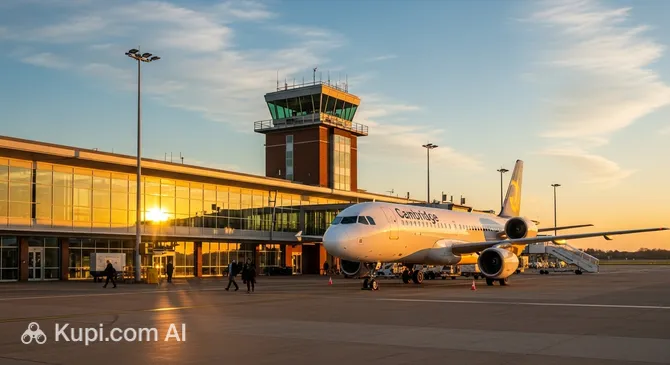
The history of Cambridge Airport is a chronicle of British aviation in miniature, beginning long before the era of mass air travel. It is one of the oldest aviation enterprises in the UK, which still retains a unique feature: for almost a century, it has remained under the management of a single family.
First Flights and Foundation
It all began in 1929, when Arthur Marshall, the son of the founder of the Marshall company, purchased a small plot of land in the Fen Ditton area to build an airfield. Arthur's passion for flying transformed the family business from automotive to aviation. Soon, a flight school was opened here, which quickly gained popularity among Cambridge University students.
However, needs grew, and in 1937, the airport was moved to its current location south of Newmarket Road. The grand opening of the new terminal and hangars took place in 1938, which became an important milestone in the development of city infrastructure.
Role in World War II
With the outbreak of the war, Cambridge Airport became a strategically important facility. It turned into a key base for the Royal Air Force (RAF). The 22nd Elementary Flying Training School was located here. It was at this airfield that over 20,000 pilots and instructors were trained, many of whom subsequently participated in the Battle of Britain.
Besides training, the Marshall company was engaged in the repair and modification of military aircraft. The scale of work was colossal: hangars operated around the clock, returning damaged machines to service, which played an invaluable role in the country's defense.
Era of Innovation and "Concorde"
In the post-war years, the airport reoriented towards engineering developments and civil aviation. One of the brightest pages in the enterprise's history was its participation in the creation of the legendary supersonic airliner "Concorde". Marshall Aerospace engineers, based at the airport, designed and manufactured the aircraft's famous droop nose, which allowed pilots to see the runway during takeoff and landing. This achievement forever inscribed Cambridge in the history of global supersonic aviation.
Modern Stage and Records
For decades, the airport attempted to develop scheduled passenger transport, offering flights to Jersey, France, and the Netherlands. In 2008, a large-scale reconstruction of the terminal was carried out to improve passenger comfort. However, competition with the giant Stansted, located nearby, forced adjustments.
An important test for the airport was the 2012 Olympic Games in London. Cambridge became one of the main hubs for receiving VIP guests and delegations, demonstrating the ability to service a huge number of business jets with jeweler-like precision. It was this experience that determined the future fate of the air harbor: in 2016, a decision was made to cease scheduled passenger flights and focus entirely on business aviation, medical flights, and maintenance.
Interesting Facts
- Cambridge Airport is the headquarters of Marshall Aerospace and Defence Group, which services C-130 Hercules aircraft for dozens of countries around the world.
- In the 1930s, it was here that the founder's son, Arthur Marshall, personally gave piloting lessons, inspiring a new generation of aviators.
- Despite its status as a business airport, it is actively used for transporting horses participating in races in nearby Newmarket, which is considered the world capital of horse racing.