Support

Southampton Airport

About the Airport

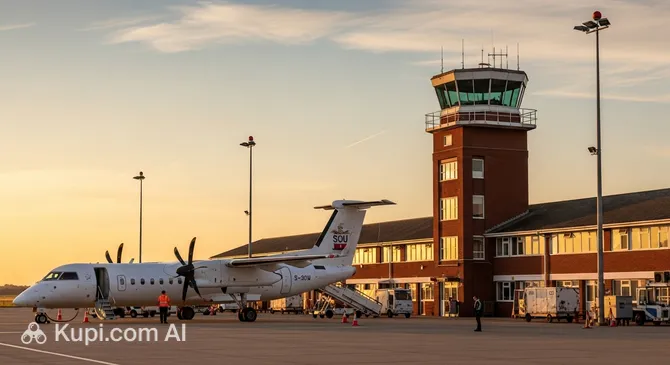
Southampton Airport. Source: Kupi.com Binoculars

Southampton Airport is not merely an air gateway to the south coast of the United Kingdom, but also a location with a rich aviation history. The first flights here took place as early as 1910, and it was from this very airfield that the legendary Supermarine Spitfire fighter made its maiden flight. Today, it is a modern and compact airport valued for its swift service and convenient location, making it an ideal starting point for travels across the country and to Europe.

IATA Code SOU
ICAO Code EGHI
City Southampton
Distance to Centre 6.5 km
Status International
Annual Passengers approx. 852,000 (2024)
Popular Airlines KLM, Loganair, Aurigny Air Services
Schedule Online Flight Board "Southampton Airport"

The main advantage of Southampton Airport is its compactness and convenience. The single terminal with 12 boarding gates allows passengers to complete all pre-flight formalities quickly and without unnecessary hassle. The airport has its own railway station, Southampton Airport (Parkway), located just a few steps from the terminal building, from where you can reach the centre of Southampton in minutes or travel to London. Despite its modest size, the airport offers all necessary services: several cafés, shops, Duty Free, and a comfortable lounge on the first floor.

Contact Information

  • Official Website: www.southamptonairport.com
  • Information Service Phone: +44 344 481 7777 (please note that calls to 0344 numbers may incur specific charges)
  • Address: Wide Lane, Southampton, SO18 2NL, United Kingdom
  • Email: For most enquiries, the airport recommends using the contact forms on the official website. For feedback and suggestions, you can use the address: feedback@southamptonairport.com.
  • Social Media: Follow airport news and updates on the official pages on Facebook, X (formerly Twitter), and Instagram.
  • Lost Luggage Information: If your belongings were lost on board the aircraft or your luggage did not arrive, you should immediately contact a representative of your airline. If you lost something within the airport terminal, please contact the Lost Property service, details of which are listed on the official website.
  • Passenger Support Contacts: For special assistance or answers to general questions, it is recommended to call the main information service phone number or use the "Contact Us" section on the airport website.

How to Get to the Airport

Southampton Airport is conveniently located and offers travellers several ways to reach it from Southampton city centre and other parts of the United Kingdom. The choice of the best option depends on your budget, time, and amount of luggage.

Trainarguably the fastest and most convenient method. The Southampton Airport (Parkway) railway station is just a minute's walk from the terminal building. From here, trains to Southampton Central station take only about 7-10 minutes. There is also a direct connection to London (Waterloo station, journey time just over an hour) and other major cities, making this option ideal for those who value speed and punctuality.

Bus represents a more budget-friendly alternative. Local bus operators, such as Unilink, provide regular connections between the airport, the city centre, the university, and other key locations. A bus journey will take longer than the train (about 35-45 minutes from the centre) but will allow you to save on travel costs.

Taxi, private transfer, or car rental — an excellent choice for those travelling with family, a large amount of luggage, or simply preferring comfort. The drive from Southampton centre to the airport takes approximately 15-20 minutes depending on traffic. Offices of all major rental companies are present at the airport, which is convenient for further exploring the picturesque surroundings, such as the New Forest National Park. For those arriving in their own vehicle, both short-term and long-term parking options are available. It is recommended to book a parking space online in advance to secure a more favourable rate.

If direct flights to Southampton do not suit you, you can consider alternative airports. Major international hubs, such as Heathrow Airport and London Gatwick, are within a one-and-a-half to two-hour drive, and from there it is easy to reach Southampton by train or bus. Closer regional options include Bournemouth Airport and Bristol Airport.

Terminals and Map

Southampton Airport (SOU) is distinguished by its compactness and convenience for passengers. Its key feature is that it consists of a single terminal that serves all domestic and international flights. This structure makes the airport extremely easy to navigate and spares travellers the need to move between different buildings.

The terminal layout is logical and intuitive. The building has two main levels:

  • Ground Floor: Here you will find airline check-in counters and the arrivals area. After landing, passengers pass through passport control (if necessary), collect luggage, and exit into the main hall, where car rental desks, taxi stands, and meeting points are located.
  • First Floor: Dedicated entirely to the departures zone. After checking in on the ground floor, passengers proceed upstairs to pass through security control. Immediately beyond it lies a spacious departure lounge with shops, cafés, and boarding gates.

Since there is only one terminal, transitions between zones are made on foot and take minimal time. All boarding gates are located in one area after security, so you will not have to walk far to your aircraft. The departures zone offers all necessary amenities, including free Wi-Fi, charging points for devices, several dining establishments, and Duty-Free shops.

Thanks to the airport's small size, passing through check-in and security control usually takes significantly less time than in large international hubs. Nevertheless, it is recommended to arrive at the airport approximately 1.5-2 hours before departure, especially during peak seasons, to complete all formalities without haste. Navigation through the terminal is straightforward — clear signage is installed everywhere, and staff are always ready to assist. The main advice: simply follow the signs, and you will easily find everything you need.

Airport History

The history of Southampton Airport (SOU) is not just a story of a transport hub, but a true chronicle of aviation achievements. Its history began back in 1910, when local aviation pioneer Edwin Rowland Moon first used the meadows where the airport is now located for his flights. By 1917, the Supermarine Aviation Works factory was already situated here, laying the foundation for the future legendary status of this place.

A key moment in the airport's history was the year 1936. It was on March 5th that the prototype of the legendary Supermarine Spitfire fighter made its first test flight from this airfield. This event forever inscribed the airport into the annals of world aviation. During the Second World War, the airfield played a crucial role in the production and testing of these aircraft, which made a huge contribution to history.

After the war, the airport gradually began to transition to civilian operations. In the 1960s, the first asphalt runway was built, allowing for the accommodation of more modern aircraft. However, the real transformation into a full-fledged commercial airport occurred later. In 1990, the airport was acquired by BAA, which marked the beginning of an era of large-scale modernisation.

A significant milestone was the opening of a new modern terminal in 1994, which continues to serve passengers today. In subsequent years, the airport continued to develop, expanding its route network and becoming one of the most important regional airports in the southern United Kingdom. Recent projects to modernise and extend the runway have strengthened its position as a convenient and efficient hub for flights across the country and to Europe.

An interesting fact: despite its modern appearance, Southampton Airport takes pride in its heritage. References to its illustrious past can be found on its premises, including a monument to the Spitfire. Thus, every passenger departing from or arriving here becomes part of a rich history that began with a simple field and led to the birth of one of the most famous machines in aviation history.

Services and Facilities

Southampton Airport (SOU) is a modern and compact hub offering passengers all the necessary services for a comfortable journey. Conditions here are created both for relaxing before a flight and for attending to work matters.

In the departures zone, you will find several options for dining and shopping. At your service are cosy cafés where you can have coffee and a sandwich, as well as bars offering beverages and light snacks. The World Duty Free shop presents a standard range of perfumes, beverages, and confectionery, while at WHSmith you can purchase the latest press, books, and travel essentials.

Free Wi-Fi is available throughout the terminal, and special stations are provided for charging gadgets. Passengers wishing to relax in a quieter environment can use the services of the business lounge, The Spitfire Lounge. Guests of the lounge are offered complimentary drinks, snacks, fresh newspapers, and comfortable seating while waiting for their flight.

ATMs are installed in the airport for financial transactions. Currency exchange points allow you to buy or sell major world currencies, however, to obtain the most favourable rate, it is recommended to order the necessary amount online in advance. In case of feeling unwell, passengers can seek first aid from the airport staff.

The airport is well-equipped for travellers with children: there are mother and child rooms with changing tables. Passengers with reduced mobility are provided with comprehensive support — from assistance with luggage and movement through the terminal to boarding the aircraft. To use this service, you must notify your airline in advance.

Although there are no large conference halls within the airport building itself, business travellers can find everything they need in nearby hotels. A hotel is located in the immediate vicinity of the terminal, which is very convenient for transit passengers or those with an early departure. Several other accommodation options are located a few minutes' drive away.

Where to Eat

Southampton Airport offers passengers several convenient options for a snack or a full meal, concentrated in the main terminal. Although the selection here is not as extensive as in major hubs, you certainly won't go hungry.

In the public zone, before passing security control, you will find the popular coffee shop Costa Coffee. This is an ideal place to have coffee with fresh pastries, a sandwich, or dessert while seeing off or meeting loved ones. The coffee shop's opening hours cover most flights, and the atmosphere allows for a comfortable time before check-in.

After passing control, in the departures zone, the main place for dining is the bar-restaurant The Olive Tree. It offers a full menu with hot dishes, including British cuisine classics — for example, a traditional English breakfast or fish and chips. Here you can have a leisurely lunch or dinner while waiting for your flight, ordering beverages. This is the best choice for those who have enough time before departure.

Regarding dietary preferences, The Olive Tree menu usually features vegetarian and gluten-free options, marked with special icons. To check for the availability of Halal or vegan dishes, it is best to ask the staff directly. In general, the price range at the airport corresponds to average figures for British air harbours — be prepared to pay slightly more than in the city.

Tips for Travellers

To ensure your journey through Southampton Airport goes smoothly, make use of these helpful tips. It is a modern and relatively small airport, making it convenient for passengers, but preparation is always important.

Arrival Time and Check-in: It is recommended to arrive at the airport at least 1.5-2 hours before the departure of domestic and European flights. This will give you enough time to check in luggage, pass through security control, and wait for boarding calmly. To save time, complete check-in online and download the boarding pass to your smartphone. Self-service bag drop kiosks will also help speed up the process.

Hand Luggage and Security Control: Before passing through screening, ensure that all liquids in your hand luggage are packed in containers of no more than 100 ml and placed in a single transparent bag. Laptops and other large electronics will need to be removed from your bag. It is strictly prohibited to carry sharp objects, weapons, and flammable substances in hand luggage. Be sure to check your airline's rules regarding the weight and size of hand luggage.

Seat Selection and Savings: When choosing a seat on the plane, be guided by your preferences: by the window — for lovers of views, by the aisle — for those who value freedom of movement. Seats in the front of the cabin usually allow for a quicker exit after landing. To save money, book parking and transfers online in advance. You can also take an empty water bottle with you and fill it at drinking fountains after the security zone.

Connecting Passengers and Customs: The United Kingdom has its own customs regulations. Upon arrival from another country, you will have to pass border and customs control. If you have no goods to declare, use the "Green Channel". Thanks to the airport's compact size, transfers here are quite quick and comfortable — simply follow the signs to your next boarding gate.

In Case of Flight Delay: If your flight is delayed, do not panic. First, check the information on the departure boards and in the airline's app. Contact your carrier's desk for information on the flight status and your rights (for example, regarding refreshments or meals). While waiting for departure, you can relax in a café, browse the shops, or use the Wi-Fi.

Reached the end of the page?

That means the route is fully explored