Support

Alliance Airport

About the Airport

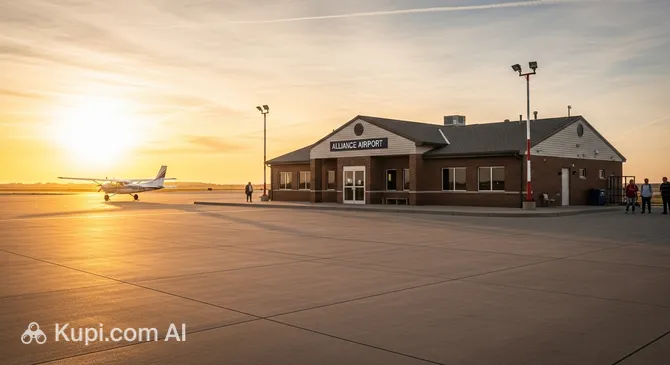
Alliance Airport. Source: Kupi.com Binoculars

Alliance Airport (AIA), located in the heart of the state of Nebraska, is more than just a runway. Founded during World War II as a training base for the US Air Force, today it is a vital air link connecting the local community with major aviation hubs. This compact and convenient airport serves as a gateway to Western Nebraska, offering passengers a simple and quick start or finish to their journey across the USA.

IATA Code AIA
ICAO Code KAIA
City Alliance
Distance to City Centre approx. 5 km
Status Domestic
Annual Passengers approx. 4,156 (enplanements in 2022)
Popular Airlines Denver Air Connection
Schedule "Alliance Airport" online flight board

Despite its modest size, Alliance Airport boasts a rich history and plays an important role in the modern transport network. A key advantage is its participation in the Essential Air Service programme, which ensures regular and subsidised flights to a major international hub — Denver, operated by Denver Air Connection. In addition to serving passenger flights, the airport plays a significant role in general aviation, supporting private flights as well as training and agricultural aviation operations. For the convenience of passengers, ground transfer to the city is organised and can be booked in advance.

Contact Information

To ensure your journey goes as smoothly as possible, it is important to have all necessary airport contacts at hand. Below you will find current contact information for Alliance Airport (AIA).

  • Official Website: All official information, including flight schedules and services, can be found on the website cityofalliance.net/157/Airport.
  • Information Desk Phone: For general enquiries, you may contact the number: +1 (308) 762-4749.
  • Airport Address: 7221 State Highway 2, Alliance, NE 69301, USA.
  • Email: For written enquiries, you can use the address: airportmgr@cityofalliance.net.
  • Social Media: At this moment, the airport does not maintain active social media pages. We recommend following updates on the official website.
  • Lost Luggage Information: If your luggage was lost or damaged during the flight, you should immediately contact your airline's representative. For items left in the terminal building, please contact the airport administration via the main phone number.
  • Passenger Support: For assistance with any questions related to your stay at the airport, please use the main information desk phone number.

How to Get to the Airport

Getting to Alliance Airport (AIA), serving the city of Alliance in the state of Nebraska, USA, is quite simple due to its close proximity to the city centre. A trip by car usually takes no more than 10–15 minutes. Since this is a small regional airport, transport options differ from those available in major metropolises.

Taxi and pre-booked transfers are the most convenient and predictable way to reach the terminal. Several local taxi services operate in the city. It is recommended to book a car in advance, especially if you have an early departure or late arrival. This guarantees transport availability and a fixed trip cost. Although this is a more expensive option compared to a private car, it eliminates worries about parking.

Car rental or private transport is the most popular and flexible option. Renting a car gives you freedom of movement not only around the city but throughout the region. Alliance Airport provides parking for both short-term and long-term stays, which is convenient for those arriving in their own vehicle. Car rental counters can be found in the terminal, but to guarantee the availability of a suitable vehicle, it is better to book it online in advance.

As for public transport, in a city the size of Alliance, there are generally no specialised bus or rail routes to the airport. Travellers should not rely on this method as a primary option. It is best to check information with local transport companies in advance, but taxis or cars remain the most reliable options.

In general, for a trip to Alliance Airport, the optimal choice would be a taxi or personal/rented car. If you require more flight options, it is worth considering larger air hubs in the region, for example, Rapid City Regional Airport or Cheyenne, which are most conveniently reached by rental car.

Terminals and Map

Alliance Airport (AIA) is a small and convenient airport with a structure that is as simple as possible for passengers. There are no confusing multi-level complexes here: the airport consists of one compact passenger terminal that handles all flights — both departures and arrivals.

The terminal layout is intuitive. All key zones are located on one level and within walking distance of each other. Immediately upon entry, you will see the check-in counters, followed by the security checkpoint. Since the airport has only one terminal, there is absolutely no need for transfers between buildings or the use of shuttles. Departure and arrival zones are located in the same building, making the arrival and departure process maximally fast and comfortable.

The main feature of the terminal is its intimacy and the absence of the hustle and bustle typical of large airports in the USA. There are no large Duty Free shops or a variety of restaurants here, but there is a cosy waiting hall and basic amenities for passengers. Thanks to the low passenger flow, check-in and security procedures are completed very quickly. Typically, all formalities take no more than 20-30 minutes, however, it is recommended to arrive at the airport 60-90 minutes before departure to complete all stages without rushing.

Navigation at Alliance Airport will not cause any difficulties even for an inexperienced traveller. All zones are clearly marked, and staff are always ready to help. It is practically impossible to get lost here, making this airport an excellent example of a calm and efficient transport hub.

Airport History

The history of Alliance Airport is closely intertwined with important events in the history of the USA. It was founded not as a civilian facility, but as a military airfield. Alliance Army Airfield was opened in 1942 at the height of World War II. Its main task was training pilots and crews for heavy transport aircraft, such as the C-47 Skytrain and C-53 Skytrooper. The base became one of the country's largest training centres for airborne troops, playing a key role in preparing units for deployment in Europe.

After the war ended, the need for such a large military facility diminished. In 1945, the airfield was declared surplus and soon transferred to the ownership of the city of Alliance. This event became a turning point in the airport's history. The city gained first-class infrastructure, including long runways and spacious hangars, which would have been too expensive to build from scratch. From that moment, the former military base began its new life as Alliance Municipal Airport (AIA).

Since then, the airport has served the needs of civil aviation, including private jets, business aviation, and periodic commercial flights. Although large-scale reconstructions comparable to its military construction have not been carried out, the infrastructure is constantly maintained and modernised to meet modern standards. An interesting fact: the legacy of World War II is still visible in the airport's layout. Its vast territory and some surviving structures serve as a living reminder of its heroic past and unique history, which distinguishes it from many other regional airports.

Services and Amenities

Alliance Airport (AIA) is a compact regional airport that provides passengers with a basic set of services for a comfortable wait before departure. Since the terminal is small, all amenities are within walking distance, making navigation simple and quick.

A small waiting area is arranged for passengers. Instead of full-service restaurants and cafes, you are more likely to find vending machines with drinks and snacks for a quick bite. There is no selection of shops, so you should take care of purchases and souvenirs in advance. There are no VIP lounges or specialised business centres at the airport; the environment here is simple and functional.

To stay connected, travellers can use the free Wi-Fi available within the terminal. Power outlets are provided in the waiting hall for charging gadgets. Banking services and currency exchange points are not represented at the airport, so it is recommended to settle all financial matters before arriving at the airport.

The airport is adapted to serve passengers with reduced mobility: ramps and specially equipped restrooms are available. Travellers requiring additional assistance are advised to contact their airline in advance. Baby changing facilities may be available for passengers with small children. In case of necessity, basic first aid can be obtained at the airport. If you need to stay overnight, several hotels are located in the immediate vicinity of the airport.

Dining

When planning a departure from Alliance Airport (AIA), it is important to consider its status as a small regional air hub, which directly affects the availability of dining services. Options here are quite limited and designed primarily for a quick snack before the flight.

Within the sole airport terminal, you will most likely find a small snack bar or café, as well as vending machines. The main assortment usually includes pre-packaged sandwiches, crisps, pastries, chocolate bars, as well as hot and cold drinks such as coffee, tea, and soda. These facilities are located in the public area (before security control) and are accessible to both departing and arriving passengers.

There are no specialised restaurants with a full menu or bars at the airport. If you are looking for local cuisine, it is best to experience it at one of the establishments in the city of Alliance before arriving at the airport. Options for passengers with strict dietary preferences (vegan, gluten-free, Halal meals) are practically non-existent. It is recommended to arrange for food in advance if you have specific needs.

In general, Alliance Airport offers basic opportunities for a quick bite. For a full lunch or dinner, we strongly advise eating in the city before travelling to the airport to avoid inconvenience. The operating hours of the local café are usually synchronised with the flight schedule but may be limited.

Travel Tips

Travelling through a regional airport, such as Alliance Airport, has its own specific features. To ensure your trip from the city of Alliance goes as smoothly as possible, use these practical tips to help save time, money, and stress.

Arrival, Check-in, and Security: For domestic flights within the USA, it is recommended to arrive at the airport 1.5-2 hours before departure. Although there are generally fewer queues at small airports, it is better to have time in reserve. To speed up the process, complete online check-in on your airline's website and save the boarding pass on your phone. Security checkpoints operate according to standard TSA rules: be prepared to remove laptops and large electronic devices from your hand luggage, as well as remove outer clothing and shoes.

Seat Selection and Hand Luggage: When choosing a seat on the plane, consider your priorities: a window seat offers beautiful views during takeoff and landing, whilst an aisle seat provides more legroom and the freedom to stand up easily. Regarding hand luggage, remember the 3-1-1 rule for liquids: all containers must not exceed 100 ml (3.4 oz) and must be packed in a single transparent bag with a volume of no more than 1 litre. It is prohibited to carry sharp objects, flammable substances, and weapons in the cabin.

Connections and Customs Control: If you have a connecting flight, study the map of the airport where the connection will take place in advance, and ensure you have enough time between flights (usually at least 60-90 minutes for domestic transfers). Since Alliance Airport serves primarily domestic flights, passengers are not required to pass through customs and passport control, which is mandatory only when crossing international borders.

Savings and Unforeseen Situations: To save money, book tickets in advance and check your airline's baggage allowance to avoid extra charges at the airport. Bring an empty reusable water bottle, which can be filled after passing security, and light snacks. In case of a flight delay or cancellation, contact your airline representative immediately. Find out the reason for the delay and clarify if you are entitled to compensation, such as vouchers for meals or hotel accommodation during a long wait.

Reached the end of the page?

That means the route is fully explored