Support

Cape Romanzof

About the Airport

Cape Romanzof Airport is not merely a runway; it is a true aerial gateway to one of the most remote and wild corners of Alaska. Located on the coast of the Bering Sea, it primarily serves to support the operations of the long-range radar station of the same name, acting as a vital artery for personnel and cargo. For the rare travellers who find themselves here, it is the starting point into the world of the harsh yet captivating nature of the USA, where civilisation gives way to winds, tundra, and boundless maritime expanses.
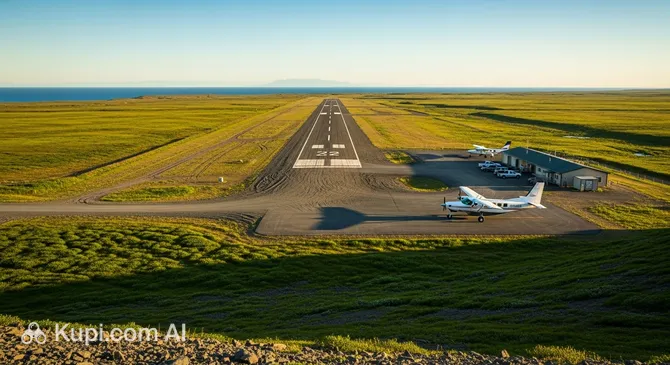
Cape Romanzof. Illustration.
Source: Kupi.com AI
PropertyValue
IATA CodeCZF
ICAO CodePACZ
CityCape Romanzof
CountryUnited States
TimezoneAmerica/Nome
ScheduleOnline Timetable

The main feature of Cape Romanzof Airport is its unique purpose and location. This is not an airport where you will find Duty-Free shops or business lounges. Its strengths lie elsewhere. Above all, it is a strategically important facility, a key infrastructure element for the radar station, ensuring its uninterrupted operation in harsh Arctic conditions. However, for travellers, its value lies in something different.

The airport provides exclusive access to nature. For enthusiasts of extreme tourism and explorers, a flight to Cape Romanzof is a rare chance to witness the pristine landscapes of western Alaska and the Bering Sea coast. Furthermore, simplicity and functionality are valued here: everything is dedicated to the goal of transporting passengers and cargo quickly and safely, without queues or long waits. The flight here on a small aircraft is itself an unforgettable adventure with breathtaking views of the wildlife from above.

Contact Information

Cape Romanzof Airport (CZF) is a small joint-use airport, primarily serving the needs of the nearby radar station. Due to its specific nature and small size, most contact details and services familiar to large airports are provided directly by the airlines operating the flights.

  • Official Website: The airport does not have a separate official website for passengers. Information regarding flights is best verified on the air carriers' websites.
  • Information Desk Phone: There is no direct telephone line for passenger enquiries. For all questions related to schedules, tickets, and flight status, please contact the airline whose services you are using.
  • Airport Address: The airport is located in the area of Cape Romanzof, Alaska, USA. There is no precise postal address for navigation systems, as it is situated within a US Air Force facility.
  • Email: There is no public email address for passenger communication.
  • Social Media: The airport does not maintain official pages on social media platforms.
  • Lost Luggage Information: If your luggage has been lost or damaged, you should immediately contact your airline's baggage tracing service. Airport staff do not handle these matters.
  • Passenger Support Contacts: All necessary support for passengers (including assistance for citizens with reduced mobility) is provided by airline representatives.

How to Get to the Airport

Cape Romanzof Airport (CZF) serves the remote settlement of the same name, Cape Romanzof, on the western coast of Alaska in the USA. Due to its isolated location and specific nature, transport accessibility to the airport differs radically from standard urban aviation hubs. Planning a trip here requires special attention to logistics.

Public transport in the traditional sense—buses, trains, or metro—is absent in the Cape Romanzof area. The settlement is very small, and the distance from it to the airport can easily be covered on foot. The travel time from the central part of the settlement takes just a few minutes.

Taxi and transfer services are not standardised here. You will not find official taxi ranks or familiar ride-hailing apps. Transport services are usually provided by local residents by prior arrangement. Depending on the season, this may involve All-Terrain Vehicles (ATVs) or snowmobiles. It is extremely important to agree on the meeting and the cost of the trip in advance, well before your arrival at the airport.

Car rental in Cape Romanzof is impossible—there are no rental company representatives here. Private transport in this area is a rarity, and movement between settlements is carried out predominantly by air. Consequently, there is also no formal parking for private cars provided at the airport.

Recommendations for Travellers:

The key to a successful trip to Cape Romanzof is thorough planning. Be sure to coordinate all details of your movement with the hosting party (for example, with company representatives or local contacts) long before departure. Air travel is the main method of reaching neighbouring settlements, such as Scammon Bay or Hooper Bay, so flights between them should also be booked well in advance.

Terminals and Map

Cape Romanzof Airport (CZF) is a small airfield primarily serving the long-range early warning radar station in Alaska. It is important to understand that this is not a large commercial airport with the infrastructure tourists are accustomed to. Its structure is extremely simple and functional.

The airport operates with just one small terminal, which is a compact building integrating all zones. There is no division into multiple terminals, floors, or complex passageways. The waiting area, check-in zone, and baggage claim area are effectively located in one common space. The airport layout is intuitively clear, as all necessary facilities are located within sight, making it practically impossible to get lost.

Departure and arrival zones do not have a strict separation as seen in large airports. Passengers waiting for their flight and those who have just arrived may share the same room. Given the low passenger flow, which consists mainly of station personnel and contractors, this organisation does not cause inconvenience. There are no transfers between terminals due to the existence of only one building.

Check-in and security screening procedures are very quick. Usually, this takes no more than 15–20 minutes. Checking in for a flight resembles registering for a private charter, and security screening is conducted promptly without queues. The main advice for navigation is simple: all operations—from entering the building to boarding the aircraft—take place in one location, so you will not need complex maps or signs.

Airport History

The history of Cape Romanzof Airport (CZF), located in a remote corner of Alaska near the town of Cape Romanzof, is inextricably linked with military aviation and the Cold War era. The airport was founded in the early 1950s not as a civilian facility, but as an airstrip to service the Cape Romanzof Air Force Station of the USA. This station was part of a massive early warning and air defence system for North America, and the airfield played a key role in its supply.

For decades, the airport's main task was ensuring logistics for the military base. In the harsh conditions of the Arctic coast, where ground communication is difficult or non-existent, the airfield was and remains a vital artery. It facilitated the delivery of personnel, food, fuel, and complex equipment. Although the airport still belongs to the United States Air Force, over time it was opened for public use as well. Today, it serves not only the needs of the military but also the residents of nearby settlements, for whom aviation is the primary means of connection with the outside world.

Serious civilian reconstructions aimed at turning it into a major passenger hub have not been carried out, as this does not align with its primary function. Nevertheless, to maintain operational capability in extreme weather conditions, the airfield is regularly serviced. One of the airport's main achievements can be considered its long-standing and practically uninterrupted operation in one of the most climatically challenging regions on the planet. An interesting fact: the cape, and subsequently the airport, was named in honour of Count Nikolai Rumyantsev (spelled Romanzoff in historical transcriptions), a Russian statesman and patron who financed round-the-world expeditions in the early 19th century.

Services and Facilities

Cape Romanzof Airport (CZF) is a small airfield serving a remote long-range radar detection station in Alaska. Due to its specific purpose and location, it does not offer the standard range of services typical of commercial airports. Passengers departing from or arriving at this point should be prepared for a minimal level of amenities.

There are no restaurants, cafes, or shops on the airport premises. There are also no banks, ATMs, or currency exchange points. Travellers are advised to carry everything they need, including food, beverages, and cash, in advance.

The waiting area is very simple and represents a basic shelter for protection from the weather. Do not count on the availability of public Wi-Fi or a large number of charging stations for electronic devices. It is strongly recommended to bring a fully charged portable charger (power bank) with you.

Specialised services for passengers with children, such as play areas or mother-and-child rooms, are not provided. Passengers with limited physical mobility must coordinate all details of their trip with the air carrier or responsible organisation in advance to ensure necessary assistance during boarding and disembarking, as special infrastructure is absent at the airport.

A medical point, business centres, conference rooms, and hotels on the airport territory or in its immediate vicinity are also unavailable. When planning a journey through Cape Romanzof, it is important to remember its functional character and be as self-sufficient as possible.

Where to Eat

When planning a trip through Cape Romanzof Airport (CZF), it is important to consider its specific nature. This is a small airfield located in a remote region of Alaska, serving primarily the needs of a radar station. Its infrastructure is minimal and differs radically from what can be found in large commercial airports.

On the premises of Cape Romanzof Airport, there are absolutely no restaurants, cafes, or vending machines for passengers. There is no division into terminals, departure zones, or food courts. The entire infrastructure is strictly utilitarian and does not imply the presence of dining outlets.

In this regard, all travellers whose route passes through this airfield are strongly advised to arrange for food and drinks in advance. Ensure you have a sufficient supply of water and snacks for the waiting time, as it will be impossible to purchase anything on-site.

Travel Tips

Travelling through Cape Romanzof Airport in the town of Cape Romanzof is an experience requiring special preparation. It is a small airfield serving a remote region, so standard tips for major airports do not apply here. The key to a comfortable trip is foresight and self-sufficiency.

The main advice for those departing from Cape Romanzof: be autonomous. There are no shops, cafes, or food and beverage machines in the airport building. Be sure to take a sufficient supply of water and snacks with you. Equally important is a fully charged power bank, as there may be no sockets for charging devices, and waiting for a flight can be prolonged.

The main cause of flight delays in this part of Alaska is unpredictable weather. Fog, strong winds, or blizzards can cause sudden changes to the schedule. Be mentally prepared to wait. Bring a book, or download films or music to your device so that time passes unnoticed. Always check the status of your flight with an airline representative.

Procedures at the airport are simplified to the maximum. Arriving several hours before departure is not required; typically, arriving 60-90 minutes prior is sufficient. Check-in and screening are quick. Online check-in may be unavailable, so simply keep your identification (ID) ready, which is necessary for domestic flights within the USA.

Pack all essentials in your hand luggage: documents, wallet, necessary medications, and warm clothing. Although screening is not as strict as in international hubs, the rules for carrying liquids (up to 100 ml) and prohibited items (sharp and flammable objects) remain in force. There is no customs control for domestic flights.

Reached the end of the page?

That means the route is fully explored