Support

Reed Arena

About

Imagine a place where the energy of thousands of voices merges into a single roar, and sporting excitement literally vibrates in the air. Reed Arena is not just a sports facility, but the heart of the social and cultural life of College Station in the USA. Located on the grounds of the famous Texas A&M University, this multi-purpose arena serves as the home for the university's basketball and volleyball teams, as well as a venue for the region's largest events.
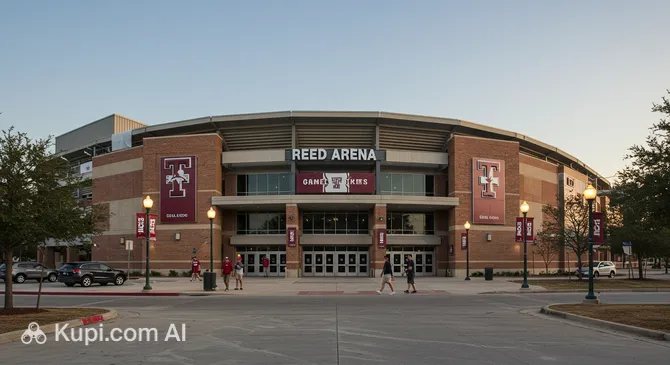
Reed Arena. Source: Kupi.com AI

Opened in 1998, the building impresses with its capacity: it is ready to host nearly 13,000 spectators in permanent seating, with space for another 2,000 people on the floor during concerts. Reed Arena is known for its stunning acoustics and modern infrastructure, including the specialized Cox-McFerrin Center with practice facilities. It hosts not only heated sports battles but also commencement ceremonies, concerts by world stars, and traditional student gatherings like Aggie Muster.

One of the arena's main features is its unique atmosphere. Thanks to the Reed Rowdies student fan group, the venue is considered one of the toughest for visiting teams in the entire country. For a tourist, Reed Arena is an opportunity to see authentic American college sports in all its glory and scale, while feeling like part of the vast "Aggie" community.

Contacts

For event schedules or ticket purchases, you can use the following contact information:

Address 730 Olsen Blvd, College Station, TX 77843, USA
Phone +1 888-992-4443
Official Website 12thman.com
Google Maps Open map

What to Do

The main reason to visit Reed Arena is undoubtedly for the basketball games. Fans come here to support the Texas A&M University men's and women's teams. Be sure to look out for the Reed Rowdies — their organized support and chants turn every game into a real show. Equally exciting are the volleyball matches, which draw full crowds of dynamic sports enthusiasts.

Beyond sports, the arena offers a rich cultural program. It regularly hosts concerts by popular artists, family entertainment shows, and large-scale trade exhibitions. If your visit coincides with university holidays, you might witness unique traditions such as Aggie Muster — a deeply emotional event that unites generations of alumni.

For those interested in the design of modern sports facilities, a visit to the arena allows you to appreciate the scale of the Cox-McFerrin Center and the functionality of the multi-purpose halls. Even if you aren't a sports fan, the sheer scale of the structure and the thoughtful logistics, including commercial kitchens and spacious lounge areas, make the engineering behind this complex truly fascinating.

Getting There

Finding Reed Arena is quite easy, as it is one of the architectural landmarks of the Texas A&M University campus. The exact address is 730 Olsen Blvd, College Station, TX 77843. If you are arriving by car, it is most convenient to use the exits onto Olsen Boulevard or Kimbrough Boulevard. There are visitor parking zones on campus, but it is recommended to arrive early on major game days.

For those arriving from other cities in the USA, the nearest air hub is the local Easterwood Airport. From there, as well as from downtown College Station, the easiest way to get there is by taxi or rental car — the trip will take about 10–15 minutes. If you are already within the university campus, use the Aggie Transit bus system, which runs regularly between the main academic buildings and sports facilities.

History & Facts

The history of Reed Arena began in 1998 when it officially opened its doors, replacing the old G. Rollie White Coliseum as the main sports center. The complex owes its name to Dr. Chester J. Reed and his wife — the 1947 graduate made generous donations that made the construction of this massive $36 million facility possible.

Over the years, the arena has gained a reputation as one of the "loudest" venues in college sports. Its reputation as a "hostile" environment for opponents was cemented by the Reed Rowdies, a group of dedicated student fans. The energy here is so intense that it is often compared to the atmosphere at the legendary Kyle Field football stadium. A historical attendance record was set on February 15, 2010, during a game against Kansas, when 13,989 spectators filled the stands.

A major milestone in the development of the complex was the opening of the Cox-McFerrin Center in 2007. This expansion, covering over 69,000 square feet, cost the university $21.5 million. The new center provided the basketball teams with state-of-the-art practice gyms, comfortable locker rooms, and player lounges, transforming the arena into a world-class training base that meets the highest standards.

Time Needed

When planning a visit to Reed Arena, consider the type of event you are attending. If your goal is to attend a basketball game or a volleyball match, you should set aside about 2–3 hours. This is enough time to enjoy the sporting spectacle, soak up the atmosphere during halftime, and visit the souvenir shops.

For exhibitions, trade shows, or graduation ceremonies, 1–2 hours is usually sufficient. If you want to take your time exploring the complex itself, seeing the Cox-McFerrin Center, and walking around the surrounding campus area, it is better to allocate half a day to combine the visit with a tour of other nearby university attractions.

Working Hours

Reed Arena's operating schedule depends directly on the calendar of planned events. Unlike museums, there are no fixed visiting hours for the general public. The building typically opens its doors to spectators 1–1.5 hours before the start of a game, concert, or ceremony.

To ensure your visit isn't in vain, it is highly recommended to check the official event calendar on the university website in advance. If there are no games or exhibitions scheduled for that day, tourist access to the main arena bowl may be limited.

Nearby

A visit to Reed Arena can easily be combined with a stroll through the picturesque Texas A&M campus. The campus is rich with symbolic monuments and cozy spots that allow you to fully experience the spirit of the university.

Name Type Distance (km)
Albritton Bell Tower Landmark 0.8
Simpson Drill Field Review Stand Landmark 0.9
Clayton William Kristiansen Fountain Fountain 1
Sul Ross Statue Monument 1.1
Academic Plaza Flagpole Landmark 1.1
Century Tree Natural Site 1.2
H2O Fountains Fountain 1.4
Aggie Well No. 1 Historical Site 1.6
College Station Historical Home (1957) Historical Building 1.8
Urban Air Trampoline and Adventure Park Entertainment 5.3

Reached the end of the page?

That means the route is fully explored