Support

Des Moines International Airport

About the Airport

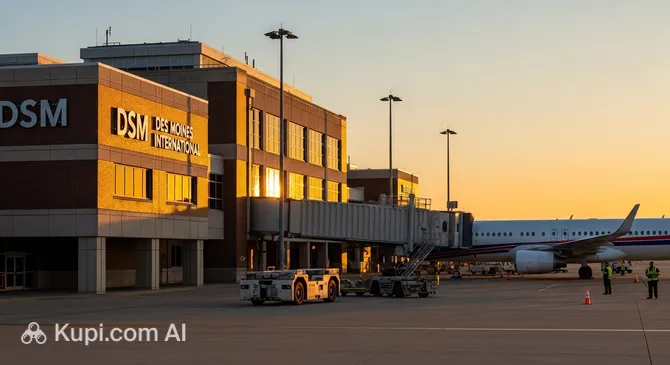
Des Moines International Airport. Source: Kupi.com Binoculars

Des Moines International Airport (DSM) is not just an air gateway to the heart of Iowa, but also an important transport hub in the US Midwest. Located just a few kilometres from the city centre, it welcomes and sees off millions of travellers annually. Despite its compact size, the airport offers everything necessary for a comfortable start or end to your journey, combining efficiency with a welcoming atmosphere.

IATA Code DSM
ICAO Code KDSM
City Des Moines
Distance to centre approx. 8 km
Status international (serves mainly domestic flights)
Passengers per year over 3 million (2023)
Popular Airlines American Airlines, Delta Air Lines, United Airlines
Schedule online flight board "Des Moines International Airport"

The airport in Des Moines is renowned for its convenient navigation and lack of long queues, which is particularly appreciated by business travellers and families. For passenger convenience, various cafes and shops operate here, and car rental services are available. Although the airport holds international status, the majority of flights are domestic, connecting Iowa with major hubs across the country, such as Chicago, Denver, and Dallas. In 2021, Allegiant Air announced plans to make the airport its base, contributing to the expansion of the route network.

Contact Information

For your convenience, we have compiled the main contact information for Des Moines International Airport (DSM). If you have any questions, we recommend reaching out via the channels listed below.

  • Official Website: You can always find the most up-to-date information on flights, services, and airport regulations on the official website: www.flydsm.com.
  • Helpline Phone: For immediate information and enquiries, you can call: +1 515-256-5050.
  • Airport Address: 5800 Fleur Dr, Des Moines, IA 50321, USA.
  • Email: A direct email address for general enquiries is not published. To contact the administration, it is recommended to use the contact form on the official airport website.
  • Social Media: Follow airport news and updates on its official pages on Facebook, X (formerly Twitter) and Instagram.
  • Lost and Found Information: If you have lost items within the terminal building, please contact the Lost and Found office managed by airport security. If your luggage was lost during a flight, you should immediately contact your airline's representative.
  • Passenger Support Service: For general questions related to your stay at the airport, please contact the main helpline number.

How to Get to the Airport

Getting to Des Moines International Airport (DSM), located just a few kilometres southwest of the Des Moines city centre, is possible via several convenient methods. The choice of the best option depends on your budget, amount of luggage, and time preferences.

Public Transport

The most economical way to reach the airport is to use the DART (Des Moines Area Regional Transit) bus network. Route No. 8 (Fleur Drive) goes from the city centre directly to the terminal. The journey usually takes about 30-40 minutes depending on traffic and your exact location. This is an excellent choice for light travellers and those looking to save money. The fare is minimal and costs just a few dollars.

Taxi, Transfer, and Ridesharing

For maximum convenience and speed, you can order a taxi or use car-hailing apps such as Uber or Lyft, which are widely used in the USA. The trip from the city centre takes just 10-15 minutes excluding traffic jams. The cost of such a trip typically varies from $15 to $25. This option is ideal if you have a lot of luggage or are travelling in a small group. You can also pre-book a private transfer that will meet you at your hotel for a fixed price.

Car Rental and Parking

If you plan to explore the surroundings or need complete freedom of movement, renting a car will be the best solution. Offices of all major rental companies are represented at Des Moines Airport. The road to the airport is simple and runs along the main Fleur Drive. For those arriving in their own vehicle, the airport offers several parking options: short-term parking in a covered garage located right by the terminal, and more affordable long-term parking in open lots, from where free shuttles run to the terminal. The cost depends on the duration and type of parking.

Terminals and Map

Des Moines International Airport (DSM) is distinguished by a simple and passenger-friendly structure. It operates one main terminal, which significantly simplifies navigation and eliminates the need to move between different buildings. All infrastructure — from check-in to baggage claim — is concentrated in one place.

The terminal is divided into two levels. The Upper Level is intended for departing passengers: airline check-in counters and the central security checkpoint are located here. After passing inspection, passengers enter the general sterile area. The Lower Level is the arrivals area, where baggage claim belts and exits to ground transport, including taxis and shuttles, are located.

The departure zone after screening is divided into two concourses: Concourse A (gates A1-A5) and Concourse C (gates C1-C7). There is no need for any transfers or transport between them — both wings are easily accessible on foot from the central area. Navigation is intuitive thanks to clear signage, so finding your boarding gate will not be difficult.

Thanks to the airport's compact size, completing all pre-flight formalities usually does not take much time. On average, check-in and screening take from 30 to 45 minutes. However, during peak hours (early morning or on holidays), queues can be longer, so it is recommended to arrive at the airport 90 minutes before departure for domestic flights.

For comfortable navigation, simply follow the signs. After passing security control, you will find yourself in a central hall with shops and cafes. Paths to concourses A and C diverge from here. Check your gate number on your boarding pass or the information screen to determine which direction you need to go. Getting lost in Des Moines Airport is practically impossible.

Airport History

The history of Des Moines International Airport began in the 1920s when city authorities realised the necessity of creating a modern aviation hub. After a long search for a suitable location, the airport was officially opened in 1933. Initially, it occupied a modest area and consisted of several runways with crushed stone surfacing and a small hangar serving as a terminal. The opening ceremony attracted huge attention and gathered thousands of spectators, highlighting the significance of the event for the entire region.

An important stage in the airport's development was the World War II period, when the facility was used by the US Army Air Corps. After the war, with the growth in popularity of civil aviation, an acute need for expansion arose. In 1948, a new terminal was built, which, having gone through numerous modernisations, still forms the basis of the modern terminal building. This step allowed the airport to handle a greater number of flights and passengers.

In the following decades, Des Moines Airport continued to develop actively. In the 1960s and 1970s, runways were lengthened to accommodate jet aircraft, and passenger halls were expanded and updated. A landmark event was receiving international status in 1986, reflecting its growing role in the country's aviation network. This new status facilitated further infrastructure modernisation, including improvements to navigation and security systems.

At the turn of the 20th and 21st centuries, the airport underwent several major renovations aimed at increasing passenger comfort and throughput capacity. Check-in areas, waiting lounges, and baggage systems were updated. Today, Des Moines International Airport is a key transport hub for the state of Iowa, serving millions of travellers annually and constantly working on plans for further expansion to meet future requirements.

Services and Amenities

Des Moines International Airport (DSM) offers passengers all necessary services for a comfortable wait for their flight. In the terminal, you will find several options for a snack or a full meal: from cosy coffee shops where you can quickly have coffee with fresh pastries, to restaurants offering a variety of dishes. Shops are also open where you can purchase souvenirs, press, books, and travel essentials.

For those who need to stay connected or work, free Wi-Fi is provided throughout the airport. There are many charging stations for electronic devices located in waiting areas and at boarding gates, so you can easily recharge your smartphone or laptop. For business travellers, business centres or conference room services may be available, allowing effective use of time before departure.

The airport cares about the comfort of all categories of passengers. Special nursing rooms and family restrooms are provided for travellers with children. Passengers with reduced mobility can count on full environmental accessibility: ramps, elevators, specially equipped restrooms, and staff assistance if necessary. There are ATMs in the terminal, and in case of feeling unwell, you can visit the first aid station.

If you have a long layover or an early departure, there are several hotels of various price categories located in the immediate vicinity of the airport, to which free shuttles frequently run. This is very convenient for those who want to rest before or after a flight without spending much time travelling to the city.

Where to Eat

At International Airport Des Moines (DSM), an important transport hub in Iowa, USA, passengers are offered a good selection of establishments where they can have a snack or a full lunch. Regardless of how much time you have before departure, you will easily find a suitable option.

Most restaurants and cafes are concentrated in the "clean" zone (airside), accessible to passengers after passing screening. Here you can find both full-service establishments and fast-food points. Before security control (landside), in the area for greeters and see-offs, the choice is usually more modest and may be limited to a coffee shop or vending machines with drinks and snacks.

If you are short on time, look out for coffee shops where you can grab sandwiches, salads, pastries, and, of course, coffee to go. For a more substantial meal, restaurants and grills are suitable. In their menus, you will find American cuisine classics: burgers, steaks, and various appetisers. Some establishments focus on local products and offer local Iowa beverages — a great opportunity to experience the local flavour.

Many restaurants offer vegetarian dishes. If you have special dietary needs (for example, a gluten-free or vegan diet), it is better to check the availability of suitable options with the staff in advance. Prices at the airport are generally higher than average city prices. Most establishments open early in the morning for the first flights and work until late evening, catering to the last departures, but exact opening hours should be checked on the airport website.

Travel Tips

To ensure your journey through Des Moines International Airport goes as smoothly as possible, make use of these helpful tips. Planning in advance will help save time, money, and nerves, allowing you to enjoy your trip from the very beginning.

Arrival and Check-in: For domestic flights within the USA, it is recommended to arrive at the airport at least 90 minutes before departure. If you are flying on an international flight, it is better to allow about 2 hours. To avoid queues, check in for your flight online and print your boarding pass at home or save it on your smartphone. Luggage can be dropped off at a dedicated counter.

Passing Security Control: Be prepared in advance. Pack all liquids, gels, and aerosols in containers up to 100 ml in one transparent bag. Laptops and other large electronics will need to be placed in a separate tray for scanning. Strictly following TSA (Transportation Security Administration) rules will significantly speed up the screening process.

Seat Selection and Carry-on: During online check-in, you will have the opportunity to select a seat. Window seats are perfect for those who enjoy the views, while aisle seats are for those who want the freedom to stand up easily. Always keep your most valuable items in your carry-on: documents, money, medication, electronics, and fragile items. Ensure there are no prohibited items, such as sharp objects, inside.

Transfers and Customs: If you have a transfer in Des Moines, check the information screen immediately upon arrival to find the number of your next boarding gate. The airport is not very large, so navigation will not be difficult. Upon arrival from another country, you will have to pass customs and passport control. Have your passport and completed customs declaration ready if required.

Saving and Waiting: To save money, bring an empty water bottle with you and fill it at a drinking fountain after passing security control. Prices for food and drinks at the airport are typically higher. In case of a flight delay, first contact your airline representative for information. Des Moines Airport has several cafes and shops, as well as free Wi-Fi, which will help pass the waiting time.

Reached the end of the page?

That means the route is fully explored