Support

Makoshika State Park

About

Imagine vast expanses where time seems frozen in whimsical shapes of stone and clay. Makoshika State Park is Montana’s largest protected natural site, located near the town of Glendive, USA. This place captures the imagination with its "badlands" landscapes: here you will see colorful layered cliffs, mysterious hoodoos, natural bridges, and deep canyons carved by wind and water over millions of years.
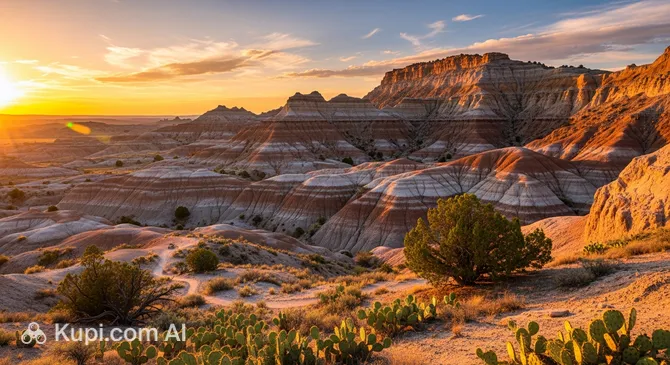
Makoshika State Park. Source: Kupi.com AI

The park's name, borrowed from the Lakota Indian language, translates as "bad lands," yet today this rugged terrain is considered a true gem for travelers. Makoshika is world-famous for the Hell Creek Formation—one of the world's richest deposits of dinosaur fossils. Amidst the juniper and pine thickets, traces of the planet's ancient inhabitants are hidden, while bald and golden eagles can often be seen soaring over the open prairies.

Beyond its paleontological value, the park is an important historical site: the famous Lewis and Clark expedition once passed through here. Today, visitors have access to modern amenities: an informative visitor center with museum exhibits, equipped picnic areas, and observation decks offering breathtaking panoramas of the Yellowstone River valley.

Contacts

To confirm current information on events or visiting conditions, you can contact the park administration directly. Visitor center staff are always ready to help with route selection or provide information about camping rules.

Address 1301 Snyder St, Glendive, MT 59330, USA
Phone +1 406-377-6256
Official Website stateparks.mt.gov/makoshika

What to Do

At Makoshika State Park, everyone will find something to enjoy—from quiet contemplation of nature to active hiking. Dozens of kilometers of trails of varying difficulty levels are laid out across the territory. Experienced travelers suggest heading out for a walk early in the morning or later in the evening: at these times, the play of light and shadow makes the rock formations exceptionally striking and photogenic.

Special attention should be paid to the visitor center, which features unique paleontological finds, including the remains of a Tyrannosaurus Rex and a Triceratops. In summer, the park turns into an active scientific site: excavations are often conducted here, which you can observe, while educational displays help children and adults understand the region's geological history.

For those who prefer active recreation with friends, the park features a disc golf course. There are also special picnic areas with grills and shelters where you can enjoy an outdoor lunch. Photographers and wildlife enthusiasts will appreciate the chance to "hunt" for shots of mule deer or rare birds, and at night, the park becomes an ideal spot for stargazing away from city lights.

Getting There

Makoshika State Park is located at 1301 Snyder St, Glendive, right on the outskirts of the city of Glendive. The main landmark for travelers is the Yellowstone River, along which these lands stretch. The easiest way to reach the main entrance is by car via highway MT-16 or Snyder Ave, where visitors will find free parking suitable for both passenger cars and large RVs.

If you are planning a long trip across Montana, it is most convenient to travel along the I-94 interstate from cities like Billings or Miles City—the drive will take between one and three hours. The nearest air hub is Glendive Airport (GDV), and rail enthusiasts can use Amtrak services, with stations located relatively close to the region.

Please note that there is no public transport directly to the park. For comfortable travel, car rental or a taxi from the city center is highly recommended. The park entrance is equipped with information kiosks to help tourists find their way immediately upon arrival.

History & Facts

The history of Makoshika State Park is inextricably linked with great scientific discoveries. As early as 1893, the first significant dinosaur fossils were found here, drawing public attention to the uniqueness of these lands. The area received official state park status in 1953, becoming a symbol of natural heritage preservation and tourism development in eastern Montana.

These landscapes also hold memories of the famous Lewis and Clark expedition. In his journals, William Clark described the area as "birnt hills" when the party stopped nearby during their return journey along the Yellowstone River. Today, scientists confirm that the park is part of the Hell Creek Formation—one of the world's richest fossil deposits from the late Cretaceous period.

The name Makoshika comes from the Lakota Indian language. It translates as "bad land" or "bad earth," which accurately describes the erosion-carved terrain that was historically extremely difficult to cross. However, it is this very ruggedness that allowed the skeletons of Tyrannosaurus Rex and Triceratops to be preserved to this day.

The scientific significance of the park continues to grow: every summer, paleontological expeditions from leading universities and museums, including the Museum of the Rockies, work here. It is a living open-air laboratory where the planet's history literally emerges from beneath layers of ancient sandstone.

Time Needed

To truly experience the scale and beauty of this place, a typical tourist will need between 3 and 6 hours. This is enough time to explore the visitor center exhibits, take a few short walks along popular trails, and stop at scenic overlooks for photos.

If you plan on more serious hiking or want to wait for the sunset, which is particularly picturesque here, it is worth setting aside a full day. Nature lovers often stay for 1–2 days, using the camping areas to fully enjoy the silence of the prairies and the Montana starlight.

Working Hours

The Makoshika State Park Visitor Center typically welcomes guests from Wednesday to Sunday, 10:00 AM to 4:00 PM. The center is closed on Monday and Tuesday, but access to the park grounds and certain trails may be open during a wider range of hours.

Since operating schedules can change depending on the season or holidays, it is recommended to check the current opening hours on the official park website before your trip.

Nearby

Exploring the surroundings of Makoshika Park can significantly enrich your travel experience. After walking among the wild rocks, it is worth stopping by the city itself to experience its cozy atmosphere and local sights.

Near the park, you will find both cultural sites and recreational spots, including specialized fossil museums that will complement the dinosaur knowledge you gained in the reserve.

Name Distance (km)
Splash Pad 0.9
City Hall 1.6
Dior Building 1.7
Oasis Bar and Casino 1.8
Beer Jug 1.9
Bar42 2.8
Wagon Wheel Bar 3
Yellowstone River Inn 4.1
Glendive Dinosaur and Fossil Museum 4.1
Glendisaurus (Triceratops) Statue 4.6

Reached the end of the page?

That means the route is fully explored