Support

D.C. Booth Historic National Fish Hatchery & Archives

About

In a picturesque corner of Spearfish lies a unique site — the D.C. Booth Historic National Fish Hatchery and Archives. Established in 1896, it is considered one of the oldest operating fish hatcheries in the USA. It is not just a production site, but a true living open-air museum spread across 10 acres of land.
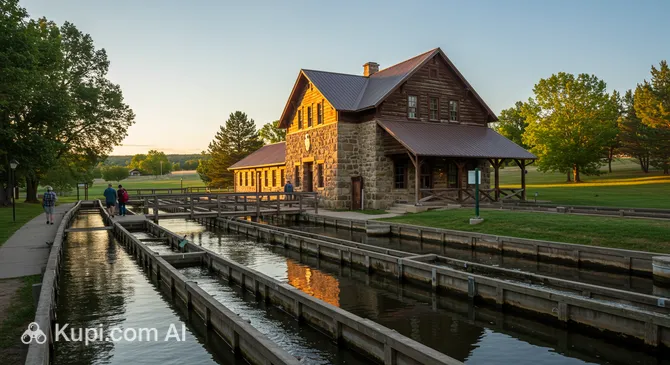
D.C. Booth Historic National Fish Hatchery & Archives. Source: Kupi.com AI

The complex is listed on the National Register of Historic Places and plays a key role in preserving America's fisheries heritage. It harmoniously combines the functions of a scientific center, where tens of thousands of rainbow trout are raised annually, and a massive archive housing over 14,000 historical artifacts.

Visitors are drawn to the chance to see historic stone buildings, walk along shaded paths, and learn how fish culture developed in the Wild West. Each year, the site welcomes over 150,000 guests, remaining one of the region's most soul-stirring and educational attractions.

Contacts

If you have any questions before your visit or wish to book a special tour, you can contact the D.C. Booth Historic National Fish Hatchery administration directly.

Address 423 Hatchery Cir, Spearfish, SD 57783, USA
Phone +1 605-642-7730
Official website dcboothfishhatchery.org
Google Maps View on map

What to Do

The main attraction that delights both adults and children is feeding the trout. You can purchase food from special vending machines and watch the churning activity in the raceway ponds, some of which have been preserved since 1900. Huge fish leap impressively out of the water, creating spectacular splashes.

Be sure to visit the Von Bayer Museum of Fish Culture. It features a unique exhibit—the Yellowstone Boat No. 39, a wooden boat from 1901 used to collect eggs in Yellowstone Park. The museum's exhibits provide detailed insight into how fish were transported in the old days and what tools the country's first fish culturists used.

A walk through the grounds will allow you to see the Superintendent’s House, an old ice house, and workshops surrounded by lush greenery. Volunteer guides are often on duty on the bridges and are happy to talk about modern methods of protecting fish from predators, such as the use of specialized noise cannons.

Getting There

The attraction is located at 423 Hatchery Cir, in a scenic spot at the confluence of Spearfish Creek and South Canyon. Finding the hatchery is easy—it is located almost in the city center, right behind Spearfish City Park.

For those traveling by car, the drive from the city center takes only 5–10 minutes. You should follow US-14A or take the I-90 exit, following signs for South Canyon Road. Free parking for visitors is provided on the complex grounds.

If you prefer walking, the trip from downtown Spearfish takes about 20–30 minutes along well-maintained sidewalks. Public transportation in the city is limited, so for tourists from other regions, the best option is a rental car or a taxi from Rapid City Regional Airport, which is about an hour's drive away.

History & Facts

The history of this site began in 1896, when the USA Congress authorized the creation of a fish culture station to restore trout populations in the Black Hills. The site was selected by expert Hector von Bayer, who purchased the land from a local sawmill. Despite harsh winters and flooding, the first fry were released into local streams as early as 1900.

The hatchery's first superintendent was DeWitt Clinton Booth, for whom the complex is named today. He managed the facility for a record 34 years, personally overseeing the construction of dams and staff residences. Under his leadership, the hatchery became a vital link in the nation's fisheries system, even sending expeditions to Yellowstone Park to collect eggs from rare fish species.

In 1983, budget cuts led to the hatchery's temporary closure, sparking a wave of protests from local residents. Thanks to community efforts, the site reopened in 1989, but this time as a historic landmark and archive. Today, it is not only an active hatchery but also the largest repository of U.S. fisheries history documents, housing over 1.8 million archival items.

Time Needed

To explore the grounds at a leisurely pace, feed the fish, and visit the museum, most tourists need about 2 to 3 hours. This is enough time to walk past all the historic buildings and stop by the archival center.

If you are traveling with children, plan for at least 1.5–2 hours, as feeding the trout in the ponds is usually the longest and most exciting part of the visit. For researchers wishing to study the fish culture museum's collection in detail, a bit more time may be required.

Working Hours

When planning your visit, please note the schedule. The complex is open to the public throughout the week, except for Sundays. Monday — Saturday: 9:00 AM to 6:00 PM. Sunday is the day off.

It is worth considering that museum operations and access to some historic buildings may depend on the presence of volunteers, so the chances of getting inside all the facilities are significantly higher during the summer season.

Nearby

The hatchery's location in the heart of Spearfish makes it easy to combine your visit with other local sights. A stroll through the neighborhood will reveal cozy parks, historical monuments, and excellent local dining options.

Exploring nearby attractions will help you better experience the atmosphere of the Black Hills and enjoy South Dakota's hospitality.

Name Distance (km)
The Yellowstone Boat 0.1
THOEN STONE MONUMENT 0.6
Antunez 0.9
REDwater Kitchen 1.0
Spearfish Public House 1.0
Back Porch 1.0
Killian's 1.1
Stadium Sports Grill 1.1
QDOBA Mexican Eats 2.3
Sawyer Brewing Co. 3.4

Reached the end of the page?

That means the route is fully explored