Support

Grand Junction Regional Airport

About the Airport

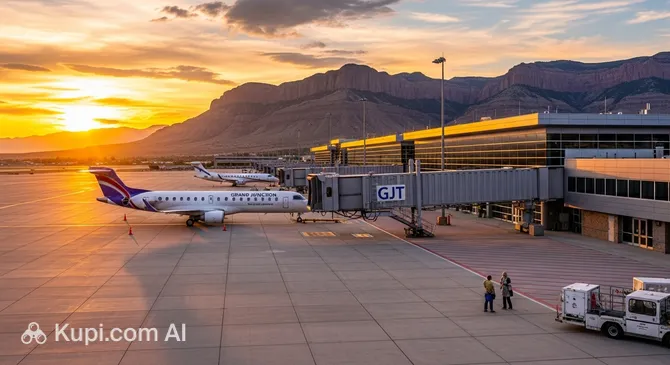
Grand Junction Regional Airport. Source: Kupi.com Binoculars

Welcome to Grand Junction Regional Airport (GJT), the main aerial gateway to Western Colorado! This airport is not just a transit hub, but a starting point for unforgettable adventures across the scenic corners of the USA. Located in the heart of the Grand Valley, it is one of the state's key airports and offers travellers a unique combination of modern comfort and quick access to natural wonders. Its compactness and thoughtful organisation make it a convenient choice for those who value their time and prefer to start their holiday without unnecessary hassle.

IATA Code GJT
ICAO Code KGJT
City Grand Junction
Distance to city centre About 7 km
Status Domestic
Passengers per year About 483,000 (2023)
Popular Airlines American Airlines, United Airlines, Delta Air Lines
Schedule "Grand Junction Airport" online schedule

Grand Junction Airport, also known as Walker Field, is famous for its efficiency and friendly atmosphere. Short queues for check-in and security, as well as closely located parking, allow passengers to avoid the stress often associated with major aviation hubs. Despite its modest size, the airport offers all necessary services: several cafes, car rental, and a souvenir shop. Its key advantage is its strategic location. From here, it is easy to reach popular ski resorts, national parks, and vineyard regions, making GJT the ideal launchpad for exploring Western Colorado.

Contact Information

For your convenience, we have compiled the main contact information for Grand Junction Airport (GJT), which may be useful during trip planning or while you are already on your way.

  • Official website: www.gjt.org
  • Help desk phone: +1 (970) 244-9100
  • Airport address: 2828 Walker Field Dr, Grand Junction, CO 81506, USA
  • Email: You can contact the administration via the contact form on the official website.
  • Social media: Current information can be found on the airport's official Facebook page.
  • Lost luggage information: If items were lost within the terminal building, please contact the airport administration. For luggage left on board the aircraft, you must contact your airline directly.
  • Customer support contacts: For general inquiries and assistance, you can call the main airport phone number.

How to Get to the Airport

Getting to Grand Junction Airport (GJT), located just a few kilometres northeast of the Grand Junction city centre, is quite simple. A car journey usually takes no more than 10–15 minutes, making it very accessible for travellers. Depending on your budget and preferences, you can choose one of several convenient transport methods.

Public Transport. The most budget-friendly way to get to the airport is by bus. The local transport system, Grand Valley Transit (GVT), offers routes connecting the airport with key points in the city. This is an excellent choice for budget-conscious tourists and those travelling light. Please check the current schedule and route number on the official GVT website, as they are subject to change.

Taxi and Transfer. For maximum comfort and speed, you can use taxi services or ridesharing apps popular in the USA, such as Uber and Lyft. A car can be ordered directly to your hotel or another location in the city. This option will be more expensive than the bus, but it is ideal if you have a lot of luggage or are travelling with family. Shuttle services are also available at the airport, which can transport passengers to several hotels.

Car Rental. If you plan to actively explore the scenic surroundings of Grand Junction, renting a car is your best choice. Counters for major rental companies are located directly in the terminal building. By booking a car online in advance, you can pick it up immediately upon arrival or return it before departure. This provides complete freedom of movement around the region.

Airport Parking. For those arriving at the airport in their own or a rented vehicle, parking zones are provided. There are options for both short-term parking (meeting or seeing off passengers) and long-term parking if you plan to leave the car for several days. The cost depends on the duration of the stay.

The choice of transport to Grand Junction Airport depends on your priorities. Although GJT is the main air hub for the city, it is worth remembering that there are other airports in the region, for example, Montrose Regional Airport (MTJ) or larger ones serving ski resorts, such as the airport in Aspen (ASE) and Eagle County Airport (EGE). The choice of arrival airport may depend on your final destination in Colorado.

Terminals and Map

Grand Junction Airport (GJT) is a modern and compact aviation hub characterised by a simple and clear structure for passengers. It operates one passenger terminal serving all flights — both arrivals and departures. This significantly simplifies navigation and makes the stay at the airport as comfortable as possible, eliminating the need to move between different buildings.

The terminal layout is logical and intuitive. The building has two main levels. The ground floor houses check-in counters, the baggage claim area, and car rental offices. After check-in, passengers proceed to the second floor, where the single security checkpoint leading to the departure area is located. Thanks to the airport's compact size, it is practically impossible to get lost here, and all key zones are within a few minutes' walk of each other.

The departure zone on the second floor is a spacious and bright waiting hall with several boarding gates. There is a small cafe, a souvenir shop, and free Wi-Fi here. The arrival zone on the ground floor includes only baggage claim belts and the exit to the city, making the process of retrieving suitcases and meeting transfers quick and easy. Since there is only one terminal, transitions between zones take minimal time.

Completing all pre-flight procedures at Grand Junction airport usually does not take much time. On standard days, check-in and security take no more than 20–30 minutes. However, during peak periods (for example, during the ski season or summer holidays), it is recommended to arrive at the airport in advance, approximately 90 minutes before departure, to avoid rushing. For navigation, simply follow the clear signs in English, which will guide you from the terminal entrance to the required boarding gate.

Airport History

The history of Grand Junction Airport (GJT) began in 1930, when it was opened as the Grand Junction Municipal Airport. In its early years, it served mainly for mail transport and accepted small private planes, laying the foundation for future aviation development in the western part of the state of Colorado, USA.

A significant stage in the airport's development occurred during World War II. In 1942, it was renamed Walker Field in honour of Walter Walker, a local newspaper publisher who played a key role in securing funding for its expansion. During this period, the airport was used by the US Army Air Forces as a training base, which contributed to the modernisation of its infrastructure.

The post-war years were marked by a growth in passenger transport. In the 1950s, the first passenger terminal was built, and in the 1960s, the airport began receiving the first jet liners, which was a real breakthrough and significantly reduced travel time to major cities. This step turned the airport into an important transport hub for the entire region.

By the 1980s, it became obvious that the old terminal could no longer cope with the growing passenger flow. In the middle of the decade, a new, more spacious and modern terminal building was constructed, which was subsequently expanded and modernised several times, especially in the early 2000s, to meet modern standards of safety and comfort.

Interesting fact: in 2007, the airport received its current official name — Grand Junction Regional Airport, to better reflect its importance for all of Western Colorado and Eastern Utah. At the same time, the airfield itself still bears the historic name Walker Field. Today, GJT continues to play a key role in the economic and tourism life of the region, connecting it with the rest of the country.

Services and Amenities

Grand Junction Airport (GJT) is a compact and modern regional airport offering all necessary services for a comfortable wait for your flight. Despite its small size, it is well-equipped to meet the needs of travellers.

For those wishing to have a snack or buy something for the road, the airport has a restaurant and dining area where you can have a full lunch or drink coffee. There is also a souvenir shop where you can purchase gifts, press, and essential items. The selection of establishments is small but sufficient to pass the time comfortably before departure.

Free Wi-Fi is available throughout the terminal, allowing passengers to stay connected, work, or be entertained online. Special charging stations for electronic devices are located in the waiting areas near the boarding gates.

The airport is fully adapted for passengers with reduced mobility and complies with ADA standards. There are ramps, accessible restrooms, and designated parking. For travellers with small children, changing tables are equipped in the restrooms. There are no specialised children's play areas in the airport.

ATMs for cash withdrawal are installed in the terminal. It is worth noting that there may be no currency exchange points at the airport, so it is better to take care of this in advance. In case of necessity, passengers can seek first aid from airport staff. There are no dedicated VIP lounges or business centres at GJT, however, the general waiting areas are quite comfortable. Several hotels are located near the airport, many of which offer free transfers for their guests.

Where to Eat

Grand Junction Airport (GJT) offers travellers a compact but functional selection of dining establishments to help wait for a flight in comfort. Given the size of the airport, all main options are concentrated in the single terminal.

The main place where you can have a full meal is the Tailwind Diner & Bar. It is located airside, meaning after passing through security. This establishment is designed in the style of a classic American diner and offers a menu suitable for both a hearty lunch and a quick snack. Here you will find burgers, sandwiches, salads, as well as traditional breakfasts. The beverage menu includes various soft drinks and other options.

For those looking for a quick option, vending machines with snacks and refreshing drinks are available in the waiting hall. They can be an excellent solution if there is very little time left before departure. Since the main restaurant is located after the security zone, it is recommended to pass security control in advance if you plan a full meal.

Regarding special dietary needs, for example, vegetarian or gluten-free dishes, it is best to check their availability directly with the restaurant staff. Typically, a salad or other suitable dish can be found on the menu. Prices at the airport correspond to the average level for such establishments: slightly higher than in the city, but quite acceptable. The restaurant's opening hours are usually linked to the flight schedule — it opens before the first morning departures and operates until the last plane departs.

Travel Tips

To ensure your journey through the airport of Grand Junction city goes smoothly and without stress, use these helpful tips. Grand Junction Airport (GJT) is a regional hub, so it is usually quieter here than in major hubs, but preparation is still important.

Arrival at the airport and check-in. For domestic flights within the USA, it is recommended to arrive at the airport at least 1.5–2 hours before departure. This time is enough to check in luggage without rushing, pass security control, and reach the boarding gate. To save time, complete online check-in on your airline's website and save the boarding pass on your phone. TSA checkpoints here usually work quickly, but during peak seasons (holidays, summer months), it is better to have a time buffer.

Hand luggage and seat selection. In hand luggage, liquids are allowed in containers up to 100 ml, packed in one transparent bag with a volume of no more than 1 litre. Laptops and other large electronics must be placed in a separate tray for scanning. When choosing a seat on the plane, consider that window seats will offer you beautiful views of the Rocky Mountains, while aisle seats provide more legroom and the ability to stand up without disturbing neighbours.

Customs control and transfers. Grand Junction Airport serves primarily domestic flights, so most travellers do not pass customs here. If you are flying to the USA from another country, you will pass customs and passport control at the first airport of arrival (for example, in Denver or Salt Lake City). Passengers with transfers at GJT should check the screens for the boarding gate number of the next flight immediately upon arrival — the airport is small, and finding the right gate will not be difficult.

Saving money and flight delays. To save money, book parking online in advance if such a service is available. Take an empty reusable water bottle with you to fill it after passing security control, and snacks that are not prohibited for carriage. In case of a flight delay or cancellation, contact your airline's counter for information on further actions. Remain calm and clarify if you are entitled to compensation, food vouchers, or hotel accommodation depending on the reason for the delay.

Reached the end of the page?

That means the route is fully explored