Support

Juneau International Airport

About the Airport

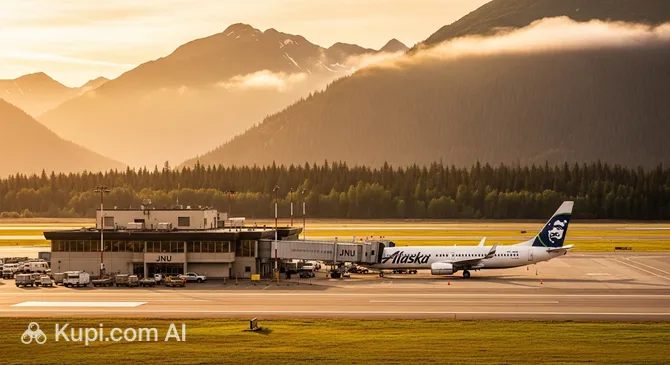
Juneau International Airport. Source: Kupi.com Binoculars

Juneau International Airport is not merely a transport hub, but a true "lifeline" for the capital of Alaska, which is isolated from the rest of the mainland due to the absence of road connections. Arriving here is considered one of the most picturesque parts of the journey: the liner descends through a narrow air corridor between high mountain ranges and the cold waters of the Gastineau Channel. A special charm is added to the air harbour by its unique proximity to a large seaplane base, so passengers can often observe nimble "air taxis" landing on the water side-by-side with powerful jets.

IATA Code JNU
ICAO Code PAJN
City Juneau
Distance to centre 13 km
Status International
Passengers per year About 730,000
Schedule Please check the airport website for details

Features and Advantages of the Airport

A key feature of Juneau is the presence of its own seaplane pond, located parallel to the main runway. This creates an amazing contrast of technologies: while modern Boeings approach for landing using instruments, small private planes take off nearby, delivering mail and tourists to the most remote corners of the wilderness.

The airport terminal, despite its compact size, offers travellers a cosy atmosphere imbued with the spirit of Alaska. Inside, you can see exhibitions of local art and the famous taxidermy bear, which has become the unofficial symbol of the air harbour and a favourite subject for photos. Additionally, the airport is renowned for the high skill of the pilots working here in complex weather conditions amidst the mountainous terrain.

Contact Information

  • Official Website: juneau.org/airport
  • Information Desk Phone: +1 907-789-7821
  • Address: 1873 Shell Simmons Dr, Juneau, AK 99801, USA
  • Email: A direct email address for general inquiries is not published. It is recommended to use the contact form on the official airport website for communication.
  • Social Media: The airport has an official page on Facebook, where you can follow news and updates.
  • Lost and Found Information: If your belongings were lost in the airport terminal, contact the Lost and Found service at +1 907-789-7821. For luggage left on board the aircraft, you must contact your airline's representative office directly.
  • Passenger Support Contacts: For assistance and answers to questions, you can contact the main airport phone number (+1 907-789-7821) or speak to staff at the information desk in the terminal building.

How to Get to the Airport

There are several ways to get to Juneau International Airport (JNU), located approximately 14 kilometres northwest of the city centre of Juneau, the capital of the state of Alaska, USA. A trip by car usually takes 15–20 minutes. The choice of transport depends on your budget, amount of luggage, and personal preferences.

Public Transport is the most budget-friendly option. The Capital Transit city bus system operates routes that pass through the airport, connecting it with the city centre and other districts, including the Mendenhall Valley. The fare is low, however, it is worth checking the schedule in advance, as buses run at specific intervals. The bus journey will take about 30-40 minutes. There are no trains or metro services in Juneau.

Taxis and Shuttles offer a faster and more convenient way to get to the airport. Taxis can be found in the city or ordered by phone. A trip from the centre to the airport will cost approximately 25–35 dollars. Some hotels and private companies offer shuttle services, which may be more cost-effective for solo travellers or groups, but these often require advance booking.

Car Rental is an excellent choice for those planning to actively explore the surroundings and who value independence. Offices of several major rental companies operate at Juneau Airport. It is recommended to book a car in advance, especially during the peak tourist season (from May to September). Important Note: Juneau's road network is isolated, and you cannot drive from here to other parts of Alaska or the mainland of North America.

If you arrive at the airport in your own or a rented car, parking is at your service. The airport territory has both short-term and long-term parking zones located in immediate proximity to the terminal. This is a convenient option for those flying away for a few days or meeting arriving passengers.

Terminals and Map

Juneau International Airport (JNU) is a compact and convenient aviation hub serving the capital of Alaska. Its main feature is the presence of one main passenger terminal, which makes navigation for travellers extremely simple and intuitive. This terminal handles all domestic flights within the USA, as well as seasonal and charter international flights.

The terminal building has a well-thought-out and logical layout. On the ground floor, there are arrival zones with baggage claim belts and airline check-in counters. Car rental offices are also located here. After check-in, passengers proceed to the second floor, where the departure zone is located. The security screening checkpoint is situated here, after which access to the boarding gates opens.

Since the airport has only one terminal, there is no need for transfers or the use of shuttles — all services and boarding gates are within walking distance in the same building. The check-in and screening process at JNU usually proceeds significantly faster than at major airports. Nevertheless, it is recommended to arrive at the airport 1.5–2 hours before departure, especially during the peak tourist season (summer), to check in luggage and complete all formalities without rushing.

For navigation, it is sufficient to follow the signs, which are clearly visible and understandable. The airport is small, so it is practically impossible to get lost here. You can walk from the terminal entrance to the furthest gate in just a few minutes. This simplicity and efficiency make Juneau Airport one of the most comfortable for starting and ending a journey through Alaska.

Airport History

The history of Juneau International Airport (JNU) is not just a story of runways and terminals, but a chronicle of the development and survival of Alaska's isolated capital. Since its foundation, the airport has served and continues to serve as a vital artery connecting Juneau with the rest of the world, as the city has no direct road connection to the North American road network.

Founded during World War II, the airport began operations as a military airfield. The first runway was ceremoniously opened in 1943 for army needs. After the war, the demand for civil transport increased sharply, and by 1946, Pan American Airways began operating scheduled flights, and in 1949, airport management was transferred to the city of Juneau. This became a key moment in its development as the main transport hub for the entire Southeast Alaska region.

With the growth of passenger traffic and the development of aviation, the airport has been modernized repeatedly. A significant stage was the construction of a new passenger terminal in 1976, which replaced older, more modest structures. In subsequent decades, work was carried out to lengthen and strengthen the runway. A major reconstruction was completed in 2009, creating a modern safety area at the end of the runway, significantly raising flight standards. In recent years, the airport has undergone a multi-stage program of expansion and terminal renovation to meet modern requirements for comfort and safety.

Among the interesting facts in JNU's history is its unique dual purpose. Besides the main runway for aeroplanes, the airport includes a lively seaplane base on the lake. This highlights the importance of small aviation for the region, where many settlements are accessible only by air or water. Juneau Airport is a vivid example of how an infrastructure facility can become a symbol of resilience and connection with the outside world in the harsh and beautiful conditions of Alaska.

Services and Amenities

Juneau International Airport (JNU) offers passengers all necessary services for a comfortable wait for their flight. Despite its relatively small size, the airport is well-equipped to satisfy the basic needs of travellers arriving in or departing from the capital of Alaska.

Within the terminal, you will find several options for dining and shopping. At your service is a restaurant where you can have a full meal, and a cafe offering coffee and light snacks. There is also a gift shop where you can purchase gifts, books, and essential goods. It is an excellent place to buy a memento of your trip to the USA.

For those who need to stay connected, free Wi-Fi is provided throughout the airport. Charging outlets and USB ports for electronic devices are located in waiting areas, allowing you to work or entertain yourself comfortably while waiting for departure. The waiting lounges are comfortable, and a historic aircraft can be seen in the main lobby, adding uniqueness to the atmosphere.

The airport is fully adapted for passengers with reduced mobility and complies with ADA standards. Accessible restrooms, ramps, and special assistance upon request are provided. Families with small children can use changing tables located in the restrooms. ATMs are installed in the terminal for financial transactions.

If you need to hold a business meeting, the airport has a conference room available for rent. Although there are no specialized VIP lounges, the general atmosphere in the airport is quite calm. Several hotels are located near the airport, many of which offer free transfers for their guests, which is very convenient for early departures or late arrivals.

Where to Eat

Juneau International Airport (JNU), despite its compact size, offers passengers several cosy options for a snack or a full lunch. The main catering establishments are located in the main terminal and are oriented towards making the wait for your flight more pleasant.

For those wishing to have a substantial meal, the airport's main restaurant, Tailwind Bar & Grill, operates in the "clean" zone (after passing security). Here you can sit comfortably and order classic American dishes: burgers, sandwiches, soups, and salads. Local Alaskan specialities deserve special attention. If the opportunity arises, be sure to try dishes made from fresh salmon or halibut — this is an excellent way to get acquainted with local gastronomy right before departure.

If you are short on time or simply want to drink coffee, there is a cafe in the public zone (before security). This is an ideal place for a quick snack, where you can grab fresh pastries, a sandwich, and a hot drink. This is convenient for both departing passengers and those seeing them off. Typically, a small coffee point is also available in the departure lounge.

Regarding special dietary needs, choices may be limited. Vegetarians will be able to find salads and some snacks on the menu. Passengers with specific dietary restrictions (such as gluten-free or Halal requirements) are advised to clarify the ingredients of dishes with the staff. Prices in airport establishments are at an average level for the USA. Opening hours are usually synchronized with the flight schedule: cafes and restaurants open early in the morning and serve passengers until the last evening departure.

Travel Tips

To ensure your journey through Juneau International Airport (JNU) goes smoothly, take advantage of these tips. It is recommended to arrive at the airport at least 2 hours before the departure of domestic flights. Although JNU is not as large as metropolitan hubs, this time is sufficient to check in, drop off luggage, and pass security without rushing.

Check-in and security procedures at Juneau Airport are standard for the USA. You can check in online to save time, or use self-service kiosks and airline counters. The Transportation Security Administration (TSA) conducts passenger screening. If you have TSA PreCheck status, you will be able to pass through the check using an expedited procedure.

When choosing a seat on a plane departing from Juneau, if possible, choose a window seat. Views of the fjords, mountains, and glaciers of Southeast Alaska can become one of the most vivid impressions of the trip. The flight direction and weather conditions influence which side will offer the best landscapes, but the chance to see something breathtaking is high from either side.

Carry-on luggage rules are standard: liquids are permitted in containers no larger than 100 ml (3.4 oz), packed in a single transparent bag. Sharp objects, weapons, and flammable substances are prohibited. If you are carrying tourist equipment (for example, trekking poles or bear spray), clarify the rules for its carriage with your airline in advance — most such items must be checked in as luggage.

For passengers with transfers, it is important to note that JNU is a small airport, and navigating it will not cause difficulties. However, always check the time required to move to the next gate, especially if you are flying with different airlines. Customs control is undergone only by passengers arriving on international flights, which is a rarity for Juneau. Most flights are domestic.

To save time and money, book flight tickets and parking in advance. Pack light snacks and an empty water bottle that can be filled after passing security. This will help avoid unnecessary expenses at the airport. Consider using public transport or shuttles for the trip to/from the airport.

In case of a flight delay, first contact your airline representative for information about the cause and estimated departure time. Clarify whether the carrier provides vouchers for food or hotel accommodation during long delays. The terminal has free Wi-Fi, cafes, and rest areas where you can spend time comfortably while waiting.

Reached the end of the page?

That means the route is fully explored