Support

Matagorda Island (National Wildlife Refuge) Airport

About the Airport

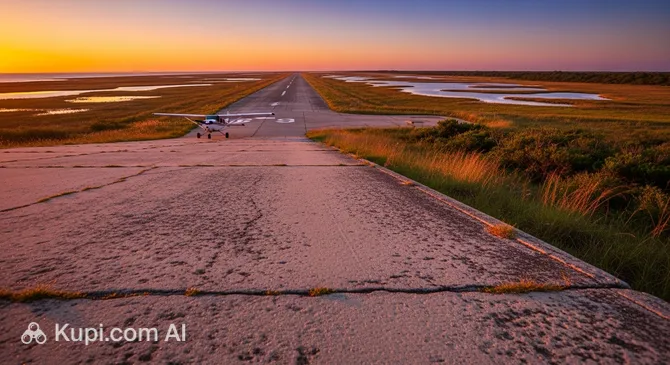
Matagorda Island (National Wildlife Refuge) Airport. Illustration.
Source: Kupi.com AI

Matagorda Island Airfield (MGI) is perhaps one of the most unusual aviation locations in the USA, where instead of the roar of turbines and queues for check-in, you will be greeted by the sound of the surf and the cries of migratory birds. Located within the National Wildlife Refuge, this former military facility today resembles a set for a movie about a lost world rather than an active transport hub. Concrete strips that once received World War II bombers now serve as a landing pad exclusively for the island's feathered inhabitants, and the airfield itself has become a unique historical monument being reclaimed by nature.

PropertyValue
IATA CodeMGI
CityMatagorda Island
CountryUnited States
TimezoneAmerica/Chicago
ScheduleOnline Timetable

Features and Status of the Airfield:

It is important to understand that Matagorda Island Airfield does not function as a civil airport for receiving tourists. It is a historical and natural site with a special access regime.

  • Historical Heritage: Originally built as an aviation training base during World War II, the airfield has retained the outlines of its massive runways. This place attracts history buffs and aviation archaeology enthusiasts wishing to see how nature reclaims space from man.
  • Conservation Zone: The airfield is located in the heart of a critical habitat for wildlife. Here you can meet rare Whooping Cranes, sea turtles, and alligators. Aviation activity is minimized (mostly for official purposes) so as not to disturb the fauna.
  • Complex Logistics: Since the island is separated from the mainland by a bay, the area of the former airfield can only be reached by private boat or ferry. This guarantees the absence of crowds and exceptional silence, broken only by the wind from the Gulf of Mexico.

Contact Information

Since Matagorda Island Airfield (MGI) is a facility closed to commercial aviation and managed by environmental agencies, it does not have standard passenger airport services (ticket offices, flight information, or baggage claim). All communication regarding visiting the territory of the former airfield is carried out through the administration of the Aransas National Wildlife Refuge.

  • Official Website: www.fws.gov/refuge/matagorda_island (Refuge Page)
  • Helpline Phone: +1 361-286-3559 (Refuge Main Office, Mon-Fri)
  • Administration Address: 1 Wildlife Circle, Austwell, TX 77950, USA (Headquarters of the management complex)
  • Email: aransas@fws.gov
  • Social Media: Official Aransas National Wildlife Refuge Facebook page (current information on access and weather conditions)
  • Lost Luggage Information: Service unavailable. In case of loss of personal belongings during an excursion or visit to the island, it is necessary to contact the rangers via the main refuge phone number.
  • Passenger Support Contacts: Not applicable. For questions regarding permits for visiting, hunting, or camping, please contact the Texas Parks and Wildlife Department office at +1 361-205-1510.

How to Get to the Airport

It is important to remember that Matagorda Island Airfield (MGI) is located on a barrier island not connected to the mainland by bridges or roads. It is impossible to drive here by car or standard taxi directly to the runway. The journey to this unique place is a true expedition consisting of several stages: a flight to the nearest active airport, a drive to the coast, and a water crossing.

Below are the main ways to get to the island and the former airfield.

Stage 1: Nearest Transport Hubs (Arrival Airports)

Since Matagorda Airfield itself is closed to civil flights, tourists need to fly into one of the major airports in Texas, rent a car, and drive to the coast (town of Port O'Connor).

  • Corpus Christi International Airport (CRP) — the most convenient option, located approximately 80–90 km (in a straight line and by road) from the crossing point. This is the nearest major civil airport.
  • William P. Hobby Airport (HOU) in Houston — located approximately 226 km away. Convenient for those looking for more flight options and low-cost carriers.
  • San Antonio International Airport (SAT) — located approximately 226 km from the coast.
  • Austin-Bergstrom International Airport (AUS) — located at a distance of about 245 km.
  • Also available in the south of the state is Valley International Airport (HRL), but it is 225 km away and less logistically convenient for a trip to Port O'Connor.

Stage 2: Transfer and Car Rental (To Port O'Connor)

Public transport (buses or trains) to the marina in Port O'Connor is practically non-existent. The only reliable way to get to the start of the water route is by car.

  • Car Rental: It is strongly recommended to rent a car at the arrival airport (Corpus Christi or Houston). The drive from Corpus Christi will take about 1.5–2 hours, from Houston — about 2.5–3 hours.
  • Taxi: A taxi ride or using services like Uber/Lyft from Corpus Christi airport to Port O'Connor is possible but will be expensive (estimated from $100–150 and up one way). It is important to arrange a return trip in advance, as finding an available car in a small coastal village will be difficult.

Stage 3: Water Crossing and Parking

You can reach the airfield and refuge from the mainland only by water across Matagorda Bay.

  • Private Boats and Charters: Most visitors use their own boats or hire local guides in Port O'Connor. The travel time by motorboat is from 20 to 45 minutes depending on the weather.
  • Ferry: There is currently no regular government passenger ferry with a fixed schedule. There is a shuttle service from the park (Matagorda Island Ferry), but its status and schedule are seasonal and depend on current refuge funding. It is necessary to check the relevance of trips by calling the refuge administration in advance.
  • Parking: Since cars are not allowed on the island (except for service vehicles), personal transport must be left on the mainland. Port O'Connor has several paid secure parking lots at marinas and public free zones near piers. The cost of paid parking varies from $5 to $15 per day.

Features of Movement on the Territory (From Shore to Airfield)

After landing at the island's dock, you will have to get to the runways on your own. The distance can be several kilometres.

  • Bicycle: The best option. You can transport your bicycle on the boat. The asphalt of the old roads and runways is broken in places, so a mountain bike or fat bike is recommended.
  • On Foot: Accessible, but consider the heat and distances. Be sure to bring a supply of water, as there are no shops or drinking water sources on the island.
  • Island Shuttle: Sometimes rangers organize truck tours for groups, but this requires prior booking.

Terminals and Layout

Since Matagorda Island Airfield (MGI) is a closed military facility of the past, now located within a wildlife area, the familiar structure of a civil airport is completely absent here. You will not find terminals with boarding gates, baggage claim belts, Duty-Free zones, or check-in counters here.

The structure of "terminals" and service zones here has been replaced by historical ruins and natural landscapes. Below is a description of how the space of this unique place is organized for the visitor.

Number of Terminals and Their Purpose

Instead of passenger terminals at Matagorda Island Airfield, several conditional functional zones of interest to tourist-explorers can be distinguished:

  • Runway Zone: The preserved system of concrete surfaces forming a characteristic triangle (a classic layout of military airfields of the mid-20th century). Now these giant open spaces serve as platforms for bird watching and convenient routes for cycling.
  • Historical Zone (Former Hangars and Barracks): In the northern part of the island, not far from the strips, you can find the remains of foundations and structures of the former Air Force base. This is a kind of "open-air museum," where the only exhibits are the concrete skeletons of buildings being consumed by coastal vegetation.
  • Arrival Zone (Dock): The only active "gate" is the boat dock on the bay side. This is where the introduction to the island begins for all arrivals.

Airport Map and Navigation

Navigation through the territory of the former airfield is more about orienteering than following signs. There are no standard "Departure/Arrival" boards here.

  • Landmarks: The main landmark is the historic Matagorda Island Lighthouse, built back in 1852. It is visible from most points in the airfield area and helps determine direction.
  • Road Network: The role of passages between "terminals" is played by old taxiways and service roads. Some of them are suitable for cycling, others may be covered with sand.
  • Maps: It is highly recommended to download offline maps in advance or take a paper map from the refuge office on the mainland, as mobile coverage on the island may be unstable or absent.

Departure and Arrival Zones

The process of "arrival" and "departure" at Matagorda Island is regulated by the tide schedule and daylight hours, not airline slots.

  • Arrival Zone (Dock Area): Located on the bay side. Here there is an information stand (kiosk) with rules of conduct in the refuge. This is the only place where there is a hint of civilized infrastructure.
  • Departure Zone: The same pier. It is important to remember that if you do not plan to stay overnight (camping), you must leave the island before sunset. "Night flights" (private boat trips) in the dark are not recommended due to navigation difficulties in the bay.

Procedure Times (Check-in and Screening)

Although there are no metal detector frames or passport scanners here, there are mandatory procedures:

  • Registration (Self-Check-in): At the entrance (near the pier), boxes for self-registration of visitors (Self-clearing check station) are often located. Tourists and hunters (in season) need to fill out a visit card. This takes 5–10 minutes.
  • Screening (Biosecurity): There is no strict search, but rangers urge visitors to ensure they do not bring invasive plant or animal species to the island. The "Leave No Trace" principle also applies: all rubbish you brought (food packaging, bottles) must be taken back with you.

Recommendations for Navigation and Safety

Moving across the huge concrete fields of the former airfield can be deceptive. Distances here seem shorter than they actually are.

  • Use a bicycle to move between the dock zone and the far ends of the runways (the distance can exceed 3–5 km).
  • Do not step off the hard surface into tall grass unnecessarily — this is the habitat of rattlesnakes.
  • Watch the weather: there are no shelters from the sun or sudden storms from the bay on the open spaces of the airfield.

Airport History

The history of Matagorda Island Airfield is a chronicle of the transformation of a strategic military facility into a conservation zone. What is today a quiet haven for rare birds was once a noisy centre for American aviation training. The remoteness of the island from the mainland, which now attracts tourists, was the main reason for military strategists choosing this place in the last century.

Birth in the War Years (1942–1945)

The airfield was officially founded and opened in 1942, shortly after the US entry into World War II. It was created as a temporary training base and a branch (sub-base) of the larger Foster Field aviation centre located in the city of Victoria. The main task of the airfield in those years was training fighter pilots. Here, cadets practiced shooting skills at aerial targets over the waters of the Gulf of Mexico, which was safer than training over populated areas of the mainland.

The Cold War Era and Expansion (1949–1975)

After the end of World War II, the airfield was temporarily mothballed, but not for long. With the onset of the Cold War, the strategic importance of the facility increased. In 1949, the base was reactivated, this time under the auspices of the Strategic Air Command. During this period, the most massive modernization of the facility took place:

  • Runways were strengthened and expanded to accommodate heavier equipment.
  • New barracks, hangars, and radar stations were built.
  • The island began to be used as a training ground for bomber crews.

Up until the mid-1970s, the airfield and the surrounding area served as an important node in the defence system, providing not only training flights but also the operation of long-range detection systems.

End of Service and New Life

In 1975, the military finally left the island. The base was deactivated, and land management was transferred to the US Department of the Interior. This was a turning point in the history of the site: instead of demolishing the infrastructure, it was decided to leave the concrete strips as they were, allowing nature to gradually reclaim them. In the 1980s, the territory officially became part of the national wildlife refuge system.

Interesting Facts and Achievements:

  • Unique Preservation: Due to the complete isolation of the island and the lack of road connections with the mainland, the concrete surface of the airfield has been preserved in surprisingly good condition after almost half a century without major repairs.
  • From Bombs to Birds: This is one of the few examples in the world where a former bombing range has become a critically important habitat for endangered species. Today, Whooping Cranes — one of the rarest birds in North America — can often be seen on the former taxiways.
  • "Ghost Base": Legends about secret bunkers on the island circulated among aviators and locals for a long time, but in reality, the infrastructure was quite standard for its time, and "secrecy" was ensured only by geographical inaccessibility.
  • Cultural Trace: The landscape of the abandoned airfield is so cinematic that it periodically attracts the attention of documentary photographers shooting projects about a post-apocalyptic world without the use of sets.

Services and Facilities

When it comes to services and facilities at Matagorda Island Airfield (MGI), standard tourist expectations must be completely revised. There is no familiar comfort of international hubs here. This is a place where "service" is provided by nature itself, and the level of "amenities" depends directly on how well you have prepared for the expedition.

Since the airfield is an abandoned military facility within a National Wildlife Refuge, commercial infrastructure is completely absent. Below is a detailed overview of what awaits the traveller (and what not to expect).

Restaurants, Cafes, and Shops

There is not a single shop, cafe, vending machine, or drinking water source on the island and in the airfield area. This is a zone of total autonomy.

  • Food: You must bring absolutely all the food you plan to consume with you. It is recommended to take products that do not require complex preparation or refrigeration (unless you have a reliable cooler bag).
  • Water: This is the most critical resource. It is hot on the island, and there is practically no shade. Count on a minimum of 4 litres of water per person per day. There are no freshwater sources at the airfield.
  • Shopping: There are no souvenir shops. The only thing you can take away from here are photos and sea shells (collection of which is limited by refuge rules).

Lounges, VIP Rooms, and Wi-Fi

The concept of a "business lounge" does not exist here, however, the entire island can be considered a huge open-air waiting hall.

  • Communication and Wi-Fi: Internet and Wi-Fi are completely absent. Cellular network coverage is extremely unstable and often disappears. This is a place for a digital detox.
  • Charging Stations: There is no electricity at the airfield. If you plan to use your phone for navigation or photos, be sure to bring fully charged Power Banks.
  • Comfort: The only available "seats" are your own folding chairs that you bring with you, or the concrete slabs of the runway. There are no sun canopies, so your own tent or umbrella is vital.

Financial and Medical Services

  • Banks and ATMs: Money is useless on the island. There is nowhere to pay by card or exchange currency. Cash may only be needed on the mainland (in Port O'Connor) to pay for parking or a charter boat.
  • Medical Assistance: There is no medical centre or pharmacy at the airfield. The nearest hospital is on the mainland, an hour's boat ride plus car travel time away.
    Important: Be sure to carry an extensive first aid kit (remedies for burns, insect bites, cuts, allergies, and painkillers). In case of serious injury, evacuation can take a lot of time.

Services for Passengers with Children

Visiting Matagorda Airfield with young children is a serious challenge requiring parental responsibility.

  • Mother and child rooms, changing tables, or playgrounds are absent.
  • Safety: It is necessary to constantly supervise children due to the proximity of water, the presence of wild animals (including alligators and snakes), and thorny plants.
  • Recommendation: The trip is suitable for school-age children interested in nature or history, but may be too tiring for toddlers due to the heat and lack of amenities.

Services for Passengers with Disabilities

Unfortunately, the infrastructure of the former military airfield is not adapted for people with disabilities.

  • There are no ramps, specially equipped toilets, or paved paths outside the old, partially destroyed concrete slabs.
  • Boarding and disembarking from a boat can be difficult.
  • Movement on sand or tall grass in a wheelchair is practically impossible.

Hotels and Accommodation (Where to Stay)

There are no hotels, guesthouses, or bungalows on the airfield or island itself. The only overnight option here is wild camping.

Option 1: Camping on the Island (Extreme)

  • Primitive Camping is permitted on the island. This means a lack of amenities: no showers, toilets are only simple compost ones (and not everywhere), water and food must be brought with you.
  • A Permit from the park is required for an overnight stay.
  • This is a unique chance to spend the night under the starry sky on the runway, listening to the ocean.

Option 2: Hotels on the Mainland (Comfort)

Most tourists prefer day visits, staying in the nearest settlement — Port O'Connor.

  • Port O'Connor has several motels, fishing lodges, and private house rental options.
  • For a higher level of comfort (chain hotels), you will have to drive inland to the cities of Port Lavaca or Victoria.

Conference Halls and Business Centres

The only "negotiations" you can hold here are a silent dialogue with nature. There is no office infrastructure. However, absolute silence and isolation make this place ideal for those who need to think over important decisions away from the bustle, provided that a laptop and internet are not required for this.
Where to Eat

When discussing dining at Matagorda Island Airfield (MGI), travellers need to consider the unique status of this location. Since the airfield is non-operational and located within an uninhabited National Wildlife Refuge, traditional gastronomic infrastructure is completely absent here.

Unlike regular airports, you won't find food courts, Starbucks coffee shops, or fine dining restaurants here. The "dining zone" on the island is wherever you decide to spread a picnic blanket, and the menu depends entirely on the contents of your backpack.

Dining on the Airfield Territory (Airside / Landside)

There is not a single catering establishment on the island itself. This means that the concept of a "pre-flight snack" transforms into the necessity of careful provision planning before sailing from the mainland.

  • Restaurants and Cafes: None (0 facilities).
  • Vending Machines: None.
  • Drinking Water: No fountains or coolers. All fresh water must be brought with you.

Recommendations for Meal Organization ("Onboard Menu")

Since it is impossible to buy food on-site, your ration for the day must be assembled in advance. Experienced visitors to the refuge recommend the following set:

  • For a quick snack: Energy bars, nuts, dried fruits, jerky. These are products that do not spoil in the heat, take up little space, and provide plenty of energy for walking along the runways.
  • For a full lunch: Sandwiches or wraps in rigid containers (so they don't get crushed in the backpack). Avoid perishable products (mayonnaise, soft cheeses) if you do not have a cooler bag.
  • Water: A critically important item. The recommended norm is a minimum of 4 litres per person per day of stay. The hot Texas sun and salty wind cause rapid dehydration.

Where to Eat Before Departure (Mainland / Port O'Connor)

The nearest "terminals" with food to the airfield are on the mainland, in the town of Port O'Connor, from where boats depart for the island. This is where you should have a hearty breakfast before the expedition or dinner after returning.

Gastronomic Features of the Region

The Texas coast is famous for its simple but hearty cuisine, combining seafood and Southern traditions.

  • Fresh Seafood: Since you are on the shores of the Gulf of Mexico, be sure to try local Gulf shrimp, oysters, or fried catfish.
  • Texas Barbecue: A state classic — brisket (beef) or slow-smoked ribs.
  • Tex-Mex: Proximity to Mexico dictates the popularity of tacos, burritos, and nachos. Pay special attention to Breakfast Tacos (tacos for breakfast with egg, potatoes, and often bacon) — this is an ideal option for a hearty breakfast before a trip to the island.

Average Price Range (on the mainland)

In Port O'Connor and the surrounding areas, prices are moderate, typical for the American countryside:

  • Quick snack (fast food, tacos): $5–10 per person.
  • Full lunch in a cafe (seafood, burgers): $15–30 per person excluding beverages.
  • Dinner in a restaurant: $30–50 per person.

Dietary Needs (Vegetarian, Vegan, Halal, Gluten-Free)

  • On the Island: You fully control your diet as you bring the food yourself. This is the safest option for people with strict restrictions or allergies.
  • On the Mainland: In small coastal towns like Port O'Connor, the choice of specialized dishes may be limited.
    • Vegetarianism: Available (salads, vegetable sides, cheese quesadillas).
    • Gluten-Free: In seafood restaurants, you can order grilled fish with vegetables (without breading), but always check sauce ingredients.
    • Halal and Kosher: Finding certified establishments in rural Texas is extremely difficult. It is recommended to focus on fish dishes or vegetarian options.

Opening Hours of Establishments (Port O'Connor)

Consider the schedule of a fishing town:

  • Many cafes offering breakfast open very early (around 05:00–06:00 AM), catering to fishermen.
  • In the evening, kitchens may close quite early, around 08:00–09:00 PM, especially on weekdays.
  • If you return from the island late in the evening, have a backup snack option in the car, as most establishments may already be closed.

Tips for Travellers

Visiting Matagorda Island Airfield (MGI) is radically different from the experience at any other airport in the world. There are no departure boards, security queues, or Duty-Free shops here. Your main companions are nature, weather, and your own foresight. Since this facility is part of a National Wildlife Refuge, the "flight rules" here are dictated by the environment.

Below are tips to help make your expedition to this abandoned airfield safe and memorable.

Recommendations on Arrival Time ("For Check-in")

Forget the "2 hours before departure" rule. The laws of daylight and tides apply here.

  • Arrive at Dawn: The best time to start from the mainland (Port O'Connor) is early morning. Firstly, the morning bay is usually calmer for a boat crossing. Secondly, the sun is not yet as aggressive.
  • Consider Tides: If you are going on your own boat, check the tide schedule. Some approaches to the island may be inaccessible during low tide.
  • Time Buffer: Allocate the whole day for the trip. Exploring the runways and historical ruins will take longer than it seems due to the large distances.

Features of Registration and Security

Instead of scanners and metal detector frames, a self-registration procedure and biocontrol await you.

  • Self-Check-in: At the entrance (at the dock or main gates), look for special boxes for visitor registration. Often there are maps and forms that need to be filled out. This is necessary for park statistics and your safety (so rangers know there are people on the island).
  • Biosecurity: Your footwear and equipment must be clean. The main task of "security" here is to prevent invasive plant seeds or alien insects from the mainland from getting onto the island.

Tips for Choosing a Seat ("On the Plane" and on the Island)

Since only birds can fly here, we are talking about comfort during transfer and stay.

  • On the Boat: If you use charter services, choose seats protected from spray or wear waterproof clothing. The morning breeze in the bay can be cool even in summer.
  • On the Island (Shade is the VIP Zone): There is practically no shade on the airfield runways. Any tree or preserved hangar wall providing shade is your "first-class seat" for rest and a snack. Scout such spots on the map in advance.

What Can and Cannot Be Carried in "Hand Luggage"

Here the rules are the opposite of those in civil aviation. Liquids are not only allowed but mandatory in huge quantities.

  • Must Bring:
    • Water: Minimum 4 litres per person. This is a matter of survival.
    • Repellents: Mosquitoes and gnats on the island can be very aggressive. Take products with a high DEET content.
    • Sunscreen and Headgear: The concrete of the runways reflects the sun, intensifying the heat.
    • First Aid Kit: Plasters, antiseptics, remedies for allergies and bites.
  • Prohibited (or Not Recommended):
    • Glass Containers: Risk of breaking and leaving shards. Use plastic or metal.
    • Alcohol: Alcohol consumption in the heat and during physical exertion is strongly discouraged due to the risk of dehydration and is generally not recommended.
    • Drones: The use of drones in national wildlife refuges is often restricted or prohibited so as not to scare the birds. Check current rules with the administration before the trip.

Recommendations for Passengers with "Connections" (Logistics)

Your journey is a multimodal route: Car -> Boat -> Walk/Bicycle.

  • "Boat – Bicycle" Connection: If possible, take a bicycle with you (preferably with wide tires). The distances between the dock and the far edge of the airfield are huge (more than 5 km). On foot, you will spend a lot of energy and time.
  • Dry Bags: When transferring from boat to shore, there is a risk of getting things wet. Pack electronics (phones, cameras) and a change of clothes in hermetic bags (dry bags).

Features of "Customs Control"

Strict ecological control based on visitor honesty operates on departure from the island.

  • Take Nothing: It is strictly forbidden to remove historical artifacts (shell casings, pieces of metal from old equipment) as well as natural objects (plants, some types of shells, bird feathers) from the island. All this is the property of the refuge.
  • Leave No Trace: You are obliged to take absolutely all the rubbish you brought with you, including organic matter (banana peels, cores). There are no rubbish bins at the airfield.

Tips for Saving Time and Money

  • Cooperation: Renting a private boat (water taxi) is expensive. Try to find fellow travellers on travel forums or at the Port O'Connor marina to share the transfer cost.
  • Own Gear: Renting bicycles or kayaks on the mainland can be pricey. If you are travelling by car around Texas, it is more profitable to have your own equipment.
  • Food with You: Buy provisions in large supermarkets (for example, H-E-B) in big cities (Houston, Corpus Christi) on the way. Prices for food and water will be higher in the small resort town of Port O'Connor.

What to Do in Case of "Flight" Delay (Unforeseen Situations)

"Flight delay" here means the boat cannot pick you up due to a storm or breakdown.

  • Plan B: Always inform someone on the mainland (friends or relatives) about your plan and return time. If you do not get in touch on time, they can call for help.
  • Emergency Supply: Always have a small supply of water and food beyond what you plan to eat, in case of a forced overnight stay.
  • Communication: Do not rely on a single phone. Ideally, have a portable radio (marine radio) to communicate with boats in the bay, as the cellular network may not work.

Reached the end of the page?

That means the route is fully explored