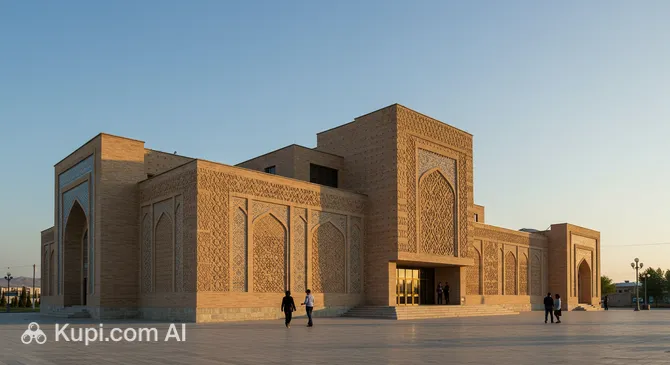
Imagine a world-class treasure hidden in the heart of the desert. The Savitsky State Museum of Arts, located in Nukus, is one of the most incredible cultural landmarks that Uzbekistan is proud of. This place is often called the "Louvre in the Desert" due to its unique and incredibly rich collection.
Savitsky Museum. Illustration.
Source: Kupi.com AI
Traveler photos:
Founded in 1966 by artist and collector Igor Savitsky, the museum houses approximately 100,000 exhibits. It features not only the folk and applied arts of Karakalpakstan and ancient artifacts from Khorezm but also the world's second-most significant collection of Russian avant-garde art from the 1920s and 1930s. This makes the museum a pilgrimage site for art historians and tourists from all over the world.
The modern museum building has become a true symbol of the region, uniting four millennia of history under one roof. From Zoroastrian antiquities to canvases by unrecognized masters, every hall of the museum tells a gripping story of the struggle to preserve cultural heritage during challenging times.
Contacts
To plan your visit to this unique cultural center, we recommend saving the contact details in advance. The museum is located in the heart of the region's administrative center.
A visit to the museum is a fascinating journey through the centuries. Begin your exploration in the Fine Arts department, which showcases works of the "Turkestan avant-garde." The canvases of early 20th-century masters, rescued by Savitsky, are striking in their expression and originality—something you won't find in any other museum in the world.
Special attention should be paid to the archaeological collection. Here you can see rare Zoroastrian ossuaries, elegant terracotta figurines, and ancient ceramics discovered during excavations of Khorezm settlements. These artifacts allow you to literally touch the mysteries of ancient civilizations that once flourished in these lands.
Don't forget to visit the Ethnography hall to appreciate the beauty of traditional Karakalpak costumes, jewelry, and carpets. We recommend booking a guided tour: a professional guide will share incredible stories about how this collection was formed and why Nukus became a magnet for art lovers from across the globe.
Getting There
Finding the Savitsky Museum is easy—it is located in the very center of Nukus on the city's main square. If you arrive by plane, the most convenient way to reach the museum is by taxi. The ride from the airport takes about 20–30 minutes, depending on traffic.
For those traveling by train, shuttle taxis and buses run from the railway station to the central districts. Since the city is quite compact, the museum is only a 5–10 minute walk from most central hotels. For precise navigation, online maps are very helpful, as the museum is one of the main landmarks in this part of Karakalpakstan.
Nearest city: Nukus
History & Facts
The history of this place is inextricably linked to the fate of Igor Vitalyevich Savitsky. A Moscow artist who first arrived in the region in 1950 as part of the Khorezm Archaeological and Ethnographic Expedition, he was so enchanted by the local culture that he decided to dedicate his life to its preservation. His journey began with collecting items of traditional folk life in remote villages.
The museum officially opened its doors on February 15, 1966. Savitsky, who became its first director, showed incredible courage: during an era of strict censorship, he began collecting works by avant-garde artists who were considered "non-conformist" and even dangerous in the USSR. He traveled across the country, purchasing canvases from the widows of artists and saving masterpieces from destruction in basements and attics.
Surprisingly, Savitsky managed to convince the authorities to allocate funds to expand the collection, creating a safe haven for art in remote Nukus. His efforts led to the formation of Central Asia's largest collection of artifacts and paintings. Today, the museum is rightfully considered a monument to human passion for beauty that managed to transcend ideological boundaries.
Time Needed
To thoughtfully explore the exhibition and not miss important details, visitors are recommended to set aside 3 to 4 hours. The museum's collection is vast and diverse, so a quick walk-through won't allow you to fully appreciate the scale of the treasures gathered here.
For true art connoisseurs and avant-garde researchers, a visit can easily take the entire day. Given Nukus's distance from major tourist routes, many visitors prefer to come twice to view both the archaeological finds and the extensive painting collection with a fresh perspective.
Working Hours
The Savitsky Museum welcomes guests according to the following schedule: from Tuesday to Thursday, it is open from 09:00 to 18:00. On Friday, the museum is open until 19:00, allowing extra time for an evening visit. On Saturday and Sunday, the hours are slightly shorter: until 17:00 on Saturday, and from 10:00 to 17:00 on Sunday.
It is important to remember that Monday is a day off. Before planning your trip, especially during holiday periods, visitors are advised to check the official website or contact the museum directly, as operating hours may change.
Day
Opening hours
Monday
Закрыто
Tuesday
09:00–18:00
Wednesday
09:00–18:00
Thursday
09:00–18:00
Friday
09:00–19:00
Saturday
09:00–17:00
Sunday
10:00–17:00
Nearby
While the Savitsky Museum is the primary destination for many travelers, a walk through its surroundings will allow you to deeper experience the city's atmosphere and see modern life in Nukus. Several interesting monuments and examples of urban architecture are within walking distance.