Support

Santo Pekoa International Airport

About the Airport

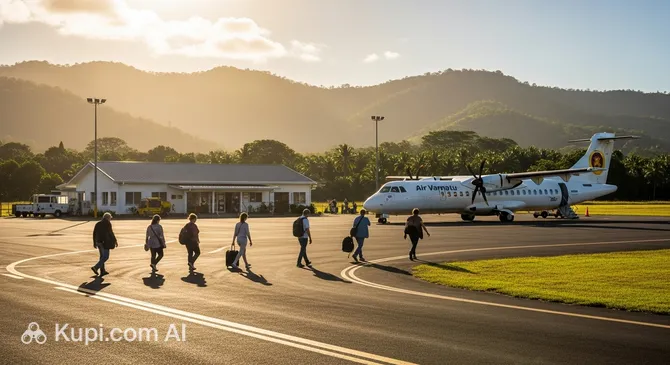
Santo Pekoa International Airport. Source: Kupi.com Binoculars

Santo Pekoa International Airport is more than just a transit hub; it is a true gateway to a hidden world of adventure on the island of Espiritu Santo. Immediately upon landing, you will feel that distinct relaxed tropical atmosphere, where time flows a little differently, and the air is filled with the scents of the ocean and exotic flowers. This small but charismatic airport serves as a starting point both for divers seeking legendary shipwrecks and for history enthusiasts wishing to touch the heritage of World War II. There is no metropolitan bustle here, and your journey through Vanuatu begins with a smile from the local staff right on the runway.

IATA Code SON
ICAO Code NVSS
City Luganville
Distance to Centre 6 km
Status International
Passengers per Year Approx. 80,000 – 100,000
Schedule Available on the online board

Features and Advantages of the Airport

The main "highlight" of Santo Pekoa is its rich history. The airport was built by American military engineers in 1942 and was originally called "Bomber Field No. 2". Echoes of that time can still be found in the vicinity of the terminal, making it a unique open-air monument. At the same time, despite its respectable age and modest size, the airport successfully fulfills the role of the country's second most important hub, receiving flights from Australia and neighbouring islands.

For travellers, the airport's location is a huge advantage. It is located just a few minutes' drive from the famous diving site — the sunken liner "SS President Coolidge", as well as near popular beaches and resorts. Thanks to the compactness of the terminal, all formalities here are completed much faster than in capital airports: very little time usually passes from the moment of leaving the plane to collecting luggage and getting into a taxi, allowing you to start your holiday as quickly as possible.

Contact Information

Below is the main contact information for Santo Pekoa International Airport (SON). It is important to note that the airport is managed by Airports Vanuatu Ltd (AVL), so most official contacts lead to their central services. For issues directly related to your flight, it is recommended to contact the airline directly.

  • Official Website: All official information about Vanuatu airports, including Santo Pekoa, is published on the management company's website: www.airports.vu.
  • Help Desk Phone: General contact number for Airports Vanuatu Ltd: +678 25111.
  • Airport Address: Santo-Pekoa International Airport, Luganville, Espiritu Santo Island, Vanuatu.
  • Email: For general enquiries, you can use the official AVL email: info@airports.vu.
  • Social Media: News and updates can be tracked on the official Airports Vanuatu Ltd Facebook page.
  • Lost Luggage Information: For questions regarding lost or damaged luggage, please contact your airline's representative directly at the airport. Airport services do not handle luggage tracing.
  • Passenger Support Contacts: For general information about airport services, use the phone and email provided above. For questions regarding booking, ticket changes, flight check-in, and other specific topics, please contact your airline.

How to Get to the Airport

Santo Pekoa International Airport (SON) is located just a few kilometres from the city centre of Luganville, making the journey there quick and convenient. The trip from the centre usually takes no more than 10-15 minutes. To travel to the airport, you can choose from several modes of transport to suit your budget and travel style.

Public transport in Vanuatu is mainly represented by private minibuses, easily recognised by the letter "B" on the number plate. This is the most affordable way to get around. They do not have a strict schedule or fixed stops — you simply "flag down" the bus on the road and tell the driver where you need to go. The trip to the airport will be inexpensive, but be prepared that the driver may pick up other passengers along the way, which will slightly increase travel time.

For greater comfort, you can use a taxi or book a transfer. Taxis (look for the letter "T" on the plates) offer a direct and fast route to the airport. It is strongly recommended to agree on the fare with the driver in advance, as meters are not always used. Many hotels and resorts also offer a transfer service to and from the airport for their guests, which is a very convenient, albeit more expensive, option.

Car rental is an excellent choice for those planning to explore the beauties of Espiritu Santo island on their own. There are several rental agencies in Luganville. By renting a car, you can not only get to the airport in comfort but also be completely free in your movements around the island. It is better to book a car in advance, especially during the peak tourist season.

If you arrive at the airport in your own or a rented car, parking is at your disposal. There is a parking lot near the terminal where you can leave your car for both short and long periods. This is a small airport, so finding a space is usually not difficult.

Terminals and Map

Santo Pekoa International Airport (SON), despite its status, is a compact and convenient aviation hub. Contrary to expectations that may arise from the word "international", the airport consists of one small terminal, which serves both domestic flights within the islands of Vanuatu and a limited number of international destinations.

The terminal layout is extremely simple and intuitive. All key areas — check-in counters, the waiting lounge, the arrival area, and baggage claim — are located in one building on a single level. Thanks to this, navigation causes no difficulties, and there is no need to transfer between terminals. You will easily find everything you need by following simple signs.

The departure area and the arrival area are located in close proximity to each other. The process of flight check-in and passing pre-flight security usually takes significantly less time than in major airports, thanks to the low passenger flow. Nevertheless, for international flights, it is recommended to arrive 2 hours in advance, and for domestic flights — 1-1.5 hours before departure, to avoid any unforeseen situations.

The main feature of the terminal is its simplicity and almost home-like atmosphere. There is no hustle and bustle or long queues here, which makes the stay at the airport comfortable and calm. The main advice for navigation is simply to follow the flow of other passengers, as it is practically impossible to get lost here. It is the ideal place for a smooth start and finish to your journey across the picturesque island of Espiritu Santo.

Airport History

The history of Santo Pekoa International Airport (SON) is inextricably linked with the events of World War II. Unlike many civilian airports, it was founded not for commercial, but for military purposes. Its construction began in 1942 by the US Army Corps of Engineers, who in the shortest possible time turned the island of Espiritu Santo into a major forward base for the Allies in the South Pacific.

Initially, the airfield was named "Bomber Field No. 2" and was one of several fields built in the vicinity of the city of Luganville. It served as the main base for heavy bombers, such as the B-17, which flew missions as part of the Solomon Islands campaign and, in particular, the Battle of Guadalcanal. The scale of construction was colossal: up to 100,000 military personnel were stationed on the island, and the airfields could accommodate hundreds of aircraft simultaneously.

After the end of the war, American troops left the island, leaving behind a huge amount of equipment and developed infrastructure, including runways. "Bomber Field No. 2" was transferred to civilian management and eventually transformed into the island's main airport. It became a key transport hub connecting Espiritu Santo with the rest of the world and the capital of Vanuatu, Port Vila.

Over the decades, the airport has been repeatedly modernised to accommodate modern passenger aircraft. The runway was reconstructed, and a new terminal was built. Today, Santo Pekoa is capable of receiving international flights, mainly from Australia and New Caledonia, playing a crucial role in the development of tourism. It is especially important for divers arriving from all over the world to explore famous shipwrecks, such as the liner "President Coolidge", which is located just a few minutes' drive from the airport.

Interesting fact: to this day, abandoned military equipment and remnants of World War II structures can be found in the jungles around the airport. Thus, every tourist flying into Santo Pekoa literally lands on a living fragment of history, where the echoes of war coexist with tropical tranquillity.

Services and Facilities

Santo Pekoa International Airport (SON) represents the main air gateway to Espiritu Santo island. As befits a small regional airport, it provides a basic but sufficient set of services for a comfortable wait for your flight.

The terminal houses a small café where you can have a sandwich, coffee, or a refreshing drink. There are also shops offering local souvenirs, travel essentials, and some duty-free goods. This is an excellent opportunity to buy something to remember your holiday by.

A general lounge is provided for waiting for flights. Although there are no separate VIP areas, the environment is usually calm. Passengers generally have access to Wi-Fi, and there are power outlets for charging electronic devices, allowing you to stay connected before departure.

Financial matters can be settled on-site: the airport has a currency exchange point and/or ATM for withdrawing cash in the local currency (Vatu). In case of minor indisposition, staff are ready to provide first aid. Basic conditions have been created for passengers with reduced mobility, and staff will always assist with boarding and disembarking from the aircraft.

There are no hotels directly on the airport grounds, but many accommodation options — from cosy guesthouses to hotels — are located within a few minutes' drive. Specialised business services or conference rooms are not provided within the terminal itself, but they can be found in hotels in the nearby city of Luganville.

Where to Eat

When planning a departure from Santo Pekoa International Airport (SON), it is important to consider that this is a small regional airport, and the choice of dining establishments here is quite limited. Unlike major international hubs, you will not find a wide variety of restaurants and food courts here. Nevertheless, it is still possible to have a snack before your flight.

Usually, a small café or snack bar operates in the main terminal building. Most often, such establishments are located in the public area (before passing security control), but sometimes a small kiosk with drinks and snacks can also be found in the departure lounge. The assortment generally includes coffee, tea, soft drinks, sandwiches, pastries, and light snacks. This is quite enough to satisfy mild hunger while waiting for a flight.

If you are counting on a full lunch or dinner, the best solution would be to eat at one of the establishments in the city of Luganville before travelling to the airport. In the airport itself, a selection of hot meals will most likely be unavailable. regarding local Vanuatu cuisine, sometimes you can find local snacks in the café, for example, taro chips or pastries with coconut, but this is not guaranteed.

Passengers with specific dietary requirements (vegetarians, vegans, as well as those looking for gluten-free or Halal dishes) will find it extremely difficult to find suitable options at Santo Pekoa Airport. It is recommended to bring food with you to avoid inconvenience. Prices at the airport are generally higher than in the city, and café opening hours are usually tied to the flight schedule.

Travel Tips

To ensure your journey through Santo Pekoa International Airport (SON) goes smoothly and without unnecessary hassle, take advantage of our tips. This small but important air hub is the gateway to Espiritu Santo island in Vanuatu, and knowing a few nuances will make your trip more comfortable.

Arrival time at the airport. For international flights, it is recommended to arrive 2-3 hours before departure. This time is enough to calmly complete all formalities. For domestic flights, arriving 1-1.5 hours in advance is sufficient. The airport in Luganville is not very big, but it is better to have a buffer of time.

Check-in and security. Check-in and security control procedures here usually go faster than in major hubs. Keep your passport and ticket ready. Airport staff are friendly and always ready to help. With online check-in, you can select a convenient seat in advance.

Choosing a seat on the plane. Flights around Vanuatu are very picturesque. If you want to enjoy views of coral reefs and tropical islands from above, choose a window seat. An aisle seat is suitable for those who plan to get up during the flight.

Hand luggage rules. Standards are mostly international: liquids (shampoos, lotions) can be carried in containers of no more than 100 ml, packed in one transparent bag. Sharp objects, weapons, and flammable substances are prohibited. Always check your airline's rules.

Tips for transit passengers. If you are flying in transit through Santo Pekoa Airport, note that this is a small terminal. A key point is to check with your airline in advance whether you need to collect and re-check your luggage for the next flight. Facilities for long waits here are limited, so plan your connection accordingly.

Customs control. Upon arrival, you will need to fill out a declaration. Vanuatu has very strict biosecurity rules to protect its unique flora and fauna. Be sure to declare any food products, plants, and goods of animal origin. The import of fresh fruit, vegetables, and meat is usually prohibited.

Saving time and money. Book a taxi or transfer from the airport in advance to avoid inflated prices on the spot. There is a limited selection of food and drinks in the terminal building, so you can bring light snacks with you. Don't forget an empty water bottle, which can be filled after passing security.

If the flight is delayed. In case of a flight delay, remain calm. Contact your airline's counter for information and check if you are entitled to compensation (water, food, accommodation). Given the modest size of the airport, it is useful to have a book, a charged power bank, or downloaded films with you to pass the waiting time.

Airports in nearby cities

Reached the end of the page?

That means the route is fully explored