Estates of Moscow and Moscow Region
Who said you need a whole vacation for travel? There's such a cool format as a short travel trip. This is when you can go somewhere in the region for the weekend or pretend to be a tourist and explore all the sights in the city. For example, in Moscow and the Moscow region. They are rich in beautiful museum-estates where you can walk and enjoy your weekend.

Estates of Moscow
To go on a trip, sometimes you don't even need to leave Moscow. The capital holds many cool
locations: ancient estates of princes, counts, and other aristocrats. Walking through them, you
can immerse yourself not only in the park's tranquility but also in history.
Izmaylovo
Perhaps this is one of the most famous estates in Moscow. And there are reasons for that:
Izmaylovo is a former country residence of Russian tsars. And they, as is known, loved luxury and
comfort. So there is definitely something to see here. Moreover, the estate is located on the
capital's only man-made island (it is called Izmaylovsky) in the middle of the
Serebryano-Vinogradny Pond. In general, Izmaylovo is a unique historical complex of monuments
dating back to the 17th–19th centuries.
Previously, there was a continuous forest
here, which surrounded ancient Moscow and was used for royal hunting. The estate itself appeared
here by order of Tsar Alexei Mikhailovich Romanov (remember history lessons: this is Peter I's
father). So it's not surprising that the childhood and youth of Russia's future first emperor were
connected with Izmaylovo. Moreover, in 1685–1694, local groves were used for maneuvers of Peter's
'toy' regiments.
Around that time, the Bridge Tower served as the ceremonial entrance
to the estate. Now, it houses a branch of the State Historical Museum "Izmaylovo and the Rulers of
Russia."
Address: Gorodok imeni Baumana, 2, bldg. 14
Kuskovo
If Izmaylovo is one of the most famous estates in the capital, then Kuskovo is one of the most
romantic. It was once the summer residence of the Sheremetev counts. It was even called "Moscow
Region Versailles" to emphasize the elegance and beauty of the complex. Just imagine: a huge
landscaped area with beautiful buildings and a picturesque park with sculptures and ponds. Kuskovo
truly resembled a garden of French kings.
Alas, not all of this wealth has survived to
our days. However, even today you can see more than 20 architectural monuments here. Among them
are the palace, grotto, a large stone orangery, and an ancient church.
Address:
Yunosti Street, 2
Vorontsovo
The estate is located in the park of the same name. Vorontsovo is a true architectural monument of
the 18th–19th centuries. It once belonged to the boyar Fyodor Vasilyevich Voronets. Today, it is
an excellent place for solitude and leisurely strolls.
Just imagine: a quiet evening,
the scent of linden trees, the rustle of oak crowns, and disabled smartphone notifications… Isn't
this true relaxation? By the way, the trees growing on the territory saw the first owner of these
lands. And today, anyone can walk in their shade and enjoy the cascade ponds.
Address:
Vorontsovsky Park, 3
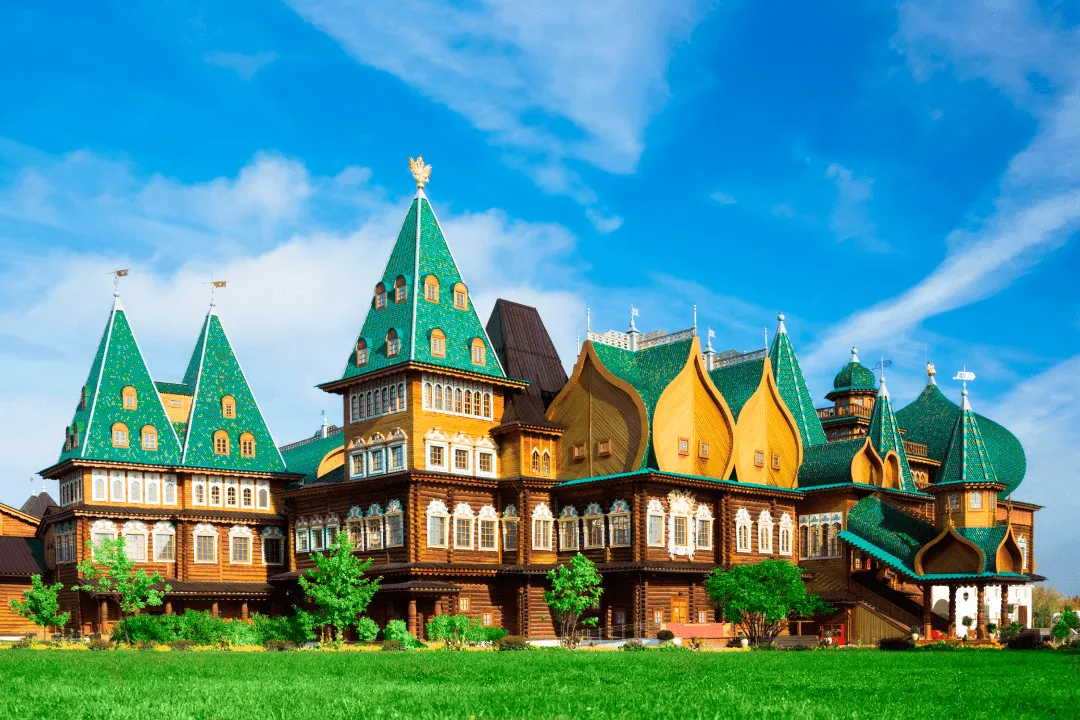
Kolomenskoye
Let's start with an interesting fact: archaeological excavations were once conducted here. During
these, it was discovered that the first people appeared on the territory of today's Kolomenskoye
Park as early as the 1st millennium BC.
Fifteen centuries later — in the 14th century
(AD) — these places became the summer country estate of Moscow tsars.
Today, the
ancient patrimony of Russian rulers is part of an artistic historical-architectural and
natural-landscape museum-reserve (yes, it sounds complicated). If we omit all the clever terms, we
can simply say: Kolomenskoye is a significant location for researchers and a favorite spot for
photo shoots for Muscovites and city guests. The latter particularly enjoy the view of the Moskva
River from Kolomenskoye. Many ancient historical and architectural monuments have been preserved
on the estate's territory.
Address: Andropova Prospekt, 39
Lefortovo
Another former residence of rulers. This time — emperors. The construction of the garden and park
ensemble in Lefortovo began in the 18th century. At that time, the entire process was concentrated
in the hands of one of Peter I's closest associates — Fyodor Alekseevich Golovin. Through his
efforts, Lefortovo Park was created, somewhat resembling the Versailles ensemble.
Shady alleys and ponds have survived to this day. Among the historical architectural
objects, there are also remnants of an 18th-century red brick terrace and the semi-ruined Grotto
of Rastrelli (that's the guy who built the Winter Palace in St. Petersburg, by the way, here are
tickets to Moscow). In addition, Lefortovo has preserved a dam-bridge that divides the ponds into
Upper and Lower.
Address: Krasnokazarmennaya Street, 3
Ostankino
Don't confuse it with the tower. The magnificent Ostankino Palace, which belonged to the
Sheremetev counts, is a true delight of 18th-century Russian art. This paradise for aesthetes has
everything: architecture, sculpture, painting, graphics, theater, and decorative art. Nowadays,
exhibits are collected here that tell the touching love story of a serf actress and Count
Sheremetev.
However, in the autumn of 2012, the palace went for restoration (and has
not yet reopened). For this reason, about 3,500 exhibits were sent to other museums. Alas, the
park is also currently closed, but you can view the facades.
Address: 1st
Ostankinskaya Street, 5
Altufyevo
The first mentions of the estate date back to the 16th century. In those days, Neupokoy Myakishev
(sounds like a joke, but that was really the man's name) looked after these lands. He was the
key-keeper of the Bread Court (ironic, given his surname). Unfortunately, the buildings from that
time have not survived to this day — the Time of Troubles interfered. The estate was completely
ruined and burned down.
Then these territories passed from one owner to another until
they eventually came into the possession of the noble family of Oltufyevs. In fact, in those days
it was called that way: with an "o". It was later that Muscovites renamed the estate to
"Altufyevo".
Today, you can see the manor house that belonged to the Oltufyevs (though
time has not spared it, so visually it indeed looks ancient), the Church of the Exaltation of the
Holy Cross, and the Altufyevsky Pond.
Address: Altufyevskoye Highway, 149
Petrovsko-Razumovskoye
This beautiful Baroque-style estate appeared in Moscow in the 18th century. In its time, these
lands passed as a dowry to Naryshkina, becoming the property of Count Razumovsky. Around the same
time, the estate received its current name — Petrovsko-Razumovskoye.
Today, it houses
the Timiryazev State Agrarian University. Alas, currently, the historical part of the park is not
accessible for free visits. You can only get there on a guided tour as part of an organized group
or on specific memorial dates. However, you can freely walk through Timiryazevsky Park with its
ponds and sculptures. Entrance is open to guests and residents of the city.
Address:
Timiryazevskaya Street, 47-49
Cheryomushki
In 1678, this noble estate belonged to Prince Prozorovsky. Later, Fyodor Ivanovich Golitsyn became
its owner. Today, it houses a scientific organization — the Institute for Theoretical and
Experimental Physics.
Interestingly, the estate's territory is divided in two by
Bolshaya Cheryomushkinskaya Street. On one side, there is the Parade Courtyard, the manor house, a
large park with a pond, and on the other — the Stable Yard and outbuildings.
In
general, there were many country estates of Moscow nobility in the Cheryomushki area once. But not
all of them have survived to this day. Cheryomushki is one of the surviving ones. The estate has
preserved its main building, regular and landscape parks. Since the Institute for Theoretical and
Experimental Physics is now located in the building, part of the territory is closed for walks.
Address: Bolshaya Cheryomushkinskaya Street, 25-28
Grachyovka
This was once a luxurious estate in the merchant eclecticism style. It miraculously survived to
this day. Grachyovka is also called "Moscow Region Monte Carlo" due to the architectural
similarity of the main house. It is richly decorated with stucco, turrets, and sculptures. In its
time, the owner of the estate — merchant Grachyov — built his palace in the style of the gambling
house of the Principality of Monaco.
During the Soviet era, the estate fell into
disrepair: the church was abandoned, the park neglected, rural houses demolished, and the
Likoborka River was channeled into a collector. But now the Znamenskaya Church and the manor house
have been restored. So Grachyovka remains a good location for walks.
Address:
Klinskaya Street, 2
Neskuchnoye
The location is also known by another name — Neskuchny Garden. There's plenty to walk around here:
even linden alleys, fountains. In short, it definitely won't be boring. Plus, in different parts
of the park, you can spot picturesque buildings of the old Neskuchnoye estate.
In fact,
on the territory of the modern Neskuchny Garden, there were once several noble estates:
Trubetskoy, Golitsyn, as well as the estates of Orlov and Demidov. Now you can see the preserved
Alexandrinsky Palace, the maid of honor's building, the hunting lodge, and the former riding
arena. There is also a representative building with outbuildings here — it houses the Academy of
Sciences, so tourists are not allowed inside. But you can walk around the landscape park as much
as you like.
Address: Leninsky Prospekt, 14-20
Estates of Moscow Region
Already explored all the beautiful capital locations? Then here are some ideas for where you can go for a weekend trip and which museum-estates to visit in the Moscow Region.
Bykovo, Zhukovsky District
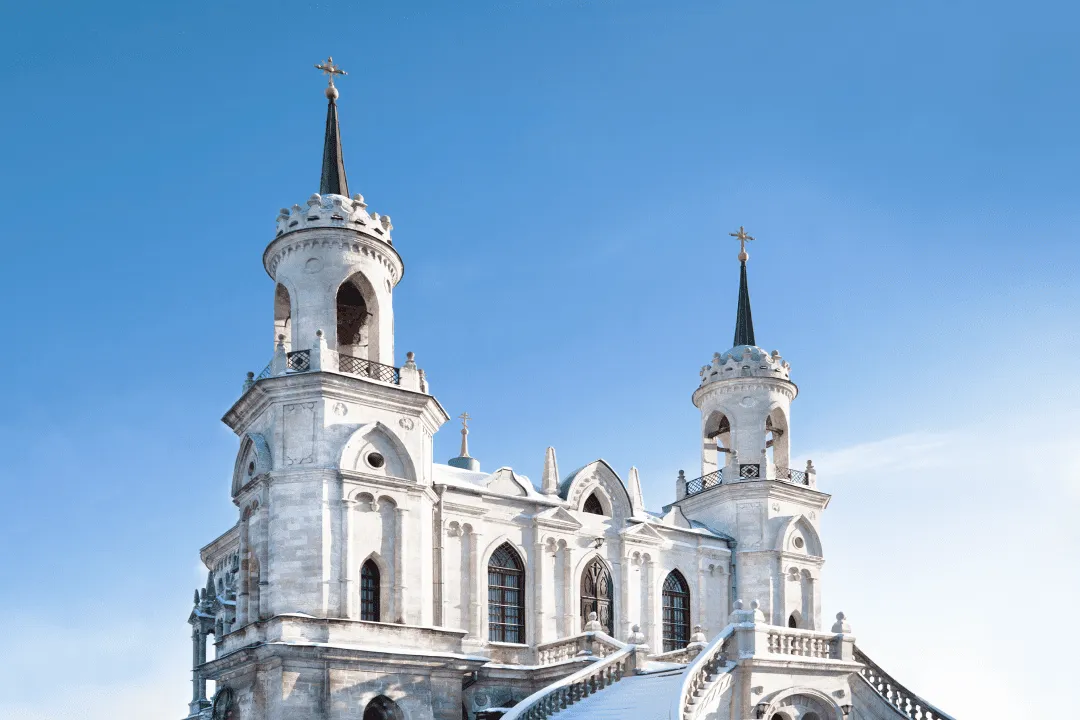
Not far from the village of Bykovo is an estate that has changed several eminent owners during its
existence. The most famous of them is Count Vorontsov-Dashkov. It was under him that the main part
of the palace and park ensemble, which has survived to this day, appeared on the estate. This is
the very red stone palace with statue-columns and a tower for an observatory.
Alas,
the estate is now abandoned, although many buildings have been preserved. Among them are the
palace itself, a garden with a rotunda gazebo, and an active church in pseudo-Gothic style. And,
of course, you can walk through the park and find ponds and semi-ruined statues.
Address: Bykovo settlement, Ramensky District, Moscow Region
Marfino, Mytishchi District
Another Moscow Region estate that has changed more than one owner. It was successively owned by
the Golitsyns, Saltykovs, Orlovs, and Panins. From the former, a church in the Golitsyn Baroque
style remains. After the Saltykovs, the stone palace they built, a rotunda gazebo, a stable yard,
a staircase with griffins, and a pier have been preserved. The Panins, in their time, redesigned a
large part of the architectural ensemble, supplementing existing buildings with elements of Empire
style and Nikolayev Neo-Gothic.
During the reign of Catherine II, all Moscow nobility
gathered in Marfino. Hunts, theatrical performances, and balls were held here. Centuries later,
the beauty of these places attracted filmmakers. More than a dozen films were shot here, ranging
from Soviet classics to modern cinema. Marfino can be seen, for example, in the films "A Friend
Among Strangers, a Stranger Among Friends," "The Woman Who Sings," "The Master and Margarita," and
"The Crusader."
Currently, there is an active sanatorium here. Therefore, to enter the park territory and walk to
the palace, you need to obtain a pass at the checkpoint. So, if you plan to visit Marfino, bring
your passport.
Address: Marfino village, Moscow Region
Abramtsevo, Sergiev Posad District
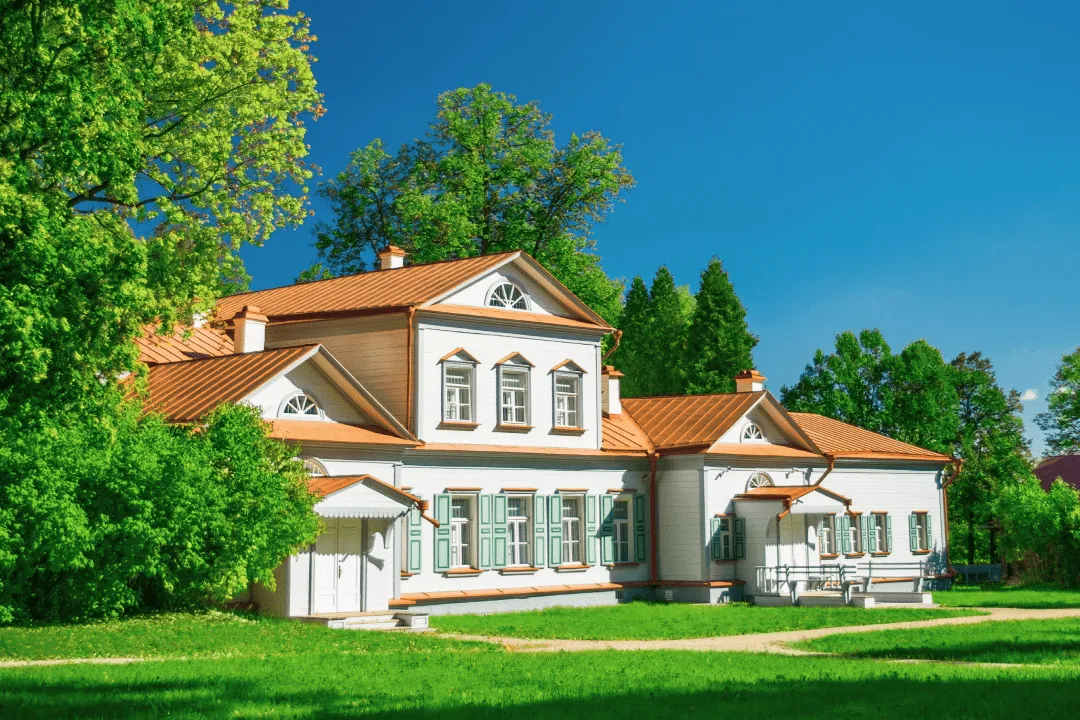
The names of Russian writers are also associated with this estate. Abramtsevo was once owned by
the writer Aksakov, who often hosted Tyutchev, Turgenev, the philosopher Khomyakov, and the
outstanding ethnographer Kireevsky. Gogol also visited here. Moreover, he even had a separate room
where the writer rested for long periods. An interesting fun fact: in 1849, Gogol read several
chapters of the second volume of "Dead Souls" to the guests and owners of Abramtsevo.
Later, Mamontov, a well-known industrialist and patron of the arts, became the owner
of the estate. Repin, the Vasnetsov brothers, Vrubel, and Chaliapin visited him.
Today,
the estate has become the "Abramtsevo" Museum-Reserve. Now you can not only walk through the
picturesque territory but also look inside, where exhibitions and displays of ceramic and wooden
products await.
Address: Abramtsevo village, Muzeynaya Street, 1, Khotkovo urban
settlement, Sergiev Posad urban district, Moscow Region
Vasilyevsky Castle, Odintsovo Urban District
If you want to see something Victorian, then this is the place for you. Vasilyevsky Castle estate
was built at the end of the 19th century and once belonged to the Shcherbatov princes. Visually,
this red brick mansion with a tower and an openwork balcony strongly resembles the estate of some
English aristocrats of the Victorian era. This makes the estate unlike any other in the Moscow
Region.
It is also worth mentioning the first owners of Vasilyevsky Castle. The
Shcherbatovs were quite eccentric and active personalities. The prince bred Arabian horses and
even sent peasants to agricultural exhibitions in England for experience exchange. The princess
traveled extensively in Asia: she visited India, Indonesia, Singapore. Under the Shcherbatovs, an
exotic garden and a library with tens of thousands of books were arranged on the estate's
territory. And roe deer roamed the park.
Today, it is a good location for a mini-trip.
Alas, it is unlikely you will be able to get inside the castle itself, but walking around the
mansion is possible and even recommended. The places here are beautiful: the Moskva River flows
nearby, across which a hundred-meter suspension bridge stretches.
Address: Herzen
Sanatorium settlement, Odintsovo Urban District, Moscow Region
Dubrovitsy, Podolsk District
Once, Peter I's tutor, Prince Golitsyn, lived here. Under him, the main attraction of the estate, the Znamenskaya Church, was built. An interesting fact: no historian knows which architects Golitsyn summoned and from where to erect this temple. But we are sure of one thing: the church looks very unusual against the backdrop of traditional Orthodox architecture. By the way, because of this dissimilarity, the temple was initially even refused consecration.
The main house has also been preserved in Dubrovitsy. However, it has been rebuilt many times, so
today it represents a mixture of several Baroque style directions. Currently, inside are one of
Russia's largest specialized libraries dedicated to animal husbandry and the "Golitsyn"
restaurant, named after the former owner of Dubrovitsy.
Address: Dubrovitsy
settlement, Podolsk District, Moscow Region
Gorenki, Balashikha
This estate changed many owners, but perhaps its heyday came during the period when it belonged to
Count Razumovsky. He rebuilt the palace, created a magnificent park with gazebos and cascade
ponds, and grew exotic plants in the orangery, making Gorenki famous for its unusual and unique
garden at that time. It's no wonder that at the turn of the 18th–19th centuries, the estate became
one of the most impressive in the Moscow Region.
Today's travelers can freely walk through the territory of Gorenki Park along shady alleys around the ponds. However, getting into the museum-estate is not so simple: entry is only possible by appointment as part of an excursion.
Address: Enthusiastov Highway, 6, Balashikha, Moscow Region
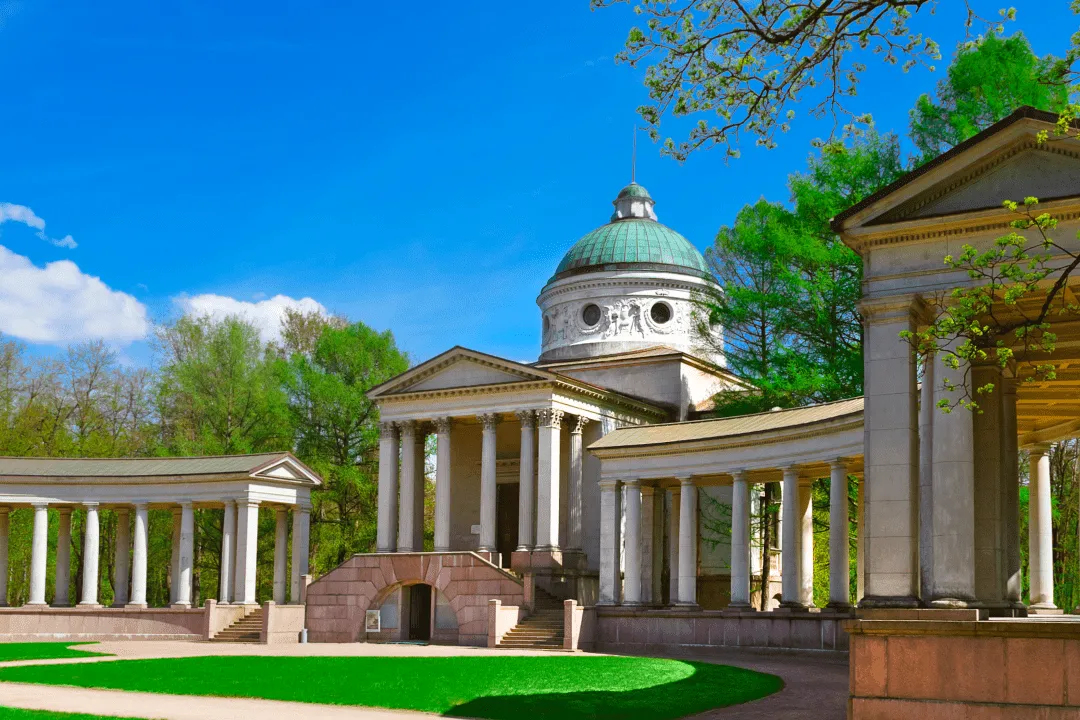
Arkhangelskoye
Arkhangelskoye is considered one of the most beautiful palace and park ensembles in the Moscow
Region. And rightly so: for three hundred years, the estate was owned by the Odoevsky, Golitsyn,
and Yusupov princes. On its territory, there are several parks: French, Italian, and English.
Thanks to them, Arkhangelskoye was considered the "Moscow Region Versailles."
The
estate is also famous for one of the largest collections of sculptures not only in the Moscow
Region but throughout Russia. For the most part, it consists of works by Italian masters of the
late 18th — early 19th centuries.
Many figures of Russian culture appeared in Arkhangelskoye in their time. Pushkin was among them. So if you want to relax in peace and quiet, head to Arkhangelskoye.
Address: Arkhangelskoye settlement, Krasnogorsk, Moscow Region
Serednikovo
Fans of literary places, we recommend a trip to Serednikovo. This architectural and park ensemble
is an example of Russian classicism architecture and one of the most famous Lermontov places in
Russia. It was in this estate that the future author of "A Hero of Our Time," Mikhail Lermontov,
spent his summer holidays. By the way, the local landscapes inspired the poet, so descriptions of
these locations can be found in his early poems. For example, the estate itself and the fast
Goretoyka River.
Currently, excursions are conducted here, so you can visit the
ceremonial courtyard and the manor house
only as part of a group.
Address: Mtsyri Sanatorium settlement, bldg. 1, Solnechnogorsky District, Moscow Region
Ivanovskoye, Podolsk
Once, at the beginning of the 19th century, this Moscow Region estate belonged to Leo Tolstoy's
great-uncle — Fyodor Tolstoy. Later — to Count Zakrevsky. Under the latter, Ivanovskoye became a
kind of center of social life. Representatives of Moscow nobility came to the estate to visit and
watch theatrical performances.
Now, anyone can come here. Travelers will find a large
bright house with columns on the bank of the Pakhra River, a building with a semi-rotunda where a
serf theater once stood, and outbuildings. By the way, Ivanovskoye is one of the best-preserved
classical noble estates in the Moscow Region.
Address: Parkovaya Street, 1, Podolsk,
Moscow Region.
Muranovo, Pushkinsky District
This place is better known as Tyutchev's estate in Muranovo. But the history of the estate is
connected not only with this poet. Baratynsky once lived here, under whom the main house was
built. The poet decided to leave for Muranovo after the Decembrist uprising to lead a calm and
measured life away from the city's hustle and bustle. Later, Tyutchev's family began to live here.
The poet married the niece of Baratynsky's wife (we know, it's complicated, but such were the
family ties between the poets). It's no wonder that many eminent writers visited Muranovo in their
time, including Gogol.
Today, the estate houses a museum dedicated to Tyutchev and Baratynsky. It contains about 28,000
exhibits, almost 10,000 books, and a collection of antique furniture (for a moment, one of the
largest in the country). It's worth coming here not only to study the literary heritage. On the
estate's territory, there is a very quiet park with linden and rose alleys, ancient oaks, and
picturesque ponds. So, like Baratynsky in his time, you can come to Muranovo to relax from the
hustle and bustle of the big city in the shade of the trees.
Address: Ashukino urban
settlement, Muranovo village, Pushkinsky Urban District, Moscow Region
Here are some ideas for a weekend trip from us. Once you've visited all the estates in the capital and the region, you can embark on a journey along Russia's Golden Ring. How does that sound?