How to transport musical instruments on a plane?
If you plan to sing by the campfire with a guitar, are going to perform at a classical music concert, or are bringing a drum from your vacation to get revenge on your neighbors for renovations — this material is for you. We tell you how to take a musical instrument with you on a flight, where to put it, and how to transport it so that it arrives safe and sound.
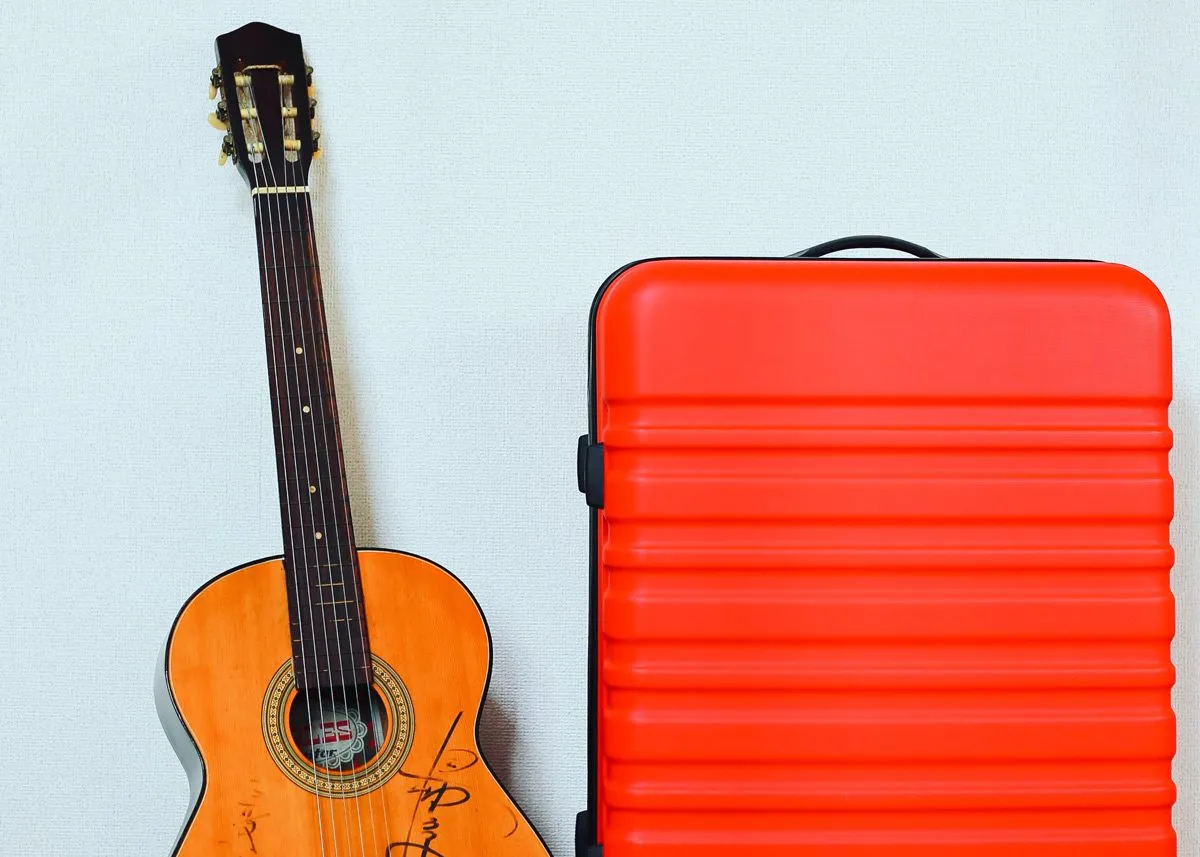
You can transport musical instruments:
• as carry-on baggage;
• in the cabin with a separate seat;
• as checked baggage within the allowance of the chosen fare;
• as checked baggage as a separate cargo.
Before taking your favorite guitar on a plane, call the airline you are flying with and clarify the procedure. Some carriers will allow you to take it into the cabin, while others will only allow it as checked baggage.
When the instrument is transported in the cabin
As a rule, fragile and small, oversized instruments can be taken as carry-on baggage, but only if they fit within the permissible parameters. Such instruments include a flute, violin, viola, trumpet, clarinet, French horn, accordion, drum.
Fragile and large, oversized musical instruments can also travel in the cabin, but there’s a catch — such musical baggage is transported on a separate passenger seat. Therefore, for your guitar or, say, cello to take its honored place in the cabin, you will have to buy a separate airline ticket for it. In addition to a guitar and cello, a synthesizer, harp, lute (you’d better Google what that is yourself), or accordion can travel in the cabin with an additional ticket.
You won’t be able to save money on this — discounts do not apply to such tickets: the seat is purchased at the adult fare for the full price, just like for the passenger accompanying the musical cargo. At the same time, unlike regular baggage, for such oversized and fragile items, you will be issued a separate boarding pass, not a baggage claim tag.
It is important to note that such baggage will need to be secured to the passenger seat, so the musical instrument must be in a case.
As a rule, the following requirements apply to baggage occupying a passenger seat:
• weight not exceeding 80 kg;
• dimensions to fit into a standard seat — no more than 135×50×30 cm (the dimensions and weight of the transport case or other packaging are taken into account, not the musical instrument itself);
Although you purchase two seats, the free baggage allowance according to the fare is only valid for one ticket — the second seat purchased for the musical instrument will not give you the right to carry more items. Thus, if you bought two tickets and are taking a cello with you, you will still be able to take no more than the standard allowance of carry-on baggage and checked baggage. And remember that you will have to load and unload musical baggage yourself, so pack wisely.
When the instrument is transported as checked baggage
Transporting musical instruments on a plane is not so scary if the instrument stays with you in the cabin: you can carefully place it in a seat (if you still decided on this financial sacrifice) or on the overhead bin. But what if you need to check it as baggage, where there is a risk of damaging, scratching, or breaking an expensive item?
Occasionally, such troubles happen: if the plane enters a turbulence zone, unsecured items in the baggage compartment can roll around and shake. To eliminate risks, follow these recommendations:
• place the instrument in a hard and durable case or cover;
• register it as fragile cargo — it will be marked with a tag and placed in a special compartment where the likelihood of damage to special baggage is minimal.
Another way is to register it as unaccompanied baggage. This type of baggage is used for giants like grand pianos or pianos, which do not fit into baggage allowances and certainly not into a seat. But this does not mean that the cargo option is only suitable for “heavyweights.” It is also convenient to transport other, relatively light musical instruments this way — for example, a double bass.
How to prepare a musical instrument for a flight
• Purchase a hard protective case made of durable material — these are sold in music stores. In such a case, the musical instrument will be held securely and will not be damaged.
• Clarify the rules and regulations for carriage with the airline you plan to fly with.
• If you are traveling abroad with an instrument of cultural value, check the customs and export regulations of your country of departure. You may need to obtain a special certificate or passport proving that the musical instrument or bow is not unique and can travel freely.
Transporting musical instruments on a plane: important tips
You have learned how to transport musical instruments on a plane, called the airline, prepared the necessary documents, and purchased a protective case. Here are a few more tips to do everything safely and carefully.
• Most airlines require notification of travel with musical instruments 36 hours before departure — remind the carrier in advance. If you don’t, there’s a risk that the airline will refuse to check you in for the flight, especially if you are carrying a large instrument.
• Loosen the strings on string instruments — guitars, ukuleles, violins. Pressure changes at altitude, so some strings might simply snap. If the musical instrument is fragile and is traveling as checked baggage, it makes sense to take out insurance in case it is damaged during transportation. It can be insured either as an add-on to the main policy or separately.