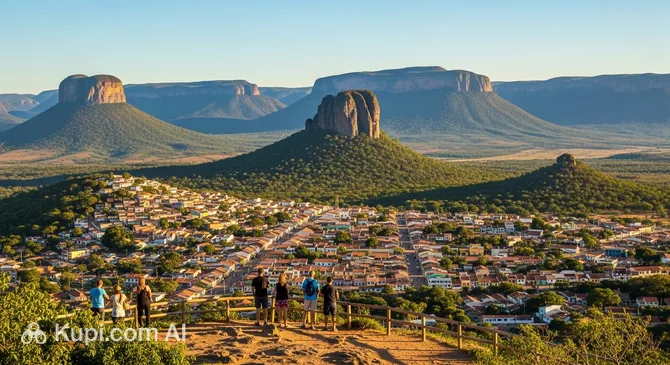
Although Carolina is known primarily as a gateway to wilderness and waterfalls, the city itself and its surroundings offer tourists a harmonious combination of green zones and cultural heritage. Here, vast national reserves coexist with cozy city squares, and the region's history is carefully preserved within the walls of museums and on the facades of old buildings.
Parks and Natural Areas
The absolute dominant feature of the region is the Chapada das Mesas National Park (Parque Nacional da Chapada das Mesas). This is not just a park, but a huge conservation area covering more than 160,000 hectares. For a tourist, this place is interesting primarily for its unique landscapes: here you can see the transition from savanna (Cerrado) to Amazonian forests. The park is home to many rare species of animals and birds, and its table mountains create a unique horizon that can be admired even from the city.
Within the city, the role of the main green oasis is played by Praça José Alcides de Carvalho. This is the "heart" of Carolina, surrounded by trees that provide saving shade on hot days. In the evenings, the square turns into a lively meeting place where locals relax with their families. For tourists, it's a great location to feel the measured pace of life in the Brazilian backlands while sitting on a bench under the rustle of palms.
Museums and Cultural Heritage
The main guardian of the city's memory is the Carolina Historical Museum (Museu Histórico de Carolina). The museum's exhibition is small but dense: it tells the story of the region's development, from the times of the first settlers and indigenous peoples to the era of trade prosperity and rubber extraction. It features household items from past centuries, old photographs, religious artifacts, and documents. Visiting the museum allows for a deeper understanding of what this remote corner of Brazil lived for throughout the centuries.
The entire Historical City Center can safely be called an open-air museum. Strolling through the streets, you will see dozens of perfectly preserved mansions in colonial and Art Deco styles. These buildings with high doors and windows, decorated with traditional tiles, are living evidence of Carolina's rich past. Many of them are recognized as national historical heritage sites, and a photo walk here will be a real journey through time.
Architectural Monuments
Among the architectural objects, a special place is held by the Church of São Pedro de Alcântara (Igreja de São Pedro de Alcântara). It is not only the main religious symbol of the city but also an important historical monument. The strict yet elegant architecture of the temple stands out against the city's skyline, and inside reigns an atmosphere of peace and tranquility.
Insider Tip
For an authentic experience, head to the Tocantins River waterfront, in the ferry crossing area, closer to sunset. This is not an official park, but it is here that the best view of the river and the setting sun opens up. Locals often come here just to sit by the water, watching the boats and enjoying the evening cool away from tourist groups.