Why visit Sochi's Dendrarium?
In this article, we explore why tourists are so eager to visit and whether it's worth queuing for the funicular to see the city from the park's highest point.
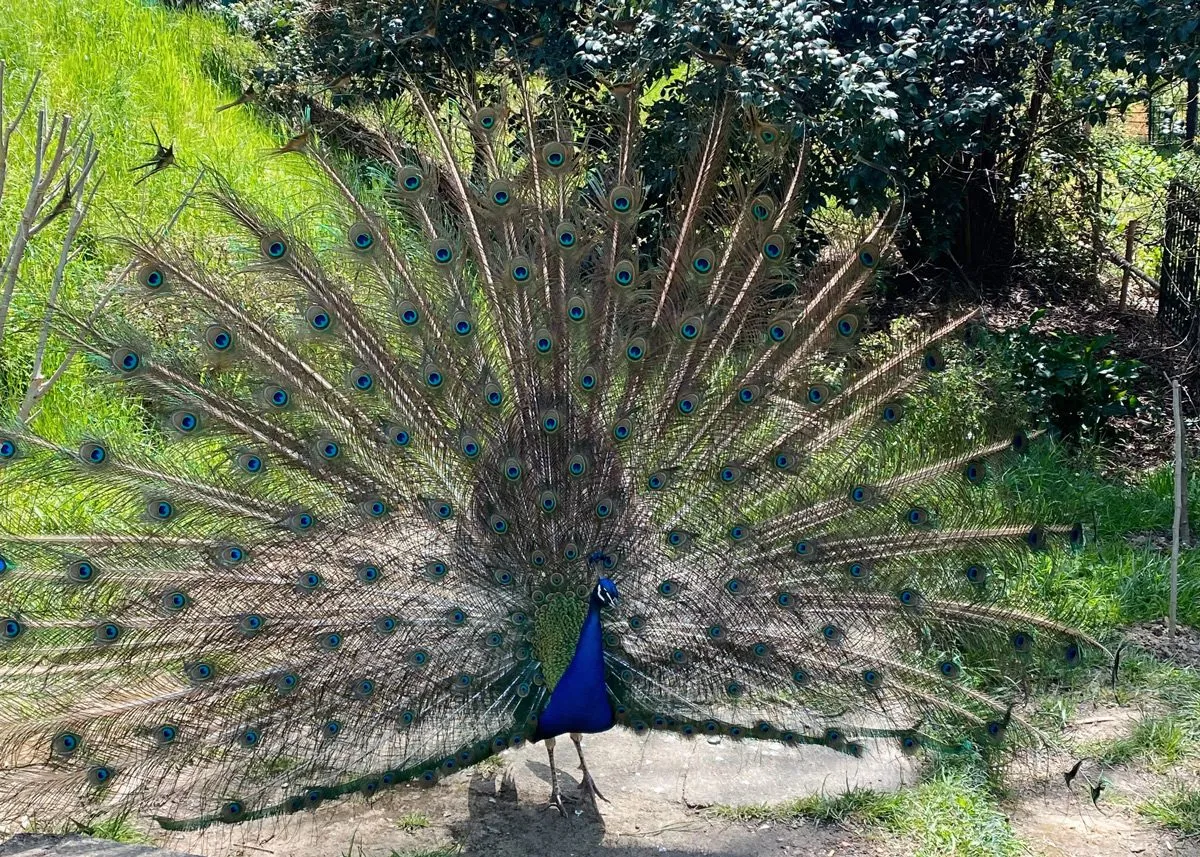
Prices at Sochi's Dendrarium
For children. If a child is under 7 years old, admission is free. For children aged 7 to 14, the ticket price is 150 rubles.
For adults. A regular ticket to both parts of the Dendrarium costs 320 rubles. You can also purchase a monthly pass (2,500 rubles) or an annual pass (6,750 rubles) for visits. If you're staying in Sochi for a long time and are interested in botany, keep this in mind.
In addition to the main park, you can visit the exhibition at Villa Nadezhda with a guided tour. Admission to the park + villa for adults costs 400 rubles, for children (from 7 to 14 years old inclusive) — 250 rubles. Tours are conducted at 11:40, 13:20, 15:10, 17:15.
Categories of people who can visit the park for free:
• children under 7 years old;
• disabled persons of groups 1 and 2 and their accompanying persons;
• WWII veterans, combat veterans;
• persons exposed to radiation due to the Chernobyl disaster and tests at the Semipalatinsk test site;
• Heroes of the Soviet Union, Heroes of the Russian Federation, and full holders of the Order of Glory;
• large families.
Opening hours
The park is open daily from 9:00 to 17:00. Ticket offices close at 16:00.
The schedule changes depending on the season.
Dendrarium website: https://npsochi.ru
Phone: +7 (862) 265-89-09
Email: forest_sochi@npsochi.ru
History of Creation
Before the Revolution
Sergey Khudekov, a playwright, journalist, ballet historian, publisher of "Peterburgskaya Gazeta," and collector, is considered the founder of the dendrarium. Throughout the 19th century, gardening was a widespread hobby in the Russian Empire: everyone loved flowers. Chekhov, for example, personally planted flowers at his Crimean dacha, while Kuprin conducted experiments on plant cross-breeding.
Wealthier people, like Sergey Khudekov, invested significant money in their hobby. In 1889, Khudekov, a member of the Imperial Horticultural Society, purchased a plot on the slope of Lysaya Gora near the Black Sea coast, built an Art Nouveau villa, and named it "Nadezhda" in honor of his wife. With the help of German landscape architect Karl Lemgau, he arranged a dendrarium modeled after a French terraced garden. By this time, Khudekov already had experience in park design: he had created a similar dendrarium in the 1870s in Ryazan Governorate, in the village of Yerlino. The local Yerlinsky Dendrarium still exists there.
The park planted 400 species of trees and shrubs, brought from Crimea, the Caucasus, and Germany. Sculptures ordered were installed as decorations, some of them dedicated to ballet — Khudekov's passion. Gradually, the number of plants increased to 550 species.
After the Revolution
After 1917, the park was nationalized by the Bolsheviks. It then received its current name — "Dendrarium." The collection gradually expanded. When Kurortny Prospekt (then Stalin Avenue), the city's longest thoroughfare, began to be built in Sochi in the 1930s, the Dendrarium was divided into upper and lower parts — a division that remains to this day.
1940s and Our Time
In the 1940s, a new stage in the Dendrarium's development began. It came under the management of researchers from the Sochi Forest Experimental Station. Over the next thirty years, the Dendrarium's collection was constantly replenished, and then a cable car appeared, connecting parts of the park, which tourists still use today.
Today, the park's collection includes over 2,000 exotic and rare plants from all regions of the world — from North and South America to East Asia. The park's territory covers a vast 49 hectares.
Dendropark Territory
Due to Kurortny Prospekt crossing the park, it is divided into two parts: upper and lower. It's best to explore the park from top to bottom: first, ascend by cable car or electric buggy, admire the panoramic view from the observation deck, then slowly descend the slope and proceed to the lower part of the Dendrarium.
The observation deck accommodates about 80 people. From there, you can see resort Sochi, the port, the coast, and the mountains of the Caucasus Range. There's a paid viewing binocular to get a closer look at everything.
The park's zones are grouped geographically; you can find plants from South and North America, Australia, Oceania, New Zealand, Europe, and Asia. A distinctive feature of the Dendrarium is the large number of conifers: there are palms, junipers, cedars, and cypresses. The most picturesque parts of the upper park are the sequoia grove, palm alley, ostrich farm, and Chinese courtyard. In spring, in April and May, magnolias bloom in the Dendrarium. Tourists recommend taking a guided tour, otherwise the abundance of plants, often without labels, can be confusing.
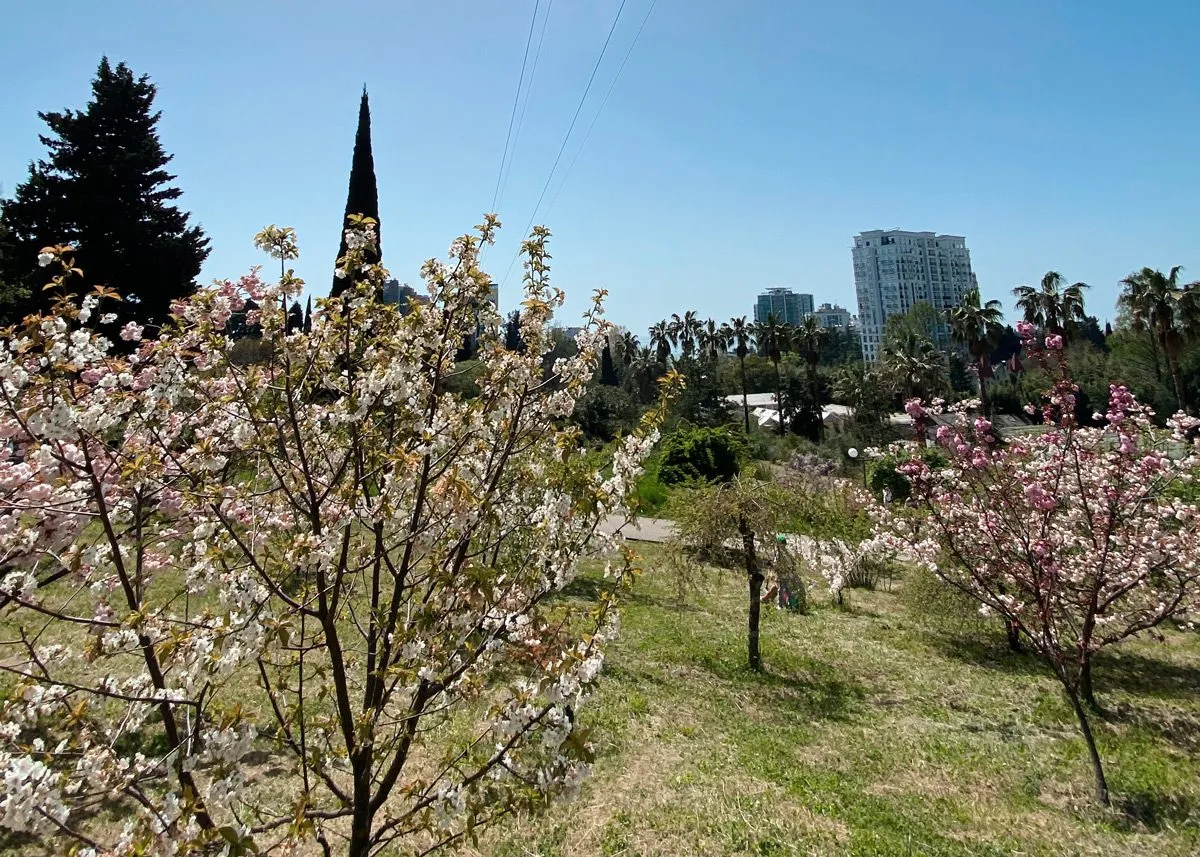
Villa Nadezhda is one of the main attractions of the upper Dendrarium, evoking associations with parks in European capitals. It is an elegant, yet unpretentious house with an observation tower, a large terrace, openwork railings, and a wide staircase that leads directly to the sea. Today, the villa houses the Khudekov Museum. The exhibition is dedicated to the collector's pursuits and passions: theater and ballet.
The lower part of the park is gentle, more compact, and convenient for walks, making it a good place to visit with children. It is connected to the upper part by an underground passage beneath Kurortny Prospekt. The main attraction of the lower Dendrarium is the green bamboo grove, where people queue to take photos. There are many ponds with birds, bridges, and small islands. Children will enjoy the aquarium with Red Sea inhabitants: moray eels, stingrays, and piranhas. Besides aquatic animals, in the lower Dendrarium, you can see rabbits, squirrels, turtles, beavers, and pelicans freely roaming the park.
There are no cafes or restaurants within the park. Exploring both parts of the Dendrarium will take approximately three to four hours, so it's best to bring snacks and water with you, especially if you're vacationing in Sochi in summer when it's hot outside. There are few benches for resting, so gather your strength before your visit.
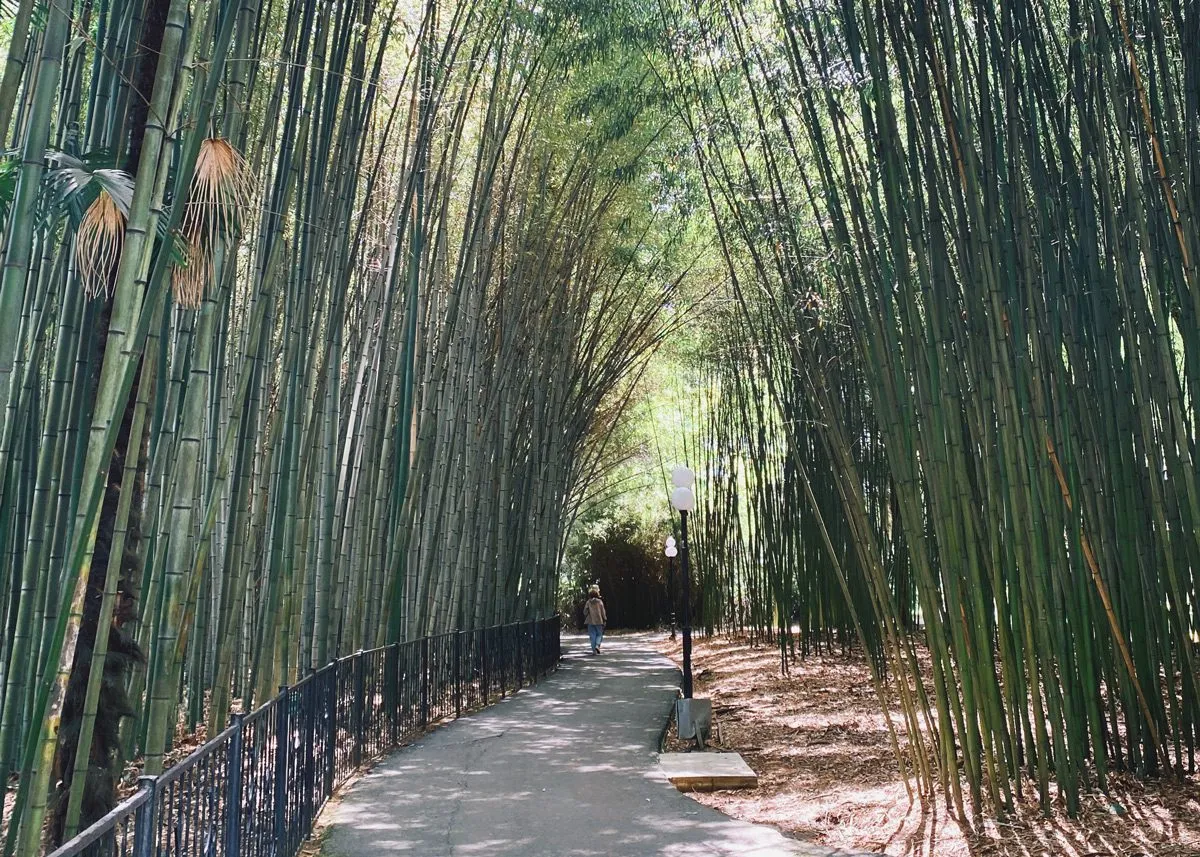
Cable Car
The Dendrarium is located on a mountain slope, and to walk through the entire park, good physical fitness is required. If you don't want to walk uphill, you can take the funicular via the cable car. The cable car connects the upper and lower points of Sochi's Dendrarium. The length of the route is about 900 meters, each cabin accommodates 20 people, and the funicular runs every 15–20 minutes.
How to get there. The easiest way to reach the cable car is from the "Tsirk" (Circus) or "Sanatorium imeni Yana Fabritsiusa" bus stops. Ticket offices are also located there.
Operating hours. The cable car operates according to the park's schedule, without breaks or days off.
Summer: from 8:00 to 19:00
Winter: from 9:00 to 16:00
In summer, the cable car is completely packed: queues can be 40 minutes, or even an hour long. It is believed that there are fewer people in winter and spring, however, some visitors write in reviews on "Yandex.Maps" that their wait in early January (!) took a full hour and a half. It's best to buy a one-way ticket and walk down from the top. At the top, there are observation decks offering views of the Black Sea and mountains.
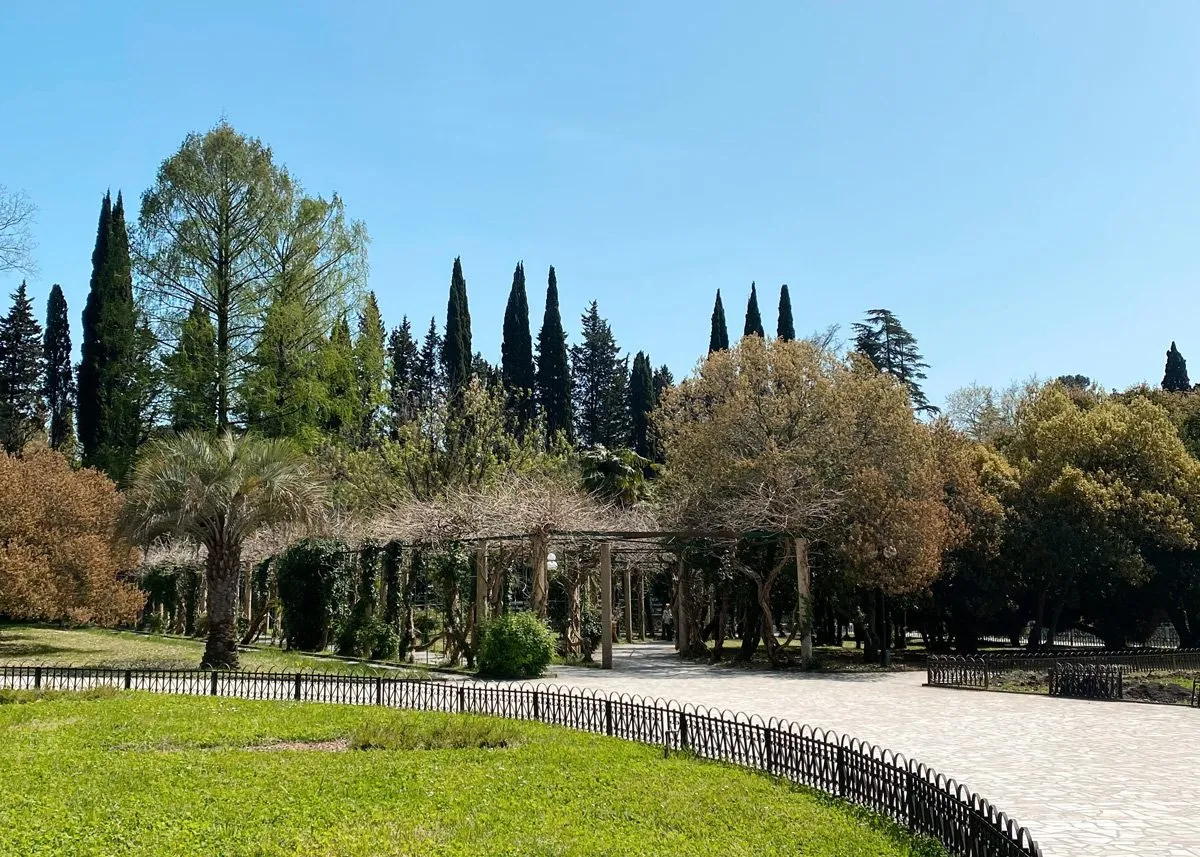
How to get to the Dendrarium
The "Dendrarium" park is located in Central Sochi. It's approximately 30–40 minutes from Adler airport, where all flights to Sochi land.
Park address: Kurortny Prospekt, 74. It's about a twenty-minute walk from the Zhemchuzhina Hotel.
From Central Sochi, where the Sea Port, Navaginskaya Street, and Gorky Street are located, buses with numbers 105, 105c, 550, 551, 12, 19, 2, 22, 3, 41, 86 go to the park. A one-way ticket costs 32 rubles, and according to local custom, payment is made upon exit: either by card or cash to the driver. You need to get off at the "Tsirk" (Circus) stop and walk to the park for about seven minutes.
From Adler you will need to take buses 105c, 551, 552 and get off at the "Sanatorium imeni Yana Fabritsiusa" stop.
For personal transport there is parking near the Dendrarium.
As a rule, Sochi buses have signs with a list of stops. You can use them for orientation. Don't hesitate to ask drivers if the bus or minibus goes to the Dendrarium: there are many tourists in the city, so locals are used to answering such questions and will help you choose the right transport.
Where to stay nearby
• Pullman Sochi Centre 5* Hotel — a modern hotel with a pool, private beach, and spa services;
• Metropol Apart-Hotel — a hotel with a panoramic pool and a volleyball court;
• SHARDEN Apart-Hotel — an inexpensive hotel one kilometer from the city center.
And don't forget to subscribe to our Telegram channel! There you'll find: selections of cheap tickets, private sales for subscribers, the latest news on entry rules to countries worldwide, and simply interesting travel content — travel hacks, guides, and expert advice.


