Support

Batna Airport

About the Airport

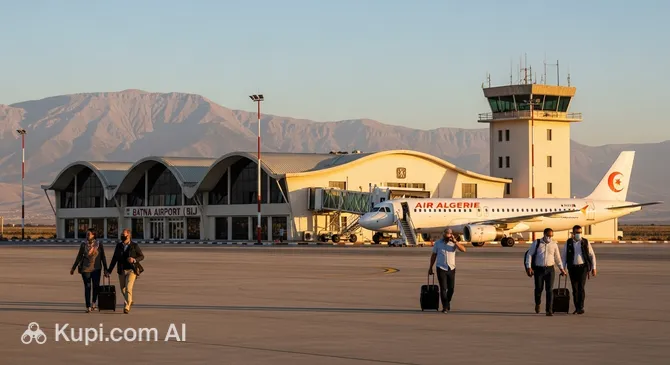
Batna Airport. Source: Kupi.com Binoculars

Batna Airport, named after Mostépha Ben Boulaïd (Mostépha Ben Boulaid Airport), serves as the air gateway to the city of the same name and the picturesque Aures mountain region in northeastern Algeria. Despite its modest size, the airport plays a vital role in transport connectivity, linking the province with both the country's capital and key European cities. For travelers eager to explore the historical and natural treasures of this part of the country, Batna Airport serves as a convenient starting point.

IATA Code BLJ
ICAO Code DABT
City Batna
Distance to Centre 35 km
Status International
Annual Passengers Over 13,000 (2020)
Popular Airlines Air Algerie, Transavia France, ASL Airlines France
Schedule Online Board "Batna Airport"

A key advantage of Batna Airport is its compactness and ease of navigation, allowing passengers to quickly complete all pre-flight formalities. The main operator here is the national carrier Air Algerie, which operates regular domestic flights, primarily to the capital, Algiers, as well as international flights to France (Paris, Lyon, Marseille). The airport features a single passenger terminal that serves both domestic and international destinations. For passenger convenience, taxi services are available at the terminal exit, providing transport to the city centre or nearby localities.

Contact Information

To contact representatives of Batna Airport - Mostépha Ben Boulaïd (BLJ), you may use the following contact details. Please note that the airport is managed by EGSA Constantine, and many contacts may lead to their central office.

  • Official Website: Although Batna Airport does not have a separate website, current information can be found on the portal of the management company EGSA Constantine: www.egsa-constantine.dz.
  • Information Desk Phone: +213 33 92 10 10.
  • Address: Aéroport de Batna - Mostefa Ben Boulaïd, Batna, Algérie.
  • Email: For official inquiries, you can use the management company's email: contact@egsa-constantine.dz.
  • Social Media: Dedicated social media pages for the airport may not exist. It is recommended to follow news on the official EGSA Constantine website.
  • Lost Luggage Information: For issues regarding lost or damaged luggage, you should first contact your airline's representative at the airport. Information desk staff can also provide necessary assistance.
  • Passenger Support Service: For assistance and answers to questions, you can approach the information desk in the airport terminal or call the general inquiry number.

How to Get to the Airport

Batna Airport (BLJ), also known as Mostépha Ben Boulaïd Airport, is located approximately 35 kilometres north of the city centre of Batna in Algeria. There are several ways to get from the city to the airport, and the choice depends on your budget, time, and comfort preferences.

Taxi and Transfer — this is the simplest and fastest way to reach the airport. A taxi ride from the centre of Batna usually takes about 30-40 minutes, but time may vary depending on traffic conditions. The cost of the trip fluctuates around 1500–2500 Algerian Dinars (DZD). It is recommended to use official taxis or book a transfer in advance. Be sure to agree on the fare with the driver before starting the journey, as taximeters are not always used.

Public Transport offers a more economical alternative. Generally, local buses run between the city and the airport. The fare is significantly lower than a taxi, approximately 50–100 DZD. This option is suitable for travellers with light luggage and plenty of time. It is best to check the schedule and exact route at the bus station in Batna.

Car Rental is an excellent choice for those seeking maximum flexibility and planning to explore the region. Both local and international rental companies operate in the city. By renting a car, you can easily reach the airport at your convenience. Batna Airport has a parking area where you can leave your car for a short or long duration.

When planning your trip, consider that there are other air hubs in the region. Depending on your route, airports in neighbouring cities might be convenient. For example, Ain El Bey Airport in Constantine is about 65 km from Batna, while Setif Airport and Biskra Airport are at a distance of about 100-120 km.

Terminals and Map

Batna Airport (BLJ), also known as Mostépha Ben Boulaïd Airport, is a small regional air station with one passenger terminal. Its compact size and simple structure make navigation intuitively clear even for first-time visitors. The terminal serves both domestic flights within Algeria and a limited number of international destinations.

The layout of the terminal is extremely clear. Since there is only one building, you do not need to worry about transferring between different structures. Departure and arrival zones are under one roof but functionally separated. Immediately after entering the terminal, you find yourself in the general hall where check-in counters are located. After completing check-in and dropping off luggage, passengers proceed to the security screening area, and then to a small departure lounge with boarding gates.

Thanks to the modest size of the airport, all pre-flight formalities usually proceed quite quickly. There are no long queues typical of large international hubs here. Nevertheless, it is recommended to arrive at the airport in advance: approximately 1.5-2 hours before a domestic flight and 2-3 hours before an international one. This time will be sufficient to leisurely complete check-in, security control, and customs procedures if necessary.

To navigate the terminal, simply follow the standard signs in Arabic and French, as well as international pictograms. Getting lost here is practically impossible. All infrastructure — from check-in counters to boarding gates — is arranged in a logical sequence. If you have any questions, airport staff are always ready to assist.

Airport History

The history of Batna Airport, officially named after Mostépha Ben Boulaïd, a key figure in the Algerian struggle for independence, is closely linked to the development of the entire region. Initially, the airport functioned as a military airfield, but as the economic and tourism significance of the city and its surroundings grew, it was transformed into a civil aviation hub serving the eastern part of Algeria.

A real breakthrough in the airport's development was the major reconstruction and opening of a new passenger terminal in 2005. This event marked a new era for the region's air gateway. The modern building, designed to handle up to 500,000 passengers per year, significantly improved the quality of service. Along with the terminal, the runway was modernized, enabling it to accommodate larger aircraft types necessary for international flights.

Batna Airport plays a special role in the cultural and religious life of the country. Every year, it becomes one of the main departure centres for pilgrims performing Hajj. During this period, special direct flights to Saudi Arabia are operated from the airport, which is a significant logistical achievement and an important event for thousands of believers from the Batna province and neighbouring regions.

Interestingly, throughout its history, the airport has evolved from a small airfield into an important transport hub that serves as a gateway to the unique Aures region. It provides access to world-famous ancient Roman ruins such as Timgad and Tazoult, promoting tourism and maintaining the connection of this historic corner of Algeria with the rest of the world.

Services and Facilities

Batna Airport, despite its modest size, offers passengers all the necessary services for a comfortable wait for their flight. In the terminal, you will find several cafes and snack bars where you can have coffee, grab a sandwich, or try local pastries. Shops selling souvenirs, travel essentials, and press are also open. The selection may not be as wide as in major hubs, but the basic needs of travellers are covered here.

General waiting halls are provided for rest before departure. Passengers preferring enhanced comfort can use the services of the VIP lounge, where beverages, snacks, and a quieter atmosphere are usually offered. Wi-Fi is available on the airport premises, which may be paid or have limited free access time. For passenger convenience, there are power outlets and special stations for charging electronic devices in the waiting halls.

Inside the terminal building, currency exchange points and ATMs operate, allowing you to withdraw cash or exchange money upon arrival without issues. In case of unforeseen health situations, there is a medical point at the airport where first aid can be provided.

The airport has also taken care of passengers with special needs. A mother and child room is equipped for families with small children. Travellers with reduced mobility can count on staff assistance, and the terminal infrastructure includes ramps and specially equipped restrooms, ensuring a barrier-free environment.

There are no hotels directly on the Batna Airport grounds. However, the nearest hotels of various categories can easily be found in the city of Batna, which is just a few kilometres away. Specialized conference rooms or business centres are generally absent at the airport, but basic working conditions, such as internet access and quiet zones, can be found in the VIP lounge.

Where to Eat

Batna Airport (BLJ) is a small regional airport, so the choice of dining establishments here is quite modest and corresponds to its size. Passengers have access to basic options for snacks and purchasing drinks, but one should not expect a wide variety of restaurants as in large international hubs. The main food outlets are generally located in the public hall before security control (landside).

Most often, you can find one or several small cafes or snack bars in the airport. Their menu usually includes hot and cold drinks (coffee, tea, water, juices), as well as simple snacks: sandwiches, pastries, and packaged snacks. If you are lucky, you might find traditional sweets or dates from Algeria. This is a great option for a quick bite before departure or to quench your thirst upon arrival.

Regarding special dietary requirements, most offered products will be halal, which is the standard for the country. However, finding specialized vegetarian, vegan, or gluten-free dishes may be difficult. Prices in local cafes are usually moderate. Opening hours are generally tied to the flight schedule — they open a few hours before departure and close after the last plane departs.

Our tip: if you want a full lunch or dinner, it is better to do so in the city of Batna before travelling to the airport. The establishments at the airport are ideal for having a cup of coffee or buying a light snack for the road, but not for a substantial meal.

Travel Tips

To ensure your journey through Batna Airport goes as smoothly as possible, take advantage of these useful tips. Proper planning will help avoid stress and make the start of your trip pleasant.

Arrival time at the airport. Plan your arrival with time to spare. For domestic flights within Algeria, it is recommended to arrive 1.5–2 hours before departure, and for international ones — at least 2–3 hours. This will allow you to calmly complete check-in, drop off luggage, and pass security screening without rushing.

Check-in and security control. To save time, use online check-in if your airline provides such a service. Have your passport and boarding pass ready at the airport. Screening procedures are standard, but queues are possible during peak hours, so do not leave security checks until the last moment.

Choosing a seat on the plane. Consider your preferences when choosing a seat. Window seats (A, F) are perfect for those who enjoy admiring views during takeoff and landing. Aisle seats (C, D) provide more freedom of movement and are convenient if you need to stand up during the flight.

Hand luggage. Carefully review your airline's hand luggage rules, especially regarding size and weight. Remember the standard restriction on carrying liquids (no more than 100 ml in one container). Valuables, documents, gadgets, and portable chargers (power banks) should always be carried in hand luggage.

Connecting passengers. If you have a connecting flight, verify in advance whether your luggage will be automatically transferred to the next flight or if you need to collect and re-check it. Leave enough time between flights, especially if a change of terminals or passport control at the transit airport is involved.

Customs control. Be prepared for customs inspection when leaving or entering the country. If you are carrying large amounts of cash or goods subject to declaration, be sure to inform customs officers. Study customs regulations in advance to avoid misunderstandings.

Saving time and money. To avoid unnecessary spending, bring an empty water bottle and fill it after passing security. A light snack will also help save on expensive airport food. A pre-booked transfer to the city often proves cheaper than a taxi taken on the spot.

In case of flight delay. If your flight is delayed, first contact an airline representative for information. Depending on the length of the wait, you are entitled to drinks, meals, and in case of a long delay — hotel accommodation. Keep all receipts for forced expenses for potential compensation.
Reached the end of the page?

That means the route is fully explored