Support

Jijel Ferhat Abbas Airport

About the Airport

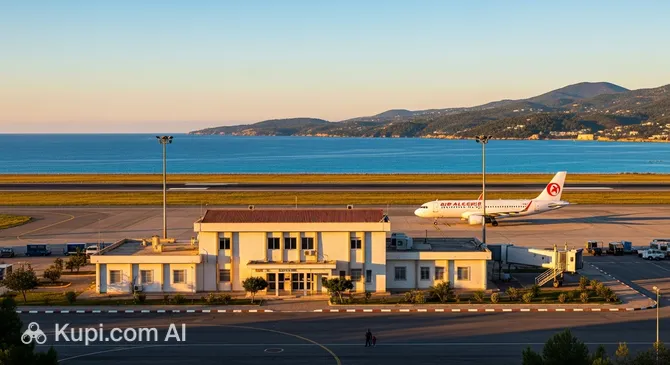
Jijel Ferhat Abbas Airport. Source: Kupi.com Binoculars

Ferhat Abbas Airport in Jijel is not just a transport hub, but a welcoming gateway to Algeria's "Emerald Coast," where dense forests descend to meet the waters of the Mediterranean Sea. This compact air harbour allows travellers to begin their acquaintance with the region without the hustle, noise, and long queues so characteristic of major international hubs. Thanks to its convenient location, just half an hour after landing, you can already be enjoying the sea breeze on the coast or exploring the picturesque mountain serpentines.

IATA Code GJL
ICAO Code DAAV
City Jijel
Distance to Centre ~14 km
Status International
Annual Passengers About 90,000 (capacity 200,000)
Schedule Available on the online board

Airport Features and Advantages:

Despite its modest size, Ferhat Abbas Airport plays a key role in the region's tourism life. Its main advantage is speed and comfort: the compact terminal allows you to pass through passport control and collect luggage in a matter of minutes. The atmosphere here is much calmer and more relaxed than in capital airports, which sets a holiday mood from the very first moments of your stay on Algerian soil.

Furthermore, the airport is renowned for its scenic location. Upon approach, passengers are treated to breathtaking views of the rugged coastline and green hills, making arrival here a distinct aesthetic pleasure. The airport also serves as a convenient starting point for visiting Taza National Park and the famous "Marvelous Caves" (Grottes Merveilleuses) located there, which are one of the region's main natural attractions.

Contact Information

Below you will find contact information for Ferhat Abbas Jijel Airport (GJL), which will help you plan your trip and contact airport representatives if necessary.

  • Official Website: The airport is managed by EGSA Constantine. Current information can be found on their official resource: www.egsa-constantine.dz. The direct website of Jijel Airport itself may be unavailable.
  • Information Desk Phone: +213 34 59 90 70. You can call this number to clarify general questions regarding airport operations.
  • Airport Address: Route Nationale 43, Taher, Jijel, Algeria.
  • Email: For official inquiries, you can use the management company's email: contact@egsa-constantine.dz.
  • Social Media: At this moment, the airport does not have confirmed official pages on popular social networks. We recommend following news on the management company's website.
  • Lost Luggage Information: If you encounter a problem with lost or damaged luggage, you must contact your airline's baggage tracing service directly. Airport staff do not handle these issues.
  • Passenger Support Contacts: For information regarding flight schedules, ticket purchases, carriage rules, and other questions related to your flight, please contact your airline.

How to Get to the Airport

Ferhat Abbas Jijel Airport (GJL) is located approximately 14 kilometres east of the city centre of Jijel, making the journey there quite quick. There are several ways to reach the terminal, each with its own features regarding time, cost, and convenience.

Taxi and Transfer — the most popular and comfortable option. The trip from the city centre to the airport usually takes 20-30 minutes, depending on traffic conditions. The estimated cost of a trip in an official taxi is 800-1500 Algerian Dinars. It is recommended to agree on the price in advance or ensure the driver has switched on the meter. Booking a private transfer through a hotel or online service is a reliable way to get to the airport without hassle, especially if you have a lot of luggage.

Public Transport in the form of buses may be available and is the most budget-friendly option — the fare rarely exceeds 50-100 Dinars. However, routes are not always convenient for tourists and may not go directly to the terminal, requiring an additional walk. This method is more suitable for thrifty travellers with light luggage. It is best to clarify information about routes closest to the airport on the spot, for example, at the Jijel bus station.

Car Rental — an excellent choice for those who value independence and plan to explore not only the city but also the picturesque surroundings of the coast of Algeria. Many rental companies have offices in the city. In a rented car, you can easily reach the airport by following road signs. Ferhat Abbas Jijel Airport has a car park where you can leave a vehicle for both short and long periods.

Terminals and Map

Ferhat Abbas Airport (GJL), serving the city of Jijel and its surroundings in Algeria, is a compact regional air hub. Its structure is simple and intuitive, making a stay here comfortable even for those travelling for the first time.

The airport consists of one passenger terminal. This single building serves both domestic and international flights, combining departure and arrival zones. Thanks to its small size, navigating the terminal causes no difficulties. All key areas — check-in counters, security screening, the waiting lounge, and baggage claim — are within walking distance of each other.

The terminal layout is extremely simple. Upon entering the building, you immediately find yourself in the general hall where check-in counters are located. After receiving a boarding pass and checking in luggage, passengers pass through the security checkpoint into the departure zone. The waiting lounge is small but offers basic amenities. The arrival zone is located in the same part of the building: after disembarking the aircraft, passengers head to the baggage claim belt, and then to the main hall where they are met.

Completing all pre-flight formalities at Jijel Airport usually takes significantly less time than at major international hubs. Typically, check-in and screening take no more than 30-45 minutes. Nevertheless, it is recommended to arrive at the airport in advance: 1.5-2 hours before a domestic flight and 2-3 hours before an international one, to avoid any unforeseen situations.

The main recommendation for navigation is simply to follow the signs. Due to the terminal's compactness, it is practically impossible to get lost here. There are no transfers between terminals as there is only one. This makes Ferhat Abbas Airport very convenient for passengers who value simplicity and speed of service.

Airport History

The history of Ferhat Abbas Airport in the city of Jijel is a clear example of the development of regional infrastructure in Algeria. Originally created as a military airfield, it was opened for national civil transport in 1983, becoming an important step in improving accessibility to the country's eastern coast. The airport received its name in honour of Ferhat Abbas, a prominent political figure and the first head of the Provisional Government of the Algerian Republic, underscoring its national significance.

A key stage in the airport's development was its large-scale modernisation in the early 2000s. One of the main achievements was the construction of a new, modern passenger terminal, which was inaugurated in July 2006. Its capacity was designed for 200,000 passengers per year, which was a record for the airport and allowed it to meet growing demand. In parallel, the runway was reconstructed and extended to 2400 metres, enabling the accommodation of larger aircraft, including the Boeing 737.

Although the airport has not been the arena for major historical events, its role in local history is invaluable. With its opening to international flights in 1993 and the subsequent launch of regular routes to France (specifically to Marseille), it became a "window to the world" for the Jijel province. This served as a powerful catalyst for economic growth, fostering tourism development on the picturesque Mediterranean coast and supporting business ties with the major industrial port of Djen Djen.

Among interesting facts, one can highlight its dual purpose. The airport continues to harmoniously combine civil and military functions today, serving as a base for the Algerian Air Force. This feature, characteristic of many regional airports with strategic importance, makes it not just a transport hub, but an important part of the infrastructure and a symbol of the development of eastern Algeria.

Services and Amenities

Ferhat Abbas Jijel Airport (GJL) is a small regional air station that provides passengers with all necessary services for a comfortable wait before departure. Despite its size, the terminal offers basic infrastructure focused on traveller convenience.

Several cafes and snack bars operate within the airport building, where one can drink coffee and purchase drinks and light snacks. There are also small shops selling souvenirs, press, and essential items. For a more comfortable wait, a VIP lounge may be available; it is best to clarify access conditions with airport representatives or your airline.

Access to the Wi-Fi network in the terminal may be limited, but zones for charging mobile phones and other gadgets are provided for passengers. Regarding financial services, ATMs are installed in the airport for cash withdrawals. It is recommended to check the availability and opening hours of currency exchange points in advance.

For emergencies, a medical point is available on the airport territory, ready to provide first aid. Passengers travelling with small children can use the mother and child room. For travellers with reduced mobility, assistance is provided for moving through the terminal and boarding the flight — for this, it is necessary to contact the airline in advance.

There are no specialised business centres or conference halls at the airport. Hotels are also absent on its territory, but various accommodation options can be found in the nearby city of Jijel, which is easily accessible by taxi.

Where to Eat

When planning a departure from Ferhat Abbas Jijel Airport (GJL), it is worth remembering that this is a small regional airport, and the choice of dining establishments here is quite limited. Nevertheless, passengers can find basic opportunities for a snack and rest before their flight.

Typically, in the main hall of the airport, accessible before passing security control (landside), one or two small cafes or snack bars operate. Here you can purchase hot and cold drinks, including coffee, tea, and water, as well as light snacks. This is the main option for both those waiting for departure and those meeting arrivals.

The assortment usually includes:

  • Quick snacks: sandwiches, pastries (croissants, buns), crisps, and sweets. This is an ideal option if you are short on time.
  • Drinks: espresso, cappuccino, traditional Algerian mint tea, and various soft drinks.

Regarding special offers, it is unlikely you will find full-service restaurants with extensive menus here. However, cafes may offer sandwiches with local ingredients or traditional pastries, allowing you to get a general impression of the cuisine of Algeria. Options for vegetarians, vegans, or people with a gluten-free diet are extremely limited, so if you have strict dietary requirements, it is recommended to bring food with you. All products generally comply with Halal standards.

Prices at the airport in the city of Jijel are usually moderate, but slightly higher than in the city itself. The opening hours of establishments are directly tied to the flight schedule — they are open during departure and arrival times. For a full lunch or dinner, it is better to choose one of the establishments in the city before travelling to the airport, as local cafes are primarily oriented towards quick and light snacks.

Tips for Travellers

To ensure your journey through Ferhat Abbas Airport in the city of Jijel, Algeria, goes as smoothly as possible, it is worth considering a few tips. Planning is the key to a calm start or end to a trip. It is recommended to arrive at the airport 2-3 hours before international flights and 1.5-2 hours before domestic ones. This will give you enough time for all procedures without rushing, even if queues arise.

To save time, use online check-in if your airline provides such an option. This will allow you to head straight to baggage drop-off or, if you are travelling light, to the security checkpoint. When passing through security control, be ready to present your boarding pass and passport, and remove laptops, tablets, and liquids in containers up to 100 ml, packed in a transparent bag, from your bag in advance.

When choosing a seat on the plane, consider your preferences. A window seat will offer beautiful views during takeoff and landing, while an aisle seat allows you to stand up freely without disturbing neighbours. To get your desired seat, try to check in for the flight as early as possible. Regarding hand luggage, be sure to check the weight and dimension allowances with your airline. Standard prohibitions apply to sharp objects, flammable substances, and liquids in volumes greater than 100 ml per container.

If you have a connecting flight, clarify at check-in whether you will need to collect and re-check your luggage at the intermediate airport. At customs control upon arrival, have your passport and completed migration card ready, if required. Honestly declare goods and currency if their quantity exceeds established limits to avoid misunderstandings.

In case of a flight delay, first contact your airline representative or the information desk to find out the reasons and estimated departure time. Remain calm and clarify what services (drinks, meals, hotel accommodation) you are entitled to depending on the duration of the wait. It is useful to have a portable charger, a book, or downloaded films in your hand luggage to pass the time.

Reached the end of the page?

That means the route is fully explored