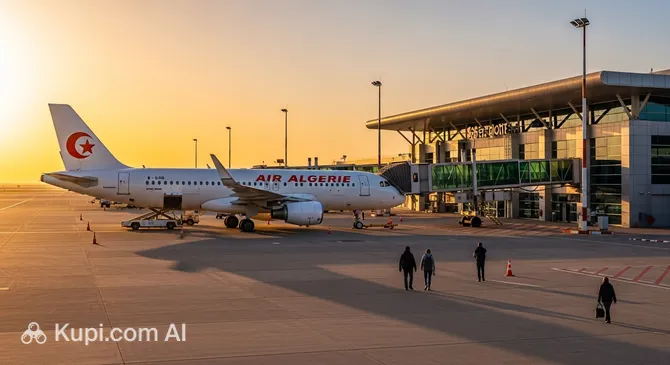
Source: Kupi.com AI
| Characteristic | Value |
|---|---|
| IATA code | QSF |
| ICAO code | DAAS |
| City | Setif |
| Country | Algeria |
| Time zone | Africa/Algiers |
| Popular airlines | Transavia, Volotea, Air Algerie |
| Schedule | Online timetable |
| Characteristic | Value |
|---|---|
| IATA code | QSF |
| ICAO code | DAAS |
| City | Setif |
| Country | Algeria |
| Time zone | Africa/Algiers |
| Popular airlines | Transavia, Volotea, Air Algerie |
| Schedule | Online timetable |
If you need to contact airport representatives in the city of Setif, please use the following contact details. Note that the airport is managed by EGSA Constantine, and some information is provided through their official resources.
Setif 8 May 1945 Airport (Aéroport de Sétif - 8 Mai 1945) is located approximately 10 kilometres southwest of the city centre of Setif, making it easily accessible for travellers. You can get from the city to the airport in several ways, suitable for different budgets and comfort levels.
Public Transport is the most economical option. Although there are no dedicated airport express trains in Setif, some city buses may operate on routes passing near the terminal. The fare is typically very low, amounting to just a few dozen dinars, making this the most budget-friendly method. It is suitable for tourists with light luggage who are comfortable navigating locally. Schedules and exact routes are best checked with local residents or at the bus station.
Taxi or Private Transfer is the fastest and most convenient method. A trip from the city centre to the airport usually takes about 15-20 minutes depending on traffic. The estimated cost of a taxi ride is 500-800 Algerian Dinars. Taxis are easy to find throughout the city, but it is strongly recommended to agree on the fare before the trip begins or ensure the driver turns on the meter. For greater convenience, especially if you have a lot of luggage or are travelling in a group, you can book a private transfer in advance. This guarantees a fixed price and timely vehicle arrival.
Car Rental offers maximum freedom of movement, especially if you plan to explore the surroundings of Setif and other regions of Algeria. Several rental companies operate counters at the airport and in the city. For those arriving in their own or a rented vehicle, paid parking is available on the airport grounds, where you can leave your car for both short and long periods.
The Setif Airport (QSF), also known as the 8 May 1945 Airport, represents a modern and compact aviation hub serving both domestic and international flights. Its structure is simple and intuitive, making the experience comfortable even for first-time travellers.
The airport consists of one main terminal, which completely eliminates the need for complex transfers or the use of shuttles. All infrastructure — from check-in to baggage claim — is located within a single building. This compactness is a significant advantage as it greatly saves passengers time and energy.
The terminal layout is logical and straightforward. Upon entry, you find yourself in the general hall where the check-in desks are located. After checking in and dropping off luggage, passengers proceed to the security control zone. Departure and arrival areas are clearly separated. The departure zone, located after passport and customs control, includes a small waiting lounge with boarding gates. The arrival zone consists of a passport control hall (for international flights), baggage reclaim belts, and a customs hall.
Completing all formalities at Setif Airport usually takes less time compared to major international hubs. Nevertheless, it is recommended to arrive at the airport in advance: approximately 2–2.5 hours before an international flight and 1.5 hours before a domestic flight. This allows sufficient time to calmly check in, drop off luggage, and pass through security screening.
To navigate the terminal, follow the signs, which are usually presented in Arabic and French, with key information duplicated in English. Due to the airport's small size, finding the correct desk, boarding gate, or baggage claim area is very easy. Airport staff are generally ready to assist with any questions, making your journey through Algeria even more pleasant.
The history of the airport in Setif is closely linked to key events in the life of Algeria. Its story began in the colonial period when the facility was built and used as a military airfield. After the country gained independence in 1962, it was converted for civil aviation needs to serve the growing demands of the region and become a vital aerial gateway for the eastern part of the country.
The official name of the airport — 8 May 1945 Airport (Aéroport de Sétif - 8 Mai 1945) — holds deep symbolic significance. It is named in memory of the events that took place on this date in Setif and other Algerian cities. These events are considered one of the turning points in the history of the national movement and hold an important place in the collective memory of the Algerian people. Thus, the airport's name serves as a constant reminder of this historic day.
A key stage in the modern history of the airport was a large-scale reconstruction, culminating in 2016 with the grand opening of a new passenger terminal. This event marked a new era for the air harbour: its capacity increased significantly, allowing it to handle a greater number of flights, including international ones. Modern infrastructure and improved service have made the airport more comfortable for travellers and attracted new airlines.
Today, Setif Airport is an important transport hub serving both domestic flights and routes to Europe, primarily to France. Its development serves as a vivid example of infrastructure modernisation aimed at stimulating economic growth and tourism in the High Plateaus region.
The Setif Airport (QSF) in Algeria offers passengers all necessary services for a comfortable wait before their flight. Before departure, you can have a bite to eat at one of the cafés, which serve light snacks, sandwiches, and beverages. Small shops also operate in the terminal, where you can purchase souvenirs, newspapers, and travel essentials.
For the convenience of travellers, comfortable waiting areas are provided within the airport building. Passengers preferring a higher level of comfort can utilise the VIP lounge services, offering a quieter atmosphere, beverages, and snacks. To stay connected, take advantage of the Wi-Fi access, and to charge electronic devices, look for designated stands or power outlets in the waiting zones.
Basic financial services are available at Setif Airport. You can use ATMs to withdraw cash or visit the currency exchange point to convert money. In case of unforeseen health issues, a medical point operates in the terminal, where qualified staff are ready to provide first aid.
The airport is equipped to serve passengers with special needs. For travellers with reduced mobility, ramps and specially equipped restrooms are provided, and airport staff will offer necessary assistance during boarding and disembarking (it is recommended to book this service in advance through your airline). Families with small children can make use of the mother and child rooms.
Although there are no hotels directly on the airport grounds, many accommodation options can be found in the city of Setif itself, which is a few minutes' drive away. For business travellers, basic business services, such as workspace and internet access, may be available in the VIP lounge, allowing for efficient use of time before departure.
Setif Airport (QSF), being a regional hub, offers passengers basic but convenient options for a snack or a full meal before departure. The selection of establishments here is not as extensive as in major international hubs, yet you will not go hungry. The main dining spots are concentrated in the main airport building, accessible to both departing passengers and those seeing them off.
In the public zone (before passing security control), there are several cafés and eateries. Here you can have a cup of coffee or tea, order soft drinks, and have a snack such as a sandwich, pastry, or light salad. This is the ideal option for those who have time before check-in or for those seeing friends off. After passing passport control and screening (in the departure zone), the selection is usually more limited and may be reduced to a small kiosk or vending machines with beverages and snacks.
Although there are no specialised restaurants with national cuisine at the airport, local café menus often feature elements of Algerian gastronomy. Look out for traditional sweet pastries or order a glass of aromatic mint tea — this is a wonderful way to experience the local flavour before flying out of Algeria. Regarding special dietary requirements, as this is a Muslim country, all food is halal by default. Finding vegetarian dishes, such as a cheese sandwich, is possible, but the choice for vegans or people with gluten intolerance will be extremely limited. In such cases, it is recommended to carry your own snacks.
Prices in Setif Airport establishments can be described as moderate — slightly higher than in the city, but quite affordable compared to European airports. The opening hours of cafés and eateries are generally tied to the flight schedule: they open a few hours before the first departure and close after the last plane has left. If you are looking for a quick snack, any café will suit you, but for a more substantial meal, it is best to settle in one of the establishments in the main hall before passing through control.
To ensure your journey through the airport in the city of Setif goes as smoothly as possible, use these tips. Planning is the key to a calm trip, especially if you are flying from Algeria for the first time.
Arrival Time: For international flights, it is recommended to arrive at the airport 2.5-3 hours before departure, and for domestic flights — 1.5-2 hours. This will give you enough time to complete all formalities without rushing, even during peak hours.
Check-in and Security Control: If possible, complete online check-in in advance — this will save you time at the airport. Keep your passport, visa (if necessary), and boarding pass ready. When passing through security, be prepared to remove all electronic devices and liquid containers from your hand luggage.
Choosing a Seat on the Plane: If the airline allows seat selection, consider your preferences. A window seat (A, F) offers beautiful views during takeoff and landing. An aisle seat (C, D) allows you to stand up freely without disturbing neighbours. Seats at emergency exits usually offer more legroom but may require an extra fee.
Hand Luggage: Be sure to pack all valuables, documents, money, medication, and fragile electronics in your hand luggage. Remember the rules for carrying liquids: all containers must be no more than 100 ml in volume and packed in a single transparent bag. It is forbidden to carry sharp objects, weapons, and flammable substances in the cabin.
Transfer Passengers: If you have a connecting flight, follow the "Transit/Transfer" signs. Check with the airline at check-in whether you need to collect your luggage and check it in again. Ensure you do not require a transit visa if you plan to leave the airport transit zone.
Customs Control: When entering or leaving the country, you will have to pass through customs control. Familiarise yourself with the customs regulations of the destination country in advance. If you are carrying goods subject to declaration, fill out a customs declaration and be ready to present them for inspection.
Saving Time and Money: To save money, book a taxi or transfer from the airport online in advance. Bring an empty water bottle that can be filled after passing security. Currency exchange at the airport is usually less favourable, so it is better to exchange a small amount for initial expenses and the rest in the city.
In Case of Flight Delay: If your flight is delayed, remain calm. First, contact your airline representative for information and instructions. Depending on the length of the delay, you may be provided with vouchers for food or drinks. Keep an eye on updates on the information screens and in the airline's app.
Have you reached the end of the page?
So the route has been studied inside and out