Support

Rio Gallegos International Airport

About the Airport

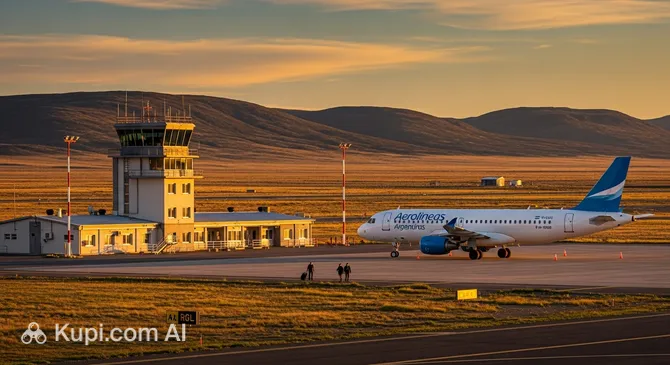
Rio Gallegos International Airport. Source: Kupi.com Binoculars

Piloto Norberto Fernández International Airport (RGL) is not merely a transport hub, but a true aerial gateway to the harsh and mesmerizing Southern Patagonia. Located where the endless steppe meets the cold waters of the Atlantic, this airport serves as a starting point for expeditions to glaciers and even to the icy continent — Antarctica. For many travellers, this is where their introduction to the "end of the world" begins, where the air is always fresh and the wind tells stories of the brave aviators of the past. Despite its rugged exterior, the terminal welcomes guests with warmth and compact cosiness, allowing for an instant transition from a long flight to the rhythm of a Patagonian adventure.

IATA Code RGL
ICAO Code SAWG
City Río Gallegos
Distance to centre 7 km
Status International
Passengers per year About 230,000
Schedule The current schedule is available on the online display in the terminal building and on the management company's website.

Airport Features and Advantages

Río Gallegos Airport possesses a number of unique characteristics that distinguish it from other regional aviation hubs in Argentina:

  • Longest runway in the region: Thanks to its strategic role and history, the airport boasts a runway 3,550 metres long. This allows it to receive aircraft of absolutely any type and size, including heavy transport planes, making it a reliable diversion airfield even for transcontinental flights.
  • Gateway to Antarctica: RGL is a key logistics hub for the "White Continent". Special flights are regularly operated from here to the Argentine Antarctic base, Marambio. Although these flights are most often official or scientific, the very fact of its proximity to the Antarctic gives the place a special atmosphere.
  • All-weather reliability: Designed with the famous Patagonian winds in mind, the airport demonstrates high operational stability. The infrastructure and navigation equipment allow for take-offs and landings even in the complex meteorological conditions characteristic of these latitudes.
  • Compactness and speed: The small size of the terminal is a significant plus for tired travellers. The journey from the aircraft steps to the city exit with luggage takes minimal time, while the absence of queues and simple navigation make the arrival process as comfortable as possible.

Contact Information

  • Official Website: You can find current information on flights, services, and airport rules on the official website of the management company, Aeropuertos Argentina 2000: www.aa2000.com.ar/rio-gallegos.
  • Information Desk Phone: For information by phone, you can call the following numbers: (+54 2966) 44-2224 / 44-2256.
  • Airport Address: Ruta Nacional N°3 Km 8, (Z9400) Río Gallegos, Santa Cruz Province, Argentina.
  • Email: A direct email address for general enquiries is not provided. It is recommended to use the contact form on the official airport website.
  • Social Media: You can follow news and updates on the official social media pages of the management company, Aeropuertos Argentina 2000.
  • Lost Luggage Information: For issues related to lost or damaged checked luggage, please contact your airline's representative directly. If you have lost personal items within the terminal building, please contact the airport information desk.
  • Passenger Support Contacts: Support for passengers is provided via the information desk phones, as well as directly at the information counter in the main hall of the airport.

How to Get to the Airport

Getting to Río Gallegos International Airport (RGL) from the city centre of Río Gallegos is quite simple, as it is located just a few kilometres away. Depending on your budget and preferences, you can choose one of several convenient methods.

Taxi and Transfer (Remis). The fastest and most convenient way to reach the airport is to use a taxi or a private transfer service, known in Argentina as a remis. The journey from the city centre takes just 10–15 minutes. The estimated cost is equivalent to 5–10 US Dollars. Given that prices in Argentine Pesos (ARS) can fluctuate, it is always recommended to agree on the fare in advance, especially when ordering a remis, which operates on a fixed rate. This is a reliable option, particularly if you have a lot of luggage or are travelling at an inconvenient time.

Public Transport. Direct bus connections to the airport in Río Gallegos may be limited or non-existent. The city bus network (colectivos) serves major districts, but routes may not pass directly through the airport. Although this is the most budget-friendly option, it may prove impractical for tourists with luggage. It is recommended to check current information on routes and schedules locally.

Car Rental and Parking. If you plan to explore Patagonia by car, renting a vehicle is an excellent solution. Several rental agencies operate at the airport and in the city centre. The drive to the airport by car takes about 10 minutes. The airport features a car park where you can leave your vehicle for a short or long term, which is convenient for those arriving in their own or rented transport.

Terminals and Map

Río Gallegos International Airport (RGL) is a compact and functional aviation hub characterized by a simple and clear structure. The airport consists of one passenger terminal, serving both domestic and the few international flights, primarily to neighbouring countries. Thanks to its modest size, it is extremely easy to navigate, making it comfortable even for those travelling for the first time.

The terminal layout is very logical. All key zones are in close proximity to one another. Located on one level are the check-in desks, the security screening area, and a small waiting hall with boarding gates. The Arrivals area is also integrated into the general structure: after collecting luggage in a dedicated hall, passengers immediately exit into the main terminal area, where they are met and where car rental desks and taxi services are located. There are no transfers between terminals, as all operations are concentrated in a single building.

A feature of the airport is its efficiency. Passing through all pre-flight formalities generally does not take much time. Flight check-in and security screening proceed quite quickly due to the low passenger volume. Nevertheless, it is recommended to arrive at the airport 1.5-2 hours before the departure of a domestic flight to check in luggage and pass through controls without haste. For rare international destinations, it is better to allow about 2.5 hours.

The main recommendation for navigating Río Gallegos Airport is not to worry. It is practically impossible to get lost here. Signage is clear and understandable, and the short distance between all points — from the entrance to the boarding gate — allows you to move on foot in a matter of minutes. If you have any questions, airport staff are always ready to assist.

Airport History

The history of Río Gallegos International Airport (RGL) is inextricably linked with the development of Patagonia and the advancement of aviation in this rugged region. The modern terminal complex was inaugurated in 1972. Originally named after Commander Armando Tola, the airport was later renamed and today bears the name of pilot Norberto Fernández, paying tribute to aviation heroes. From the very beginning, it was designed as a dual-purpose facility: for civil transport and as a strategic base for the Air Force of Argentina, which defined its key role in the development of the country's southern territories.

One of the most significant periods in the airport's history occurred in 1982. During the conflict in the South Atlantic, the airbase in Río Gallegos became a crucial forward airfield for Argentine aviation. Its strategic location allowed for operations in the conflict zone, and today this period remains an important part of the military history of the country and the airport itself.

With the transfer of management to Aeropuertos Argentina 2000 in the late 1990s, a new era of modernization began at the airport. Works were carried out to upgrade the runway, navigation equipment, and the passenger terminal. These improvements allowed for the reception of more modern types of aircraft and significantly increased the level of comfort and safety for passengers travelling to the southernmost region of continental Argentina.

Today, Río Gallegos Airport continues to fulfil its dual function. It is not only an important transport hub for residents and visitors of Santa Cruz province but also a logistics centre for Antarctic expeditions. Its history is a reflection of the perseverance and strategic vision that allowed remote corners of Patagonia to be connected with the rest of the world, making them accessible to travellers and explorers.

Services and Amenities

Río Gallegos International Airport (RGL) offers passengers a basic set of services necessary for a comfortable wait for their flight. Despite its modest size, the terminal is designed to ensure convenience before flying. Inside, you will find a small café where you can have a coffee and a snack, as well as a shop with newspapers, souvenirs, and travel goods. This is an excellent place to pass the time and buy gifts from Patagonia.

For those who value enhanced comfort, the Aeropuertos VIP Club lounge is available at the airport. Here, passengers can relax in a quieter environment. Free Wi-Fi is provided throughout the terminal, allowing you to stay connected. Charging stations for electronic devices are also equipped for the convenience of travellers, located in the departure waiting area.

ATMs are installed in the airport for withdrawing cash. However, full bank branches or currency exchange points may be absent, so it is recommended to arrange currency exchange in advance. In case of need, a medical post is operational in the terminal, ready to provide first aid.

The airport is equipped to receive passengers with special needs. Ramps, accessible toilets, and assistance services for passengers with reduced mobility are provided; these can be booked in advance through the airline. For travellers with small children, there is a mother and child room where you can take care of your baby in a calm environment.

There are no specialized business centres or conference rooms in the airport building. For business meetings, it is better to use the services of hotels in the city of Río Gallegos. There are also no hotels directly on the airport grounds; however, the city itself, located a few kilometres away, offers a wide selection of accommodation options to suit any taste and budget.

Where to Eat

When planning a departure from Río Gallegos International Airport (RGL), it is important to consider that this is a small regional air terminal, and the choice of dining establishments here is quite limited. Do not expect a large variety of restaurants as found in major international hubs. Nevertheless, passengers have the opportunity to have a snack before their flight.

The main and, typically, the only option for food at the airport is a small café or snack bar located in the general departure hall, accessible to all visitors before passing security control (landside). This establishment is ideal for a quick bite or a cup of coffee while waiting for a flight. The assortment usually includes:

  • Hot and cold drinks: coffee, tea, soft drinks, water.
  • Argentine pastries, such as medialunas (croissants).
  • Simple sandwiches (sandwiches de miga) and toast.
  • Various packaged snacks: chips, biscuits, chocolate.

The café's opening hours are usually tied to the flight schedule and may be limited. Prices, as in most airports, are somewhat higher than in the city. Regarding special dietary needs, finding vegetarian, vegan, or gluten-free meals here is extremely unlikely. Travellers with strict dietary restrictions (including Halal requirements) are recommended to bring food with them.

Thus, the airport in Río Gallegos offers basic facilities to have a coffee and eat a sandwich. If you are counting on a full lunch or dinner, the best solution would be to eat at one of the restaurants in the city itself before travelling to the airport. There you can experience Patagonian cuisine, trying, for example, the famous local lamb (cordero patagónico), which you certainly won't find on the airport menu.

Traveller Tips

Travelling through Río Gallegos International Airport (RGL) will be easier and more pleasant if you prepare in advance. Here are a few useful tips that will help you navigate this important Patagonian transport hub and avoid unnecessary hassle.

Arrival Time and Check-in: For domestic flights within Argentina, it is recommended to arrive at the airport 1.5–2 hours before departure. If you have an international flight, it is better to allow 2.5–3 hours. To save time, use online check-in if your airline provides this option. This will allow you to head straight to baggage drop or, if you are travelling light, to the security checkpoint.

Security Control and Hand Luggage: Security procedures at the airport are standard. Be prepared to remove laptops and other large electronics from your hand luggage. Remember the rules for carrying liquids: containers with a volume of no more than 100 ml packed in a transparent bag are permitted. It is strictly forbidden to carry sharp objects, weapons, and flammable substances into the cabin. Always check the current hand luggage allowance on your airline's website to avoid extra charges for excess weight or oversized items.

Seat Selection: When flying out of Río Gallegos or arriving here, it is worth choosing a window seat. You may be treated to breathtaking views of the endless expanses of the Patagonian steppe. For those who value comfort and the ability to stretch their legs, the best choice would be an aisle seat or a row by the emergency exit (often for an additional fee).

Transfers and Customs: Río Gallegos is rarely used as a major transfer hub; most flights here are final destinations. If you do have a connection planned, check with the airline whether you need to collect and re-check your luggage. Upon arrival on an international flight, you will have to pass customs control. Be prepared to declare imported goods, especially food products of plant and animal origin, the import of which is strictly controlled.

Saving Time and Money:

  • Book a taxi or transfer from the airport to the city in advance — this is often cheaper than taking a car on the spot.
  • Bring an empty reusable water bottle to fill after passing security.
  • Pack light snacks: food and drinks at the airport can be quite expensive.

In Case of Flight Delay: In the event of a long delay or flight cancellation, first contact your airline representative for information on further actions. Depending on the duration of the wait, you may be provided with vouchers for food or hotel accommodation. Having travel insurance will help compensate for unforeseen expenses. Considering this is a small regional airport, keep a book or a charged power bank with you to pass the time.

Reached the end of the page?

That means the route is fully explored