Support

Santa Fe Airport

About the Airport

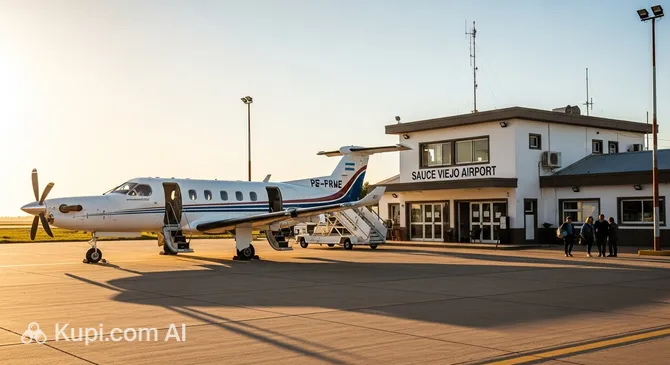
The Santa Fe Airport, officially known as Sauce Viejo Airport (Aeropuerto de Sauce Viejo), serves as the air gateway to the province of the same name and its vibrant capital. Located near the banks of the mighty Paraná River, this airport acts as a starting point for exploring the region's rich colonial history, culture, and natural beauty. Although it is not among the largest aviation hubs in Argentina, its compact size and convenient location make it an ideal choice for travellers who value time and comfort.

Santa Fe Airport. Source: Kupi.com Binoculars
IATA Code SFN
ICAO Code SAAV
City Santa Fe
Distance to centre 17 km
Status Domestic
Annual Passengers Approx. 63,000 (2019)
Popular Airlines Aerolíneas Argentinas, LADE

The main advantage of Santa Fe Airport is its compactness and simplicity. There are no long queues or confusing terminals here, allowing passengers to complete all pre-flight formalities quickly and without stress. The airport primarily serves domestic flights, connecting the region with key cities in the country, primarily the capital. The small but functional terminal building offers basic amenities, including cafés and car rental desks, ensuring a comfortable start or end to your journey through this picturesque part of Argentina.

Contact Information

  • Official Airport Website: santafe.gob.ar/ms/aeropuerto-sauce-viejo
  • Inquiry Service Phone: +54 342 499-5061 / +54 342 499-5064
  • Airport Address: Ruta Nacional 11, Km 452.5, S3017 Sauce Viejo, Santa Fe, Argentina
  • Email: It is recommended to use the contact form on the official website
  • Airport Social Media: Official pages are available on Instagram and Facebook (links on the website)
  • Lost Luggage Information: Contact the PSA (Policía de Seguridad Aeroportuaria) office in the main hall or your airline's representative
  • Passenger Support Service Contact: +54 342 499-5061 (available from 07:00 to 22:00)

How to Get to the Airport

Santa Fe Airport (Sauce Viejo Airport, SFN) is located approximately 17 kilometres southwest of the city centre of Santa Fe, making it easily accessible for travellers. You can get to the terminal or from the terminal to the city in several ways, depending on your budget and preferences. On average, the journey takes between 25 to 50 minutes. When planning your route, please consider that traffic conditions in Argentina may vary depending on the time of day.

The most economical way to reach the airport is by public transport. A special bus route (Línea C) connects the Santa Fe bus terminal with the airport. This is an excellent choice for light travellers looking to save money. The bus journey usually takes about 50-60 minutes. Be sure to check the current schedule, as it may change depending on the day of the week and the season.

For greater comfort and speed, you can use taxi or transfer services. This is the most convenient option, especially if you have a lot of luggage or are travelling with family. Cars can be found at designated stands in the city or booked in advance via an app or by phone. In Argentina, "remis" services are also popular — these are private taxis with a fixed fare, allowing you to know the cost of the trip in advance. The travel time by taxi will be approximately 25-30 minutes.

If you value independence and plan to travel extensively around the region, car rental would be the ideal solution. Several rental companies have offices at the airport and in the city centre. Having your own transport will give you the freedom to explore the surroundings of Santa Fe at your own pace. For those arriving at the airport in their own car, parking is provided. Both short-term and long-term parking options are available.

If your plans include a more extensive trip around the region or you are looking for more flight options, it is worth considering other nearby airports. For example, General Justo José de Urquiza Airport in neighbouring Paraná is only 33 km away. Larger hubs offering a greater number of flights include Fisherton Airport in Rosario (132 km) and Ingeniero Aeronáutico Ambrosio L.V. Taravella International Airport in Córdoba (325 km).

Terminals and Map

Santa Fe Airport (SFN), officially known as Aeropuerto de Sauce Viejo, is distinguished by its compact size and simple, intuitive layout. This makes it very convenient for travellers, as navigation here causes no difficulties even for those visiting this region of Argentina for the first time.

Terminals and Their Purpose

The airport complex consists of just one passenger terminal. It serves all arriving and departing flights, which are predominantly domestic (the main destination being Buenos Aires). Because all operations are concentrated in a single building, passengers do not need to worry about complex transfers or using inter-terminal transport.

Airport Layout and Zones

The interior space of the terminal is organised logically and functionally, making it easy to orient yourself:

  • Check-in and Departure Zone (Partidas): Located in the main hall. Here you will find airline check-in counters. Immediately behind them are the aviation security control points. After passing through security, passengers enter the "sterile" waiting area (Pre-embarque), equipped with boarding gates.
  • Arrival Zone (Arribos): Located in the same building but functionally separated from the departure zone. The baggage claim hall with a conveyor belt is located here. The path from the aircraft steps to the city exit takes minimal time.
  • General Zone: In the public part of the hall before the security zone, travellers can find a cafeteria, car rental desks, and restrooms.

Features and Navigation

The main feature of the terminal is its intimacy and recent modernisation. The airport has been updated to improve passenger comfort and flight safety. Navigation signs are duplicated in English, which facilitates orientation for international tourists. Since the building is small and mostly single-level for passengers, the risk of getting lost here is practically zero.

Procedure Times

Despite the relaxed pace of the airport and the absence of huge crowds typical of international hubs, compliance with standard aviation regulations is mandatory. It is recommended to arrive at the airport 1.5–2 hours before your flight departure time. This will allow you to check in your luggage and pass through security control without rushing. The screening procedure itself usually proceeds quite quickly, however, during peak hours (usually morning or evening), it is better to have a small time buffer.

Recommendations for Passengers

If you are departing from Santa Fe, keep your documents at hand when entering the screening zone — it is located in the immediate vicinity of the check-in counters. For arriving passengers, navigation is even simpler: just follow the signs for "Salida" (Exit) or "Equipaje" (Baggage) after entering the terminal from the airfield.

Airport History

The history of Santa Fe Airport (SFN), also known as Sauce Viejo Airport, is a tale of development, overcoming difficulties, and rebirth. Officially opened on 9 December 1955, it was built to replace an old airfield and was intended to become the main air gateway for the province of Santa Fe in Argentina.

In the first decades of its existence, the airport developed steadily, serving domestic flights and connecting the region with Buenos Aires and other major cities in the country. It played an important role in the economic and social life of the province, facilitating passenger and cargo transport. However, the most significant and dramatic moment in its history occurred in 2003.

In April 2003, catastrophic flooding of the Salado River caused immense damage to the city of Santa Fe and its surroundings. The airport found itself at the epicentre of the disaster: the runway, terminal, and all equipment were seriously damaged, leading to its complete closure. This event was a true test, but simultaneously a starting point for a new era in the airport's life.

After the flood, a large-scale reconstruction began. The old terminal was demolished, and a modern building was erected in its place, which was inaugurated in 2005. The runway was fully restored and modernised, and new navigation equipment was installed. Effectively, the airport was built anew. This reconstruction became a symbol of the resilience and revival of the entire region. Today, Santa Fe Airport is a modern and functional transport hub, the history of which clearly demonstrates the ability to overcome any challenges.

Services and Facilities

Santa Fe Airport (SFN), also known as Sauce Viejo Airport, is an important regional transport hub. Despite its modest size, it provides passengers with all necessary services for a comfortable wait for their flight.

Within the terminal, you will find a café where you can have a snack, drink coffee, or purchase soft drinks. There is also a shop offering souvenirs, press, and travel essentials. The selection of establishments is small but sufficient to pass the time before departure.

For the convenience of passengers, comfortable waiting areas are provided in the airport. Travellers can use free Wi-Fi to stay connected, as well as find charging stations for electronic devices. Although dedicated VIP lounges may be absent, the general waiting zones are well-equipped.

ATMs are installed in the terminal building where you can withdraw cash. Currency exchange points may be limited or absent, so it is recommended to arrange money exchange in advance. In case of necessity, you can contact the medical point for first aid.

Santa Fe Airport cares for passengers with special needs. For travellers with children, there is a mother and child room. Passengers with reduced mobility are provided with necessary assistance during boarding and disembarking, and the terminal infrastructure, including ramps and specially equipped restrooms, is adapted for their convenience.

There are no hotels directly on the airport grounds, however, in the immediate vicinity and in the city of Santa Fe itself, there are many accommodation options to suit any taste and budget. Specialised business centres or conference rooms are absent in the terminal, as the airport is primarily oriented towards serving passenger flights.

Where to Eat

When planning a departure or meeting at Santa Fe Airport (SFN), it is important to consider that this is a small regional airport, and the choice of dining establishments here reflects that. Options are mainly oriented towards quick snacks and waiting for flights, rather than gastronomic delights.

The main dining area is located in the general hall of the terminal, accessible to both departing passengers and those seeing them off (landside, before passing security control). Typically, one or two cafés or snack bars operate here. After passing security (airside), the choice may be extremely limited or non-existent, so it is better to have a snack beforehand.

What you can find on the menu:

  • Quick Snacks: This is the main format of establishments at the airport. You will be offered classic Argentine snacks such as empanadas (pies with meat or cheese), "de miga" sandwiches (thin crustless sandwiches), as well as pastries — medialunas (croissants) and other facturas. This is an excellent option to satisfy your hunger before the flight.
  • Beverages: Naturally, good coffee is served here, including the traditional "café con leche", tea, soft drinks, and bottled water.
  • Full Meals: Opportunities for a full hot lunch or dinner are very limited. Sometimes the menu may feature a "dish of the day" (plato del día), but one should not count on a wide selection of restaurant dishes. If you wish to have a substantial meal, it is better to do so in Santa Fe before travelling to the airport.

Prices at the airport are generally higher than in the city. The opening hours of dining establishments are usually tied to the flight schedule: they open a few hours before departure and may close during quiet periods. Passengers with special dietary requirements (vegans, vegetarians, people with gluten intolerance) are recommended to carry their own snacks, as specialised dishes will likely be absent from the menu.

Travel Tips

Travelling through Santa Fe Airport, like any other, will be easier and more pleasant if you prepare in advance. Here are a few tips that will help you orient yourself and avoid unnecessary stress.

Arrival time at the airport. For domestic flights within Argentina, it is recommended to arrive at the airport 1.5–2 hours before departure. If your flight is international (which is less typical for this airport but possible), it is better to arrive 2.5–3 hours in advance. This time will be sufficient to calmly complete all procedures.

Check-in and security control. To save time, use online check-in for your flight if your airline provides such an option. At the airport, keep your passport and boarding pass ready. Although security queues here are usually shorter than in major hubs, do not leave passing through it until the last moment.

Seat selection on the plane. If it is possible to select a seat during check-in, consider your preferences. Window seats will offer you beautiful views during take-off and landing, while aisle seats allow you to stand up freely and stretch your legs during the flight.

Hand luggage. Remember the general rules: liquids can be carried in containers of no more than 100 ml, packed in a transparent bag. Sharp objects, weapons, and flammable substances are prohibited. Be sure to check your airline's website for current weight and size limits for hand luggage to avoid extra charges.

Passengers with transfers. If you have a connecting flight, clarify in advance whether your luggage will be checked through automatically or if you need to collect it and check it in again. Find out the gate number for your next flight immediately upon arrival to estimate how much time you have in reserve.

Customs control. When arriving from another country, you will have to pass customs control. Keep your passport and completed declaration (if required) ready. If you are carrying goods subject to declaration, prepare the necessary documents and receipts in advance.

Saving time and money. Booking a transfer from the airport online is often more cost-effective than finding a taxi on the spot. Bring an empty reusable bottle with you to fill it with water after passing security control. Travelling light, with only hand luggage, will also help save both time and money.

In case of flight delay. If your flight is delayed, first contact the airline representative for information. Depending on the duration of the delay, you may be provided with vouchers for food, beverages, or even hotel accommodation. Remain calm and clarify your rights as a passenger.
Reached the end of the page?

That means the route is fully explored