Support

Derby

About the Airport

The Derby Airport (DRB) is not merely a runway in the north of Western Australia, but a true gateway to the rugged and beautiful world of the Kimberley region. It is from here that unforgettable adventures to ancient gorges, unique tidal phenomena, and the boundless expanses of the Australian outback begin. This small but strategically important airport serves as a key link for local residents, intrepid tourists, and vital services such as the Royal Flying Doctor Service.
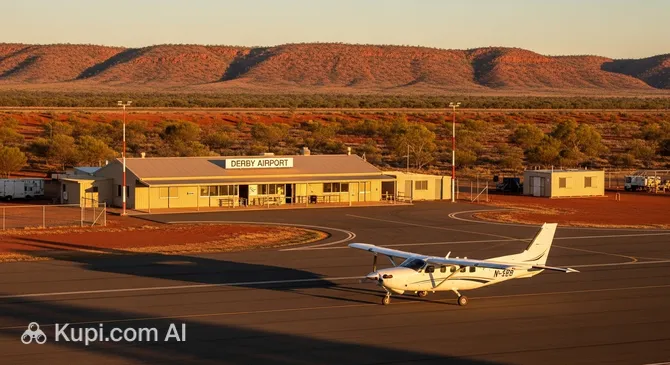
Derby. Illustration.
Source: Kupi.com AI
PropertyValue
IATA CodeDRB
ICAO CodeYDBY
CityDerby
CountryAustralia
TimezoneAustralia/Perth
ScheduleOnline Timetable

The main feature of Derby Airport is its compact nature and functionality. There is no bustle of large aviation hubs here, which makes the arrival and departure process as quick and comfortable as possible. The airport mainly serves regional flights connecting Derby with Broome and other settlements in the Kimberley, and also serves as a base for numerous charter and scenic flights.

For travellers, this is the starting point for aerial excursions to such natural wonders as the Horizontal Falls and the Buccaneer Archipelago. Proximity to the city is another undeniable advantage. You can reach the centre in just a few minutes by taxi or rental car, allowing you to immediately immerse yourself in exploring this unique corner of Australia.

Contact Information

For the most accurate information regarding the operation of Derby Airport (DRB), it is recommended to refer to official sources. The airport is managed by the Shire of Derby / West Kimberley administration. Below are the current contact details.

  • Official Website: Detailed information on services, tariffs, and airport operating rules is posted on the official website of the shire administration in the relevant section: sdwk.wa.gov.au/services/airport-services.
  • Inquiry Service Phone: For general questions regarding airport operations, you can call the administration office at +61 8 9191 0999.
  • Airport Address: The airport is located at: Derby Highway, Derby, Western Australia 6728, Australia.
  • Email: For written inquiries, you can use the official administration email address: sdwk@sdwk.wa.gov.au.
  • Social Media: Important updates and news regarding the airport may be published on the official social media pages of the Shire of Derby / West Kimberley, for example, on Facebook.
  • Lost Luggage Information: In the event that your luggage was lost during the flight, you should first contact the representative of your airline. If you have lost personal items within the terminal, contact the airport administration via the main phone number.
  • Passenger Support Contacts: Since Derby Airport is a small regional airport, there is no separate passenger support service. All questions should be directed to the general phone number or email of the shire administration.

How to Get to the Airport

Getting to the airport of Derby (DRB) is quite simple, as it is located just a few kilometres from the city centre. A car journey usually takes no more than 5-10 minutes, making access to the terminal quick and convenient for all travellers.

The main way to get to the airport is by taxi or private transfer. There are several taxi services operating in the city that can be called by phone. This is the most reliable and fastest option, especially if you have a lot of luggage. It is recommended to book a car in advance, especially for early morning or late flights, to avoid waiting. The cost of the trip will depend on the company's tariff, but due to the short distance, it will not be high.

For those planning to explore the Kimberley region and who value independence, the best solution would be car rental. Many major and local rental companies have representatives in Derby, offering the option to pick up or drop off a car directly at the airport. This gives maximum freedom of movement across the expanses of Western Australia. Check the conditions for returning the car at the airport when booking.

Specialised public transport, such as regular bus routes to the airport, is absent in Derby due to the compact size of the city. Therefore, travellers should not rely on buses or trains for travel to the airport.

If you are driving to the airport in your own or a rented vehicle, you can use the parking available on the airport grounds. For a small regional aviation hub, parking is usually located in the immediate vicinity of the terminal and is either free or inexpensive.

Terminals and Map

Derby Airport (DRB) is a small regional airport that plays an important role in the transport system of the Kimberley region in Western Australia. It is important to understand that its structure is extremely simple: the airport consists of one small terminal which serves all types of flights — both regular regional and charter. There is no division into international and domestic zones, as the airport is focused exclusively on flights within the country.

The terminal layout is intuitive. Essentially, it is a single building where all necessary services are combined under one roof. Immediately at the entrance, you will find check-in counters, followed by a small waiting area for departing passengers. The arrival and baggage claim zones are also located here, making navigation extremely easy. Getting lost in Derby Airport is practically impossible, as all functional zones are within sight of each other. Consequently, there are no transfers between terminals.

The departure and arrival zones are parts of a single hall. After check-in, passengers proceed to the general waiting area. Check-in and screening procedures (if applicable to your flight) are very quick due to the low passenger flow. Typically, all formalities take no more than 15–20 minutes. Nevertheless, it is recommended to arrive at the airport approximately 60 minutes before departure to check in luggage and take your seat in the waiting area without rushing.

The main recommendation for travellers is not to expect the infrastructure of a major hub from Derby Airport. It is primarily a functional transport node. The set of services here is basic: restrooms and seating areas. There are no shops, cafes, or currency exchange points in the terminal, so it is worth taking care of food and drinks in advance. Orientation is very simple: follow the few signs, and you will easily find everything you need.

Airport History

The history of Derby Airport (DRB) is closely intertwined with the development of the entire Kimberley region and the history of aviation in Australia. Originally, an airfield appeared here in the 1920s to service the first mail and passenger flights, which became a lifeline for isolated settlements in the north of the country. However, its strategic importance increased sharply during the Second World War when it was transformed into a major military base for the Royal Australian Air Force — RAAF Base Derby.

During the war years, the base became a key staging ground for Allied forces, providing patrols and protection for the northern coast. In March 1942, the airport, like the city itself, was bombed by Japanese aviation, which forever inscribed it in the country's military history. After the war ended, the airfield returned to civilian life, but its role remained vital. It became a main base for the famous Royal Flying Doctor Service, which continues to provide emergency medical assistance to residents of remote farms and communities today.

Another interesting fact from the airport's history is its participation in the innovative "Air Beef" scheme in the 1950s. To avoid the long and exhausting driving of cattle over land, an abattoir was built near the Glenroy airfield, from where meat was flown to Derby for further transport. This significantly improved the quality of beef from the Kimberley region.

Over the decades, the airport has been modernised repeatedly to accommodate modern aircraft and the growing flow of passengers. Today, it continues to fulfil its historical mission: connecting the region with the rest of the country, serving the tourism industry, supporting mining companies, and acting as an indispensable link in the healthcare and logistics system of Western Australia.

Services and Amenities

Derby Airport (DRB) is a small regional aviation hub serving mainly local flights. Due to its size, the range of services here is basic and focused on meeting the essential needs of passengers before departure. In the terminal building, you will find a waiting area, but specialised VIP lounges are absent. Shopping and dining opportunities are also quite limited, so it is recommended to bring snacks with you or have a meal in the city before arriving at the airport.

Access to free Wi-Fi in small regional airports in Australia may not be provided, so it is better to have mobile internet. The number of power outlets for charging devices may also be small — just in case, take a portable charger with you. There are no ATMs or currency exchange points in the terminal; all financial transactions should be carried out in advance at banks in the city of Derby.

For passengers with reduced mobility, basic amenities are provided to ensure terminal accessibility, including ramps and specially equipped restrooms. However, for assistance with boarding or moving around the airport, it is strongly recommended to contact your airline in advance. Specialised nursing rooms may be absent, but airport staff will assist passengers with children whenever possible.

There are no hotels, business centres, or conference rooms on the airport grounds. The nearest accommodation options and business services can be found in the city of Derby itself, which is a short distance from the airport. Medical assistance is limited to first aid; in emergencies, city services are called.

Where to Eat

For travellers planning a departure from Derby Airport (DRB), it is important to consider the specifics of this transport hub. It is a small regional airport in Western Australia, the infrastructure of which differs significantly from major international hubs. Here, there is no familiar variety of restaurants, food courts, or chain coffee shops located across different terminals.

Within the single passenger terminal, dining options are extremely limited. Generally, passengers can rely on vending machines with light snacks (chips, chocolate, biscuits) and soft drinks. At certain times, basic service with hot beverages (coffee, tea) may be available, but one should not expect a full menu with hot meals.

Due to the absence of cafes, finding specialised dining options (vegetarian, vegan, Halal, or gluten-free) within the airport itself is difficult. If you follow a strict diet, it is strongly recommended to take care of food in advance.

Recommendations for passengers:

The best solution for a full lunch or dinner would be to visit establishments in the city of Derby before heading to the airport. In the city, you can try local cuisine, including the famous Australian barramundi (fish) or steaks, as well as find cafes with a wider selection of dishes.

For a quick snack while waiting for your flight, we advise bringing sandwiches, fruit, or other products that are convenient to carry in hand luggage (observing security regulations). This will ensure a comfortable wait and flight for you, independent of the operating schedule of kiosks at the airport.

Tips for Travellers

When planning a departure from the airport of Derby, it is worth considering a few points to ensure your journey goes smoothly. Since this is a regional airport, processes here usually move faster than in major hubs. Nevertheless, it is recommended to arrive at least 60-90 minutes before the departure of a domestic flight. This time will be sufficient to check in for the flight and pass through security screening without rushing.

When checking in, if you are travelling without luggage, use online check-in to save time. Security standards here are the same as throughout Australia: liquids in hand luggage must be in containers of no more than 100 ml and packed in a transparent bag. All sharp objects and prohibited substances should be left at home. To speed up screening, remove all metal items from your pockets in advance, and take laptops and other large electronics out of your bags.

Seat selection on the plane can significantly affect flight comfort. If you want more legroom, choose seats near the emergency exits. For those who love photography, window seats away from the wing are suitable. Passengers with short connections are better off choosing seats closer to the exit to leave the cabin first. If you have a long layover, research in advance what services are available at the airport, although in small airports like Derby, they may be limited.

Customs control in Australia, even on domestic flights, is known for its strictness, especially regarding biosecurity. It is strictly forbidden to transport fresh fruit, vegetables, meat, and dairy products between certain states without a special permit. Be sure to declare any food products, plants, or wooden items to avoid large fines.

To save money, book tickets and check in online, and also arrange airport transfer in advance. In case of a flight delay, first contact your airline representative for information on the new departure time and possible compensation. In a small airport, there may not be much entertainment, so bring a book, a charged power bank, or download movies to your device in advance.

Reached the end of the page?

That means the route is fully explored