Support

Hughenden

About the Airport

Hughenden Airport is not merely a runway in the heart of the Queensland Outback, but a true gateway to the prehistoric past of Australia. Located in a region known as the "Dinosaur Trail," this small yet vital aviation hub serves as a starting point for travellers eager to witness unique paleontological discoveries. For locals, it is an indispensable link to major cities, while for tourists, it represents the fastest way to immerse themselves in an atmosphere of adventure and boundless Australian landscapes. The airport reflects the spirit of the region itself: it is compact, functional, and welcoming in its own unique way.
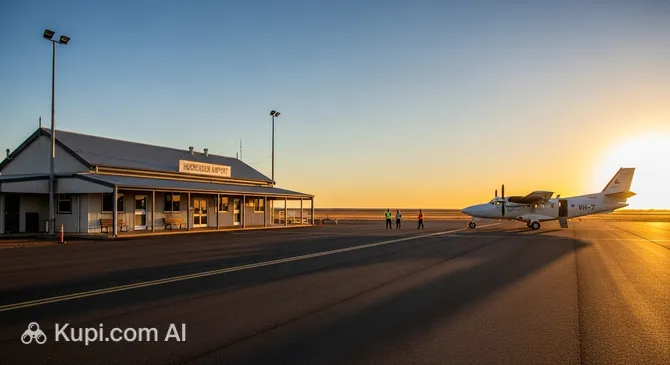
Hughenden. Illustration.
Source: Kupi.com AI
PropertyValue
IATA CodeHGD
ICAO CodeYHUG
CityHughenden
CountryAustralia
TimezoneAustralia/Brisbane
ScheduleOnline Timetable

The main feature of Hughenden Airport is its intimacy and simplicity. There is none of the hustle and bustle or queues found in metropolises, making the check-in and boarding process as fast and comfortable as possible. It is a typical regional airport of the Australian Outback, where everything is geared towards efficiency and convenience for passengers taking regular flights to Townsville, Mount Isa, and other Queensland cities. Despite its modest size, it plays a key role in supporting local tourism, especially for those arriving to explore the famous "Dinosaur Trail." For travellers, this is the ideal start, allowing them to save travel time and immediately dive into the unique atmosphere of the region.

Contact Information

  • Official Website: Hughenden Airport does not have a separate website. Information is available on the Flinders Shire Council management page: flinders.qld.gov.au/our-services/airport.
  • Help Desk Phone: +61 7 4741 2900 (Flinders Shire Council phone number, airport management).
  • Airport Address: Brodie St, Hughenden, Queensland 4821, Australia.
  • Email: flinders@flinders.qld.gov.au (General email for Flinders Shire Council).
  • Social Media: There are no official social media pages for the airport. News and updates can be tracked on the Flinders Shire Council Facebook page.
  • Lost Luggage Information: For issues regarding lost or damaged luggage, please contact the airline you flew with directly. Regarding items left in the terminal, please contact the administration via the main phone number.
  • Passenger Support Contacts: For general questions regarding terminal operations and available services, it is recommended to use the main Flinders Shire Council telephone number.

How to Get to the Airport

Hughenden Airport (HGD) is located just a few kilometres from the city centre of Hughenden, making the journey there quick and simple. Given the size of this small town in Australia, transport options are quite specific, but reaching the terminal will not be difficult.

Taxi and Private Transfer — this is the most popular and reliable way to get to the airport. The trip from the city centre takes only about 5-10 minutes. There are several local taxi services operating in Hughenden. It is highly recommended to book a car in advance, especially if you have an early morning or late evening flight, as the number of available vehicles is limited. The cost of the trip will be low due to the short distance.

Car Rental — an excellent option for those planning to explore the picturesque surroundings and national parks of the region. Car rental depots are typically located in the town itself, rather than at the airport. You can easily drive to the airport in a rental car and leave it in the car park. This is also convenient for those arriving in Hughenden who wish to immediately begin an independent journey.

Airport Parking. For those driving their own or a rental vehicle, parking is provided at Hughenden Airport. As with most small regional airports in Australia, parking here is likely to be free of charge and located in immediate proximity to the terminal.

Public Transport. It is important to note that there are no regular public transport routes (buses, trains) in Hughenden that connect the town to the airport. This is due to the compact size of the town and low passenger traffic. Therefore, you must rely on a taxi or car for your trip to the airport.

Terminals and Map

Hughenden Airport (HGD) is a compact regional aviation hub with a structure that is as simple and convenient as possible for passengers. There is no complex network of buildings or walkways here, making it very easy to navigate. The airport operates with just one passenger terminal, which serves all flights — both departures and arrivals.

The terminal layout is intuitive. All key zones are located in one small building: immediately upon entry, you will find the check-in counters, followed by a compact waiting area and the security screening point. The departure and arrival zones are in close proximity to each other, so after landing, you will quickly reach the baggage claim area and the exit. Since there is only one terminal, there is no need to transfer between buildings.

The main advantage of Hughenden Airport is the speed of completing all procedures. Thanks to the low passenger traffic, flight check-in and security screening take minimal time, allowing you to avoid queues and long waits. Typically, the entire process from entering the building to boarding the gate is very swift.

No special recommendations are required for navigating the airport — it is practically impossible to get lost here. All signs are clearly visible, and staff are always ready to assist. This simplicity makes starting or ending a journey in this corner of Australia maximally comfortable and eliminates the stress often associated with large aviation hubs.

Airport History

The history of Hughenden Airport (HGD) begins during the years of World War II. It was built in the early 1940s as one of the strategic airfields deep in Queensland, forming part of the defensive network of northern Australia. At that time, it was used by the Royal Australian Air Force (RAAF) and the United States Army Air Forces (USAAF) for aircraft dispersal and maintenance, playing an important, albeit auxiliary, role in military operations in the Pacific Theatre.

After the war ended, the airfield transferred to civilian management and became a vital link connecting the isolated town of Hughenden with the rest of the country. For many decades, it has been and remains a key base for the famous Australian Royal Flying Doctor Service (RFDS). The "Flying Doctors" use the airport to provide emergency medical assistance to residents of remote farms and settlements, highlighting its immense social significance.

Over time, the airport has undergone modernization repeatedly to meet growing safety and comfort requirements. Key stages of development included asphalting and extending the runway, installing modern navigation and lighting equipment to ensure 24-hour operation, as well as reconstructing the small but functional passenger terminal. These works were funded at both the local and federal levels to maintain reliable air connectivity.

Today, Hughenden Airport is not just a piece of transport infrastructure. It performs a crucial function in supporting the local community, business, and tourism, acting as the aerial gateway to the famous Australian "Dinosaur Trail." Its history is a vivid example of how a military facility can transform into an indispensable civilian asset, serving people for generations.

Services and Facilities

Hughenden Airport (HGD) is a small regional aviation hub in Australia serving local flights. Consequently, the range of services and amenities here is basic and designed for a comfortable wait before departure in a small but functional terminal.

There are no restaurants or large shops at the airport. Typically, vending machines with drinks and light snacks are available for passengers. It is recommended to arrange meals in advance. The availability of free Wi-Fi and charging stations for gadgets should be checked on-site, as access may be limited.

A barrier-free environment is provided for passengers with reduced mobility. If you require special assistance during boarding or disembarking, we advise you to notify your airline in advance. For travellers with small children, there are no specialized mother and child rooms, but standard restroom facilities are available.

It is important to note that there are no bank branches, ATMs, or currency exchange points within the airport terminal. All financial matters must be resolved in the town of Hughenden, located nearby. The nearest hotels and motels are also located there, as no accommodation is provided on the airport grounds.

Hughenden Airport does not have VIP halls, business lounges, or conference rooms. It is a compact aviation node intended for the quick and convenient service of regional passengers, rather than for long stays.

Dining

When planning a trip through Hughenden Airport (HGD), it is important to consider that this is a small regional hub serving mainly local flights. Therefore, the choice of dining establishments here is quite limited and not comparable to the assortment found in large international airports in Australia. Passengers are advised to have a meal in town before travelling to the airport if they require a full lunch or dinner.

Typically, the terminal building houses one small cafeteria or kiosk. It is located in the general area before security control (landside). Here you can purchase basic beverages — coffee, tea, water, juices, as well as light snacks. The assortment usually includes pre-packaged sandwiches, pastries, crisps, and chocolate. This is a convenient option for a quick snack before departure, but not for a substantial meal.

Regarding special dietary needs, finding options for vegetarians, vegans, or those with gluten intolerance will be extremely difficult. Please note that the assortment generally does not include Halal or Kosher meals. Passengers with strict dietary restrictions are strongly advised to bring food with them. The opening hours of the sole cafeteria are directly tied to the flight schedule: it usually opens shortly before departure and closes after the aircraft has left.

Travel Tips

Travelling through the regional Hughenden Airport can be a simple and convenient start or end to your trip around Australia. To ensure everything goes smoothly, make use of our tips specially prepared for passengers departing from or arriving in Hughenden.

Arrival at the Airport and Check-in. Hughenden Airport is small and serves domestic flights, so there are rarely large crowds here. It is recommended to arrive 60-90 minutes before departure. This time will be quite sufficient to check in luggage and pass through security control without rushing. To save time, always try to complete online check-in if your airline provides such an option.

Seat Selection and Hand Luggage. When choosing a seat on the plane, consider that flights departing from Hughenden offer stunning views of the Australian Outback. A window seat will allow you to enjoy them fully. Regarding hand luggage, standard rules apply: sharp objects, flammable substances, and liquids in volumes exceeding established norms for domestic flights are prohibited. Please check current requirements with your airline before flying.

Transfers and Customs Control. Hughenden Airport serves only domestic flights, so there is no customs or passport control here. If you have a connecting flight, it will likely be at a larger airport, such as Townsville or Brisbane. Allow sufficient time between flights for baggage claim and re-check-in if required by your ticket conditions.

Economy and Contingencies. To save money, book tickets in advance and try to travel with hand luggage only to avoid baggage fees. The airport itself may have a limited selection of food and drinks, so you can bring a small water bottle (empty for passing through security) and snacks. In case of a flight delay, contact your airline representative for information. Remain calm and clarify whether you are entitled to compensation, meals, or hotel accommodation depending on the duration of the delay.

Reached the end of the page?

That means the route is fully explored