Support

Narrandera

About the Airport

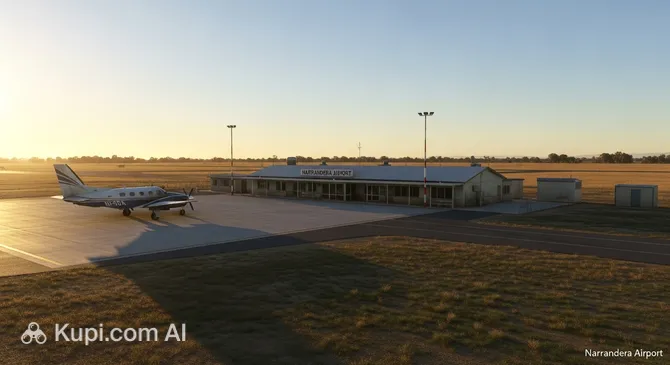
Narrandera. Source: Kupi.com Binoculars

Narrandera Airport is not merely a transport hub, but a cosy aerial gateway to the picturesque Riverina region. Located amidst the vast Australian expanse, it connects the measured provincial life with the dynamic rhythm of large metropolises. Here, you will not find endless queues or city bustle—only tranquillity, fresh air, and breathtaking views of the golden plains of New South Wales immediately after take-off.

IATA Code NRA
ICAO Code YNAR
City Narrandera
Distance to Centre ~7 km
Status Domestic
Annual Passengers No official data
Schedule Check the official website

Features and Advantages of the Airport:

Narrandera Airport, also known as Narrandera-Leeton, plays a vital role in the transport accessibility of the region, serving two towns simultaneously. It is ideal for travellers who value comfort and a stress-free environment.

  • Free Parking: One of the main advantages for car owners is the availability of free parking, accessible for both short-term and long-term stays directly at the terminal.
  • Fast Service: Thanks to the compact size of the terminal, check-in and security procedures are completed as quickly as possible, allowing you to arrive at the airport shortly before departure.
  • Regular Connections: The airport ensures stable links with Sydney (flight time is approximately 1 hour 20 minutes) and Griffith, making it a convenient starting point for business trips and tourism.

Contact Information

  • Official Airport Website: Airport page on the Narrandera Council website
  • Helpline: +61 2 6959 5510 (Narrandera Shire Council, Mon-Fri)
  • Airport Address: Irrigation Way, Narrandera NSW 2700, Australia
  • Email: council@narrandera.nsw.gov.au
  • Airport Social Media: Narrandera Shire Council Official Facebook Page
  • Lost Luggage Information: If items were left on board the aircraft, please contact Regional Express (Rex) on 13 17 13. For items left in the terminal, inquiries can be made to the airport administration via the general council number.
  • Passenger Support Contacts: For all general inquiries, please contact the Narrandera Shire Council administration during business hours.

How to Get to the Airport

Narrandera Airport is located on Irrigation Way, approximately 7 kilometres west of Narrandera town centre and 25 kilometres from the neighbouring town of Leeton. Given the regional status of the airport, the transport infrastructure here has specific features distinct from major hubs.

Taxi and Transfer

This is the most reliable and common way to reach the terminal for those without personal transport. Unlike in metropolises, taxis here rarely wait for passengers at the exit around the clock.

  • Recommendation: It is strongly advised to book a car in advance by contacting local services (e.g., Narrandera Taxis). This guarantees that a driver will meet you upon the flight's arrival.
  • Travel Time: The journey from the centre of Narrandera takes just 10 minutes, and from Leeton—about 20–25 minutes.
  • Cost: The estimated fare from Narrandera is 20–30 AUD, and from Leeton—about 50–60 AUD. Please confirm rates directly when booking.

Car Rental

For travellers wishing to explore the Riverina region independently, renting a car is the best choice. Counters for well-known rental companies (such as Hertz and Thrifty) are usually present at the airport. It is recommended to book a vehicle online in advance to ensure the availability of a car of the desired class upon arrival.

Public Transport

It is important to know that there is no direct public transport (scheduled buses or trains) running directly to the terminal entrance. The nearest railway station is in the town itself, where NSW TrainLink trains arrive. From the station to the airport, tourists will need to take a taxi.

Parking

The airport offers exceptionally favourable conditions for car owners. The car park is located in immediate proximity to the terminal building, eliminating the need to carry luggage for long distances.

  • Cost: Parking is provided free of charge for both short-term stops (dropping off passengers) and long-term stays.
  • Safety: The area is open, but the peaceful environment of the region makes the parking secure.

Alternative Routes via Neighbouring Airports

If the flight schedule to Narrandera does not suit you, you can utilise larger regional transport hubs and reach your destination by rental car or intercity bus.

  • The nearest major hub is Wagga Wagga Airport, located approximately 100 km away (about 1 hour 15 minutes drive).
  • Slightly further is Albury Airport (about 157 km), offering more flight options.
  • For those planning a grand tour of Australia, the entry point could be Canberra Airport (254 km) or Orange Airport (283 km).
  • Parkes Airport is also available in a neighbouring region, but it is at a significant distance (236 km).

Terminals and Map

Narrandera Airport (NRA) is designed to be as simple and convenient for passengers as possible. The entire airport complex consists of one small passenger terminal. This single-storey building serves both departing and arriving flights, making navigation intuitive even for those flying from here for the first time.

Layout and Navigation

Due to the airport's compactness, the terminal layout is elementary. Entering through the main doors, you immediately find yourself in the general hall, where the following are located:

  • Airline check-in counters (mainly Regional Express);
  • Departure waiting area;
  • Baggage claim area;
  • Restrooms.

It is impossible to get lost here: the entrance, check-in area, and boarding gate are within direct line of sight of each other. Since there is only one terminal, transfers between buildings or the use of shuttles are not required.

Departure and Arrival Zones

Passenger flow organisation at Narrandera has features typical of cosy regional Australian airports:

  • Departure: After a quick check-in, passengers wait for boarding in the general hall. There is only one boarding gate here. Passengers walk out onto the apron independently and proceed to the aircraft on foot under the guidance of ground staff. There are no aerobridges; boarding is done via stairs.
  • Arrival: Arriving passengers also walk from the aircraft to the terminal building. The baggage claim area is inside, in immediate proximity to the exit. Luggage is delivered very quickly due to the low traffic at the airport.

Terminal Features

The Narrandera Airport terminal is a functional space without excesses. You will not find Duty Free shops or extensive food courts here. Travellers have access to comfortable seats in the waiting lounge, air conditioning for protection against the summer heat, and vending machines with drinks. The main feature of this place is the absence of the hustle, noise, and stress typical of major international hubs.

Procedure Times

The absence of long queues is the main advantage of flying from Narrandera. Nevertheless, airlines ask passengers to be punctual:

  • Check-in: Usually opens 60 minutes prior and strictly closes 30 minutes before the scheduled departure. Despite the intimate nature of the airport, staff adhere to strict rules, and arriving late for check-in may result in being denied boarding.
  • Security Screening: The pre-flight security procedure here is significantly faster than in metropolises and rarely takes more than 5–10 minutes.

Navigation Recommendations

Since the airport is very small, you do not need to study complex maps in advance. If you are being dropped off by car, the drop-off zone is literally a few steps from the terminal entrance. For a comfortable journey, it is sufficient to arrive 45–60 minutes before departure to calmly check in your luggage and await boarding while enjoying the view of the runway through the lounge windows.
Airport History

The history of Narrandera Airport (NRA) is significantly richer and more fascinating than it might appear when looking at this small regional airfield. Its past is inextricably linked with Australia's military history, and the spirit of those times can still be felt in these parts.

Military Birth and the Golden Age of Aviation

The official starting point in the airport's history is considered to be 1940. At the height of the Second World War, the Australian government chose this flat terrain to create a strategically important facility—an RAAF Base Narrandera. The location was ideal due to the open landscape and favourable weather conditions necessary for pilot training.

Key Development Stages:

  • 1940–1941: Infrastructure construction and the opening of the No. 8 Elementary Flying Training School. It was here that thousands of young cadets took to the skies for the first time.
  • 1945–1947: After the war ended, the base was disbanded. During this period, infrastructure was gradually transferred to civilian authorities. Many military buildings were dismantled or sold, but the runways and some hangars remained.
  • 1950s–1980s: The airfield began functioning as a civilian port, connecting the remote agricultural region with major cities. During this time, its role as a vital hub for local farmers and postal services was solidified.
  • 1983: An important stage of modernisation when the management of the airport officially passed to the Narrandera Shire Council, allowing for the planned development of passenger transport.

Modern Era and Modernisation

In recent decades, Narrandera Airport has undergone a series of renovations to meet modern civil aviation safety standards. One of the significant milestones was the cooperation agreement between the councils of Narrandera and Leeton towns. This partnership cemented the airport's status as the "air gateway" for the entire Riverina region, reflected in its frequent reference as "Narrandera-Leeton".

The runways were strengthened to accommodate turboprop aircraft such as the Saab 340, which are actively used by Regional Express (Rex). The passenger terminal was also updated, becoming more comfortable for travellers while retaining its historical modesty.

Interesting Facts and Historical Heritage

Despite its civilian status, the airport preserves the memory of its combat past, making it an interesting site for aviation history enthusiasts.

  • Training Ground: During the operation of the No. 8 Flying School, over 5,800 pilots were trained here. The primary training aircraft was the legendary Tiger Moth biplane.
  • Architectural Heritage: Original Bellman hangars, built back in the 1940s, can still be seen on the airport grounds. These structures are a living reminder of the military aviation era.
  • Secret Mission: During the war years, a secret unit engaged in high-altitude research was also based here, which was a rarity for regional bases of that time.
  • Memorial: Today, a memorial stands on the airport grounds in honour of the men and women who served at RAAF Base Narrandera, reminding tourists that they are on historic land.

Services and Amenities

Narrandera Airport (NRA) is a classic regional Australian airport: compact, cosy, and functional. Since the terminal serves a small number of flights, one should not expect infrastructure on the level of international hubs. The focus is on speed of service and basic comfort necessary for passengers before a short flight to Sydney or Griffith.

Dining and Shopping

Due to the small size of the terminal, opportunities for shopping and a full meal here are limited. Travellers should take this into account when planning their trip:

  • Restaurants and Cafés: There are no full-service restaurants or coffee shops with hot food inside the terminal. Passengers have access to vending machines with soft drinks, water, and light snacks (chocolate, crisps).
  • Recommendation: It is strongly recommended to have a meal in town before heading to the airport. If you are flying on a morning flight, take care of breakfast in advance.
  • Shops: Duty Free outlets, newsagents, or souvenir shops are absent from the building.

Connectivity and Work

Despite the distance from metropolises, the airport allows you to stay connected:

  • Wi-Fi: A Wi-Fi network provided by the Council is usually available in the terminal, though connection speed and stability may vary. It is recommended to have your own mobile data plan (coverage of major operators in the airport area is stable).
  • Device Charging: Specialised charging stations with USB ports may not be available, but a small number of standard electrical sockets are accessible in the waiting lounge.
  • Business Services: There are no separate conference rooms or business centres at the airport. However, the quiet atmosphere in the waiting lounge allows for comfortable work on a laptop or making a call before boarding.

Financial and Medical Services

Infrastructure for handling daily tasks in the terminal is kept to a minimum:

  • ATMs and Currency Exchange: There are no ATMs or currency exchange points in the airport building. Please arrange for cash withdrawals in advance in the town centres of Narrandera or Leeton. Most services (e.g., taxis) can be paid for by card, but carrying some cash is always useful.
  • Medical: A medical centre or pharmacy is absent from the terminal. Airport staff have first aid kits for emergencies. The nearest hospitals and pharmacies are located in town (about 10 minutes drive).

For Passengers with Special Needs

Narrandera Airport is friendly to passengers with reduced mobility thanks to its single-storey layout:

  • Accessibility: The terminal entrance, check-in area, and waiting lounge are on the same level, without steps or thresholds, which is convenient for wheelchair users.
  • Restrooms: A toilet equipped for people with disabilities is available in the terminal.
  • Boarding the Aircraft: Since there are no aerobridges, boarding is done via the apron. Regional Express (Rex) staff are always ready to assist with ascending the aircraft stairs. It is recommended to notify the airline of the need for assistance when booking your ticket.

Services for Passengers with Children

The atmosphere at the airport is calm, which reduces stress for young travellers. Basic baby changing facilities are provided in the restroom area. There are no playgrounds in the terminal, but the windows offer an excellent view of the runway, which often fascinates children.

Hotels and Accommodation

There are no hotels on the airport grounds themselves, but thanks to the proximity to the town, reaching accommodation is very quick. The main accommodation options are in Narrandera (7–10 minutes drive):

  • Narrandera Club Motor Inn: A popular motel with comfortable rooms and a good rating.
  • Camellia Motel: A cosy option in the town centre, convenient for transit passengers.
  • Fig Tree Motel: Offers family rooms and a pool.
  • If you are heading to Leeton, the journey to local hotels (e.g., Leeton Heritage Motor Inn) will take about 20–25 minutes.

Where to Eat

When planning travel through Narrandera Airport (NRA), it is important to consider its status as a small regional hub. Unlike large international airports, there is no extensive network of gastronomic establishments here. The terminal is designed for the quickest possible processing, so the concept of a long wait with lunch is not envisaged here.

Restaurants and Cafés in the Terminal

Inside the terminal building, there are no full-service restaurants, cafés, or juice bars. Passengers should not count on a hot breakfast or freshly brewed coffee immediately before departure. Catering infrastructure is limited to basic snacking options:

  • Vending Machines: Self-service machines are installed in the waiting lounge. Here you can purchase bottled water, sweet fizzy drinks, juices, chocolate bars, and crisps.
  • Location: The machines are located in the general area (Landside), accessible immediately after entering the terminal, in close proximity to the check-in counters and waiting area.
  • Opening Hours: Available whenever the terminal is open (usually from an hour before the first flight until the departure of the last).
  • Average Cost: Prices are standard for vending machines: a drink or snack will cost 3–6 AUD.

Dining Recommendations: Where to Eat Before Departure

Since the selection at the airport itself is limited to snacks, experienced travellers strongly recommend eating in town before the trip. The journey from the centre of Narrandera takes only about 10 minutes, allowing you to comfortably have lunch at one of the local establishments and make your flight.

Local Cuisine and Specialities (In Town)

If you have time before leaving for the airport, it is worth visiting establishments in Narrandera to try local baked goods, famous in the Riverina region:

  • Australian Meat Pies: A classic of local cuisine. Town bakeries (e.g., Narrandera Bakery on East Street) prepare excellent pies that are convenient to take with you on the road. This is a hearty option that replaces a full lunch.
  • Coffee to Go: Since there is no barista in the terminal, lovers of good coffee should buy a cup of their favourite beverage in town coffee shops on the way to the airport.

Special Dietary Requirements (Vegetarian, Vegan, Gluten-Free)

Passengers with strict dietary restrictions should be particularly attentive:

  • At the Airport: The assortment in vending machines rarely includes healthy, vegan, or gluten-free options. The most one can count on is water or nuts.
  • Halal: There are no specialised Halal products in the vending machines.
  • Tip: Be sure to arrange a lunch box in advance or visit a supermarket in town (e.g., Coles) before leaving to assemble a snack that suits your diet. Bringing food in hand luggage on domestic flights is permitted (subject to liquid restrictions if applicable, though screening on regional lines is often more flexible).

Summary: Dining Strategy for the Passenger

  • For a quick snack: The machines in the terminal (chocolate, water) are suitable if you did not manage to eat beforehand.
  • For a full meal: It is categorically recommended to eat in the restaurants or local eateries of Narrandera or Leeton before leaving for the airport. The average bill for lunch in town will be 15–25 AUD.

Travel Tips

Travelling through a small regional airport like Narrandera (NRA) differs significantly from the experience of flying through giant hubs. A calm atmosphere reigns here, but there are nuances, knowledge of which will make your trip flawless. Here is a list of useful tips compiled especially for guests of the Riverina.

Arrival Time Recommendations

The main rule of Narrandera Airport is the "golden mean". Arriving too early is not necessary as there is little entertainment in the terminal, but being late is not an option.

  • Optimal Time: Arrive at the airport 45–60 minutes before departure. This time is more than enough to go through check-in and drop off luggage without rushing.
  • Strict Deadline: Remember that Regional Express (Rex) check-in counters close exactly 30 minutes before departure. If you arrive later than this time, you may not be allowed on board, even if the aircraft is still on the tarmac.

Check-in and Security: Features

Procedures here take place in a homely atmosphere, but safety requirements are strictly observed.

  • Documents: Keep your identification (passport) to hand. Although this is a domestic flight, ID checks are mandatory.
  • Weighing Hand Luggage: Since flights are operated on small aircraft (usually Saab 340), staff are very attentive to the weight of cabin bags. Be prepared for your bag to be weighed at the check-in counter.

Tips for Seat Selection

A flight from Narrandera is an excellent opportunity to enjoy views of the Australian outback from a bird's eye view.

  • For Best Views: Choose a Window seat. Upon departure in clear weather, a stunning panorama opens up over the patchwork quilt of Riverina's agricultural fields and the winding channel of the Murrumbidgee River.
  • For Comfort: Saab 340 aircraft are turboprops. If you are sensitive to noise, try to choose seats in the rear of the cabin, further away from the engines and propellers.
  • Configuration: Note that the seating layout in such aircraft is often 1+2. If you are flying alone, a seat in the row with a single chair ensures maximum privacy.

Hand Luggage: What is Allowed

Overhead locker dimensions in regional aircraft are significantly smaller than in large Boeing or Airbus liners.

  • Bag Size: Hard shell cabin-size suitcases may simply not fit on the shelf. The best choice for Narrandera is a soft sports bag or backpack which can be easily deformed.
  • Valet Service: If your hand luggage turns out to be too large for the cabin, staff will offer you the "Gate Check" (or Valet) service. You will leave the bag at the stairs before boarding and collect it at the same place immediately after landing. Do not forget to remove valuables, electronics, and medication from such a bag before handing it over.
  • Liquids and Aerosols: On regional flights, rules for carrying liquids may be more relaxed than on international ones, but it is better to adhere to standard norms, especially if you are connecting to another flight later.

Recommendations for Transit Passengers

Most flights from Narrandera head to Sydney. If Narrandera is just the beginning of your long journey, consider the following:

  • Connection in Sydney: Rex flights usually arrive at Terminal 2 (Domestic) of Sydney Airport. If you have a transfer to an international flight (Terminal 1), allow at least 3–4 hours for the connection, as you will need to change terminals by bus or train.
  • Luggage: Clarify at the counter in Narrandera whether your luggage will be checked through to the final destination. If you have separate tickets (not a single booking), you will have to collect luggage in Sydney and check it in again.

Customs and Bio-Control

The airport is domestic, so there is no customs control in the usual sense. However, the Riverina is a vital agricultural region.

  • Fruit Fly: Strict biosecurity rules apply in the region. Do not attempt to transport fresh fruit and vegetables if you are unsure of the Fruit Fly Exclusion Zone rules. Special bins for disposing of such products may be installed at the airport.

Tips for Saving Time and Money

  • Taxi in Advance: Do not hope to catch a car "on the fly" at the exit. Booking a taxi beforehand by phone will save you time and nerves.
  • Dining: Eat in town before leaving. Prices in the airport vending machines are higher than in a supermarket, and the choice is meagre.
  • Water: Bring an empty reusable bottle. In Australia, tap water is potable, and you can fill it in the washroom after security (if the tap design permits), saving on purchasing bottled water.

What to Do in Case of Flight Delay

Delays can happen due to weather conditions or technical reasons. Infrastructure for long waits is limited.

  • Gadgets and Charging: Be sure to fully charge your phone and laptop before leaving the hotel. There are few sockets in the waiting lounge, and they may be occupied.
  • Content: Download films, music, or books in advance. Wi-Fi may be unstable, and mobile data congested.
  • Communication: If the flight is cancelled, contact the airline call centre (Rex: 13 17 13) immediately, as the number of seats on subsequent flights in small aircraft is limited.

Reached the end of the page?

That means the route is fully explored