Support

Yam Island

About the Airport

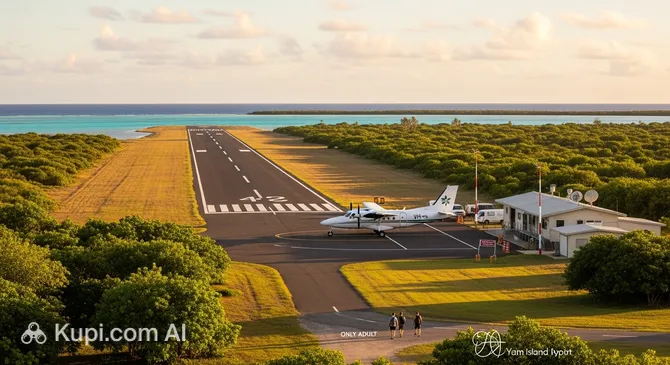
Yam Island Airport is not merely a runway, but a true aerial gateway to one of the most secluded and picturesque corners of the Torres Strait. Situated on a tiny island, it serves as a vital artery connecting the local community with the rest of Australia. For travellers, it is the starting point into a world of authentic island culture, pristine nature, and breathtaking views of coral reefs opening up right from the aircraft window.

Yam Island. Illustration.
Source: Kupi.com AI
PropertyValue
IATA CodeXMY
ICAO CodeYYMI
CityYam Island
CountryAustralia
TimezoneAustralia/Brisbane
ScheduleOnline Timetable

The main feature of Yam Island Airport is its intimacy and simplicity. Forget the hustle and bustle of metropolises: there are no huge terminals or duty-free shops here. Instead, a small but functional pavilion and friendly staff await you, creating an almost homely atmosphere. Boarding and disembarking are quick, and the whole process resembles catching an intercity bus rather than boarding a plane at a major hub.

A key advantage of the airport is its strategic location. It provides regular connections to other Torres Strait islands and the major transport hub on Horn Island, from where you can reach Cairns and other mainland cities. For tourists, this is a unique opportunity to explore remote islands, and for locals, a necessary link to the outside world. Furthermore, the flight to this region is an adventure in itself, as incredible panoramas of turquoise waters and scattered coral atolls unfold from above.

Contact Information

  • Official Website: Yam Island Airport (XMY) does not have its own official website. The airport in Yam Island is managed by the Torres Strait Island Regional Council, on whose portal general information can be found.
  • Help Desk Phone: There is no specialised help desk at the airport. For general enquiries regarding its operation, it is recommended to contact the Torres Strait Island Regional Council.
  • Airport Address: Yam Island, Queensland 4875, Australia.
  • Email: The airport does not provide a separate email address for passengers. Please use the contact details of the managing organisation for communication.
  • Social Media: There are no official social media accounts for the airport.
  • Lost Luggage Information: For all issues regarding lost or damaged luggage, you must contact the airline directly regarding the flight you travelled on.
  • Passenger Support Contacts: Assistance for passengers, including information on tickets, schedules, and special services, is provided by the air carrier. Please contact your airline directly.

How to Get to the Airport

Getting to the airport on Yam Island is a task that differs radically from travelling to a major aviation hub somewhere in Australia. The island is very small, and its airport is essentially a runway located in immediate proximity to the main settlement. Therefore, a long and tiring journey is certainly not something you need to worry about.

The primary and most logical method of moving around the island, including the route to the airport, is walking. The distance from any point in the residential part of the island to the runway can be covered in 5–15 minutes. There is no conventional public transport here, such as buses or trains. You will also not find official taxi services or car rental agencies — there is simply no need for them in such a compact territory.

If you have a lot of luggage or require transport for any reason, the only option is a pre-arranged transfer. It is recommended to discuss this possibility with representatives of your accommodation or the hosting party during the trip planning stage. Regarding parking, the airport has no formal paid car park. It is simply a small area used by local residents.

Air transport plays a vital role in connecting the scattered islands of the Torres Strait. In addition to Yam Island Airport, other airfields operate in the region. The nearest neighbours are Warraber Island, located approximately 34 km away, Saibai Island (60 km), and Badu Island (about 71 km). A larger transport hub in this area is considered to be Horn Island Airport, from where flights to other parts of the country are operated.

Terminals and Map

Yam Island Airport (XMY) is a small regional airport with one passenger terminal. Its structure is extremely simple and functional, fully meeting the needs of a small island. There is no separation into domestic and international flights here — the terminal serves all arriving and departing aircraft, primarily local airline flights connecting Yam Island with other Torres Strait islands and the mainland of Australia.

The airport layout is intuitively understandable, and getting lost here is practically impossible. Essentially, the terminal is a single small building where all key zones are combined. The departure zone and arrival zone are typically the same space. After check-in, passengers wait for boarding in a small hall, and then walk to the aircraft directly across the airfield. Arriving passengers proceed from the aircraft to the building to collect luggage in the same manner. Consequently, there are no transfers between terminals.

Passing through all pre-flight procedures at Yam Island Airport takes a minimum amount of time. Check-in for the flight takes place at a single counter and usually lasts just a few minutes. Security screening, if conducted, is also organised as quickly as possible, as passenger traffic here is low. It is recommended to arrive at the airport approximately 45-60 minutes before departure to check in luggage without haste and wait for boarding.

The features of the terminal lie in its minimalism. Do not expect Duty-Free shops, numerous cafés, or business lounges here. Infrastructure is limited to basic amenities: a small waiting area with seats and restrooms. The main advice for navigation is simple: everything you need is in one hall, and airport staff are always ready to help and suggest where to go.

Airport History

Yam Island Airport (XMY), also known as Iama Airport, is not a major international hub with a long history of global events, but a vital facility for the eponymous island in the Torres Strait. Its history is inextricably linked with the development of the local community and ensuring its connection with the outside world.

The exact date of the airfield's founding on Yam Island has not been widely publicised, however, like many other runways in this region, it was likely created in the second half of the 20th century. The main purpose of its construction was to ensure reliable transport communication for the remote community. From the very beginning, the airport served to deliver mail, essential goods, transport passengers, and, crucially, for medical evacuation.

The main stages of the airport's development were modest but significant for local residents. Initially, it may have been a simple dirt strip. The key modernisation was most likely the asphalting of the runway, which allowed flights to be received in any weather and enabled the use of more modern types of small aircraft. Today, the airport represents basic but functional infrastructure maintained for regular communication.

The main achievement and "record" of Yam Island Airport is its continuous operation as a "lifeline" for the islanders. It has not witnessed major historical events on a global scale, but every flight performed is a small story: family reunions, saved lives, or opportunities for children to receive education on the mainland. An interesting fact is that due to the short runway and location specifics, the airport can only serve Short Take-Off and Landing (STOL) aircraft, making its operation a unique task for pilots.

Services and Facilities

Yam Island Airport (XMY) is a small regional airfield that serves as the main air harbour for the eponymous island in the Torres Strait. It is important to understand that this is primarily a functional transport hub, not a large terminal, so the range of services here is very limited. Passengers are advised to plan their trip taking into account the minimalist infrastructure.

On the airport territory, you will not find restaurants, cafés, or shops. There are no duty-free zones, souvenir stalls, or high-comfort lounges or VIP halls. All necessary purchases, including food and drinks, are best made before arriving at the airport.

Access to public Wi-Fi is not provided at Yam Island Airport. There are also no specialised charging stations for electronic devices here, so it is strongly recommended to bring a portable power bank. Banking services, including ATMs and currency exchange points, are absent in the terminal.

The airport has basic infrastructure to ensure accessibility, but specialised services for passengers with reduced mobility or separate mother and child rooms are not provided. If you require special assistance, please inform your airline in advance. There is no permanent medical post on the premises; in emergencies, assistance is provided by airport staff or local services.

There are no hotels, business centres, or conference halls in the airport itself or in its immediate vicinity. Accommodation options should be sought in the residential areas of the island. All business matters are also recommended to be resolved outside the airport.

Where to Eat

When planning a journey through Yam Island Airport (XMY), it is important to consider its specifics. This is a small regional airport that serves mainly the local population and flights between the Torres Strait islands. Consequently, the infrastructure here is quite modest and does not imply a wide selection of catering establishments.

In the Yam Island Airport terminal, you will not find restaurants, cafés, or bars in the usual sense. Opportunities to purchase food and drinks are extremely limited and may be reduced to vending machines with a basic set of snacks (crisps, chocolate) and bottled water. One cannot count on a full lunch, special dietary meals (vegetarian, gluten-free), or freshly brewed coffee here.

Therefore, travellers are strongly advised to take care of meals in advance. The best solution would be to eat a full meal before leaving for the airport or to bring your own snacks and drinks. This will allow you to wait comfortably for your flight without worrying about finding food on site.

Traveller Tips

Travelling through Yam Island Airport acts as a gateway to one of the unique islands of the Torres Strait in Australia. Although it is a small regional airport, knowing a few nuances will make your trip more comfortable and predictable. Here are some useful tips for passengers.

Arrival, Check-in, and Security. Yam Island Airport is very compact, so you do not need to arrive three hours before departure as you would at major international hubs. Usually, arriving 60–90 minutes before departure is sufficient. This time is enough to check in and pass security without haste. Procedures here are much faster than at large airports, and the staff are generally very friendly. If possible, complete online check-in in advance to save time.

Seat Selection and In-flight Comfort. Flights in this region are often operated on small turboprop aircraft. If you want to enjoy stunning views of the coral reefs and Torres Strait islands, choose a window seat. Note that noise levels in the cabin on such flights can be higher than on large jets, so noise-cancelling headphones would be useful.

Luggage and Hand Luggage Rules. Standard Australian aviation security rules apply here. In hand luggage, liquids must be in containers up to 100 ml, packed in a transparent bag. Sharp objects and other dangerous substances are prohibited. Always check weight and dimension allowances for hand luggage on your airline's website, as they may be stricter on regional flights.

Quarantine Control Specifics. This is a critically important point for travellers to the Torres Strait. Although it is a domestic flight, strict quarantine rules apply in the region to protect the unique ecosystem. This means that bringing certain goods onto the island (and taking them off) is restricted. Generally, it is prohibited to transport fresh fruit, vegetables, plants, seeds, and certain animal products. Before travelling, be sure to check the current list of restrictions on official Queensland Government websites to avoid fines and confiscation.

Connecting Passengers and Savings. Direct transfers at Yam Island Airport are unlikely, as it is a destination point. If you have a connection at a larger airport (e.g., in Cairns), study the terminal map in advance. To save money, book tickets well in advance and consider travelling with hand luggage only. Infrastructure at the airport is minimal, so bring water and a light snack with you — this will help you save money and pass the time more comfortably while waiting for your flight.

What to Do in Case of Flight Delay? Tropical weather can be unpredictable, and flight delays do happen. If your flight is delayed, first contact an airline representative for information. Find out about your rights regarding the provision of drinks, food, or accommodation (depending on the length of the delay and the carrier's policy). Given the modest size of the airport, there may not be a café or many shops here. A pre-charged power bank, a book, or a downloaded film will help pass the waiting time.
Reached the end of the page?

That means the route is fully explored