Support

Antwerp City Hall

About

The majestic Antwerp City Hall is more than just an administrative building; it is a true architectural manifesto of the Dutch Renaissance. Located on the main city square, Grote Markt, it serves as the heart of the city of Antwerp and is one of the most significant historical monuments that Belgium takes pride in. Built in the 1560s, the building impresses with its facade, where the austerity of Italian traditions and the elegance of Flemish Gothic are harmoniously intertwined.
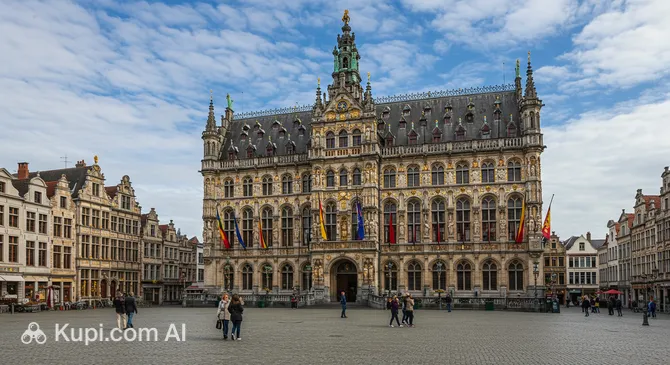
Antwerp City Hall
Antwerp City Hall. Иллюстрация. Источник: Kupi.com AI

This four-story structure, 76 meters high, is considered the first Renaissance building in Northern Europe. Its lavish facade is decorated with columns, a rusticated lower floor, and rich heraldry. Due to its exceptional historical value, the city hall is included in the UNESCO World Heritage list, embodying the era of Antwerp's prosperity as a global trade hub.

Today, it still functions as the city hall; however, for tourists, it is primarily a masterpiece by architect Cornelis Floris de Vriendt. Special attention is drawn to the central risalit, crowned with a figure of the Virgin Mary and the imperial eagle, emphasizing the city's former status within the Holy Roman Empire.

Contacts

To clarify visit details or receive up-to-date information on special events, you can use the city hall's official contact information.

How to contactContact
AddressGrote Markt 1, 2000 Antwerpen, Belgium
Phone+32 3 221 13 33
Websitewww.antwerpen.be

What to Do

The main impression of visiting the city hall begins with its facade: be sure to examine the details of the florisstil style — a unique ornamentation invented by local craftsmen. On the building, you can see statues, the coats of arms of Antwerp's margraves, and an eagle facing the empire. If you are lucky enough to get inside, magnificent 19th-century interiors await you. Of particular value are the halls decorated with paintings by Henri Leys, which depict key scenes from the city's history.

Inside the city hall, you can also see portraits of monarchs and former burgomasters, as well as luxurious halls for receptions and city council meetings. Solemn wedding ceremonies are still held here today, so you have a chance to feel the living energy of this historic site.

After exploring the building, it is recommended to linger in Grote Markt square. It offers the best view of the city hall's Gothic roof in contrast with the surrounding guildhalls. A walk around the building will allow you to appreciate its scale and see the inner courtyard, which preserves the atmosphere of an ancient European center.

Getting There

Located in the heart of the historical center at Grote Markt 1, the city hall is easily accessible to any traveler. If you arrive at the magnificent Antwerpen-Centraal station, the walk to the square takes about 15–20 minutes through bustling shopping streets, allowing you to immediately immerse yourself in the city's atmosphere.

For those who prefer public transport, trams and buses going to the Groenplaats or Meir stops (routes 2, 3, 5, 6, 10) are ideal. From these stops, it is only a few hundred meters walk to the main city hall building through cozy medieval alleys.

If you are traveling from Brussels Airport, it is most convenient to take a direct train to Antwerp. Within the old town, it is best to move on foot or by taxi, as the area around Grote Markt is primarily pedestrianized, and the nearest parking lots (such as Parking Groenplaats) are just a couple of minutes' walk away.

Ближайший город: Antwerp

History & Facts

In the mid-16th century, when Antwerp was experiencing its "Golden Age" and surpassing Genoa and Venice in wealth, the old Gothic city hall from 1406 became too cramped. In 1561, under the direction of the outstanding architect Cornelis Floris de Vriendt, construction began on a new building intended to embody the power and prosperity of Europe's leading trade center.

The building's fate was challenging: in 1576, during the dramatic events known as the "Spanish Fury," the city hall was severely damaged by fire. Only the outer walls survived, yet the townspeople restored their symbol in just three years. It was here that Floris introduced a unique decorative system — florisstil — which combined Italian Renaissance forms with local traditions and became a benchmark for Flemish masters for decades.

Interestingly, the central facade is decorated with heraldic symbols of the Margraves of Antwerp and the Dukes of Brabant, while a statue of the Virgin Mary, the city's patron saint, stands in a niche. The city hall is not just an administrative building, but a living historical monument included in the UNESCO World Heritage list as one of the most important examples of Northern Renaissance civil architecture.

Time Needed

Exploring Antwerp City Hall and its adjacent square usually takes between 1 and 2 hours. This time is quite sufficient to leisurely examine the details of the facade, take commemorative photos, and step inside to view the interiors if no official events are being held.

If you plan to combine your visit with a break at one of the many cafes on Grote Markt or a visit to the neighboring cathedral, it's worth setting aside about half a day for your walk. The city hall itself is a site that impresses both with its grand scale and its fine decorative details that deserve thoughtful contemplation.

Working Hours

For those planning a visit inside or contacting official services, Antwerp City Hall operates according to the following schedule:

Monday — Friday: from 08:30 to 17:30.
Saturday and Sunday: closed.

Please note that on public holidays and during official receptions, access for tourists may be limited, so it is best to view the building's facade at any time during daylight hours.

DayWorking hours
Понедельник8:30 – 17:30
Вторник8:30 – 17:30
Среда8:30 – 17:30
Четверг8:30 – 17:30
Пятница8:30 – 17:30
СубботаЗакрыто
ВоскресеньеЗакрыто

Nearby

Exploring the surroundings of the central square allows you to see several of the city's iconic sites in a single day. Right next to the city hall, you will find architectural masterpieces and monuments that tell the story of the region from the Middle Ages to the present day.

A stroll through this area is an opportunity to see legendary fountains, ancient castles on the banks of the Scheldt River, and unique museums located within walking distance of each other.

NameDistance
Brabo Fountain0 km
HotelO0.1 km
Het Steen0.2 km
Cathedral of Our Lady0.2 km
De Muze0.3 km
Dogma0.3 km
Plantin-Moretus Museum0.3 km

Reached the end of the page?

That means the route is fully explored