Support

Kaiser-Wilhelm Monument

About

At the confluence of two great rivers, the Rhine and the Moselle, stands one of Europe's most recognizable landmarks — the Emperor William Monument. Located at the legendary site known as "German Corner" (Deutsches Eck), this monument is the heart of the city of Koblenz and an important national symbol that attracts millions of travelers visiting Germany every year.
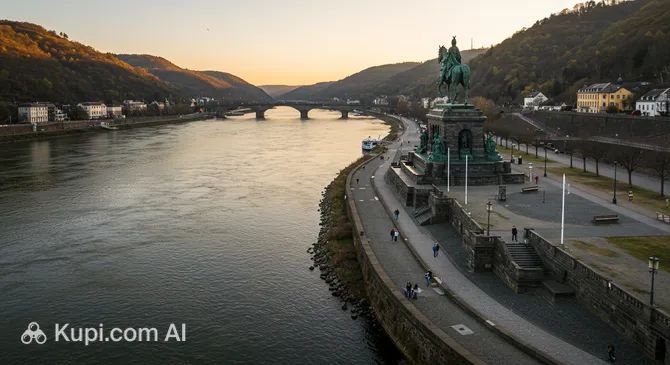
Emperor William Monument
Emperor William Monument. Иллюстрация. Источник: Kupi.com AI

This majestic structure features a 14-meter equestrian statue of Kaiser Wilhelm I, mounted on a massive granite pedestal. The total height of the complex is an impressive 37 meters. The Emperor is depicted in general's uniform, and next to his horse is a female figure symbolizing the unity of the German lands.

The facade of the monument is decorated with elegant reliefs depicting the imperial eagle and commemorative inscriptions, including lines by the poet Max von Schenkendorf. Due to its location and scale, the monument serves as an excellent landmark and the city's primary observation deck, offering breathtaking views of the river expanses.

Contacts

To plan your visit and for additional reference information, you can use the following details:

How to contactContact
AddressPeter-Altmeier-Ufer, 56068 Koblenz, Germany
Websitewww.kuladig.de

What to Do

The main highlight for any visitor is climbing to the observation platform at the base of the monument. From here, you get a magnificent panoramic view of the meeting point of the Rhine and the Moselle. It is the perfect spot to see how the differently colored waters of the two rivers blend together, and to watch the busy river traffic and passing cruise liners.

Walking along the artificial spit where the monument stands allows you to fully experience the atmosphere of the "German Corner." You can examine the bas-reliefs on the granite pedestal in detail and take impressive photos against the backdrop of the giant statue. The Peter-Altmeier-Ufer embankment is a great place for a peaceful stroll, where you can enjoy the fresh river air and views of the hills surrounding the city.

Many tourists choose to finish their visit by relaxing in one of the nearby cafes while admiring the Kaiser's majestic silhouette. Evening is also a popular time to visit: the monument's illumination creates a special, solemn atmosphere, making the location one of the most romantic spots in Koblenz.

Getting There

Reaching this landmark in Koblenz is easy, as it is one of the city's most popular destinations. The monument is located on the Peter-Altmeier-Ufer embankment, right at the famous "German Corner." If you are in the city center, a pleasant walk along the river will lead you directly to the monument.

For those who prefer public transport, there are bus and tram stops within walking distance named "Deutsches Eck" or "Kaiser-Wilhelm-Denkmal." You can also take a taxi; the ride from the central station only takes a few minutes.

For a more scenic approach, many river cruises on the Rhine and Moselle stop right at the German Corner. Drivers will find parking spaces along the embankment, though these can be scarce on weekends and holidays due to the high volume of tourists.

Ближайший город: Koblenz

History & Facts

The idea for the monument emerged in the late 19th century as a symbol of gratitude for the unification of Germany. The site was personally chosen by Emperor William II, and the construction funds—an impressive one million marks at the time—were raised through public donations. The grand unveiling of the majestic statue took place on August 31, 1897.

The monument has had a challenging history: in the mid-20th century, the original sculpture was severely damaged. For a long time, only a flagpole stood on the empty pedestal, and the site was officially known as the "Memorial to German Unity." This served to highlight the people's desire for reunification during the post-war period.

The equestrian statue we see today is a meticulous copy of the original. It was recreated from surviving blueprints and archival materials by Professor Raimund Kittl. The Emperor returned to his rightful place in September 1993, marking a new chapter in the history of the reunified country.

Interestingly, the original head of the old statue was not lost. Today, this historical artifact is carefully preserved in the Middle Rhine Museum, allowing visitors to compare the intricate details of the old and new craftsmanship.

Time Needed

To leisurely explore the monument, study the bas-reliefs on the pedestal, and enjoy the panoramic river views, most visitors need between 30 and 60 minutes. This is usually enough time to take beautiful photos and learn a bit about the site's history.

If you plan to combine your visit with a walk along the embankment or a stop at a nearby cafe, you should set aside about 1.5 to 2 hours. The "German Corner" is a place where you'll want to linger and watch the riverboats pass by.

Working Hours

The area of the "German Corner," where the Emperor William Monument is located, is accessible to visitors 24 hours a day. You can come here early in the morning to watch the sunrise by the river, or late in the evening when the monument is beautifully lit up.

The official schedule confirms that access to the monument is open 24/7 every day of the week, including holidays. This makes it one of the most convenient locations to visit at any time of year.

Круглосуточно

Nearby

Exploring the surroundings of the "German Corner" can greatly enrich your travel experience. The area around the monument is steeped in history, and its landscapes offer many options for culture and outdoor relaxation.

Below are some interesting sites located in the immediate vicinity that are worth including in your itinerary:

NameDistance
German Corner0.1 km
Basilica of St. Castor0.2 km
Koblenz Cable Car – Valley Station0.3 km
Konrad Adenauer Embankment0.4 km
Koblenz Cable Car0.5 km
Pegelhaus0.6 km
Historiensäule (History Column) at Görresplatz0.6 km

Reached the end of the page?

That means the route is fully explored