Support

Landesmuseum Hannover

About

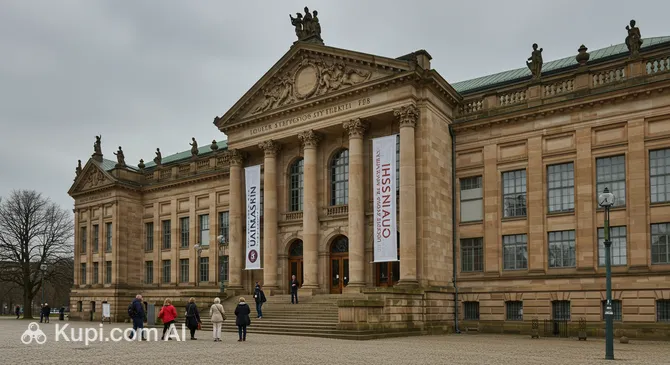
The Lower Saxony State Museum is the region's largest regional heritage center, located in the city of Hanover. The majestic Neo-Renaissance building, erected in 1902, draws attention with its architectural elegance and stands directly opposite the famous New Town Hall. This is a place where Germany reveals the richness of its history, nature, and art through unique collections.
\n\n
Lower Saxony State Museum
Lower Saxony State Museum. Иллюстрация. Источник: Kupi.com AI
\n\n

The museum's exhibition is divided into three fascinating sections: NatureWorlds (natural history), PeopleWorlds (archaeology and ethnology), and ArtWorlds (fine arts). This variety makes the museum a versatile attraction where every visitor will find something captivating—from ancient artifacts to masterpieces of world painting.

\n\n

It houses outstanding works of art spanning the period from the Middle Ages to the early 20th century. A particular point of pride for the museum is not only the canvases of great masters but also a live aquarium with rare inhabitants, making a visit an educational adventure for the whole family.

Contacts

To plan your visit to the Lower Saxony State Museum, you can use the contact information provided below. The museum's official website offers up-to-date information on current exhibitions and special events.

\n\n
How to contactContact
AddressWilly-Brandt-Allee 5, 30169 Hannover, Germany
Phone+49 511 9807686
Websitewww.landesmuseum-hannover.de

What to Do

A visit to the museum promises a wealth of discoveries for art lovers. In the ArtWorlds section, you can see firsthand masterpieces by masters such as Albrecht Dürer, Peter Paul Rubens, Rembrandt, and Lucas Cranach the Elder. Sculpture enthusiasts should look out for the delicate works of Tilman Riemenschneider, which are striking in their level of detail.

\n\n

The PeopleWorlds archaeological section offers a journey back through the centuries. Among the most valuable exhibits are the Schulenburg gold lunula, which is about 4,000 years old, and the famous red-haired mummy from the 2nd century AD. These artifacts allow you to touch the mysteries of ancient civilizations and the daily lives of ethnic groups from Africa and Oceania.

\n\n

Families with children will especially enjoy the natural history department. Here, you can study a giant model of a prehistoric reptile and observe life in the aquarium and vivarium, home to 2,000 species of reptiles and insects. The combination of a classic museum and a living corner of nature makes a stroll through the halls dynamic and engaging.

Getting There

The museum is located at Willy-Brandt-Allee 5, in the picturesque Maschpark area, almost directly opposite the New Town Hall. If you are in the city center, a walk from the Market Square (Marktplatz) will take about 10–15 minutes (a distance of only about 1 km), allowing you to enjoy the city's architecture along the way.

\n\n

For those who prefer public transport, the most convenient option is bus No. 200. You should get off at the Hannover Rathaus-/Bleichenstraße stop, which is in the immediate vicinity of the building's entrance. Alternatively, you can take a taxi from anywhere in central Hanover; the trip will take no more than 5–7 minutes.

Ближайший город: Hanover

History & Facts

The museum's history dates back to the late 18th and early 19th centuries, when the first public scientific and artistic associations began to form in Hanover. A significant contribution to the collection's development was made by King George V, under whose reign the Museum of Art and Science opened in 1856. Subsequently, various private and royal collections were merged into a single Provincial Museum.

\n\n

The museum's current building is the result of an ambitious project by architect Hubert Stier, who won a professional competition in 1895. The grand opening in its majestic new Neo-Renaissance home took place in 1902. The building itself is an outstanding architectural monument of the era.

\n\n

Special attention should be paid to the exterior decor. The facade is adorned with a monumental relief frieze titled "Highlights in the Development of Mankind." This large-scale work was created by the leading sculptors of the time: Georg Herting, Karl Gundelach, and Georg Küsthardt. The frieze symbolizes the progress of civilization, setting a thoughtful tone for visitors before they explore the internal exhibitions.

Time Needed

To thoughtfully explore all three thematic departments of the museum, it is recommended to set aside at least 3–4 hours. This is enough time to get acquainted with the key masterpieces of painting, marvel at rare archaeological finds, and spend time by the aquariums.

\n\n

However, true art and history enthusiasts could easily spend an entire day here. The presence of temporary exhibitions and extensive archives allows for a deep dive into the details of each era without feeling rushed. If you are traveling with children, allow extra time to visit the vivarium, which is usually a big hit with younger visitors.

Working Hours

The Lower Saxony State Museum is open to visitors six days a week. From Tuesday to Sunday, the doors are open from 10:00 AM to 6:00 PM. This is a consistent schedule that makes it easy to plan a cultural program for any day of the week except Monday.

\n\n

Please note that the museum is closed on Mondays. It is recommended to arrive in the morning to have enough time to explore all the main exhibitions before closing.

DayWorking hours
ПонедельникЗакрыто
Вторник10:00 – 18:00
Среда10:00 – 18:00
Четверг10:00 – 18:00
Пятница10:00 – 18:00
Суббота10:00 – 18:00
Воскресенье10:00 – 18:00

Nearby

Exploring the area around the museum can significantly enrich your trip. Thanks to its central location, both historical quarters and modern entertainment centers are within walking distance or a short distance away.

\n\n
NameDistance
Maschpark0.1 km
New Town Hall0.3 km
Aegidien Church0.4 km
Escape Room Hanover0.6 km
Markthalle Hanover0.6 km
Marktkirche0.8 km
Hanover Old Town0.9 km

Reached the end of the page?

That means the route is fully explored