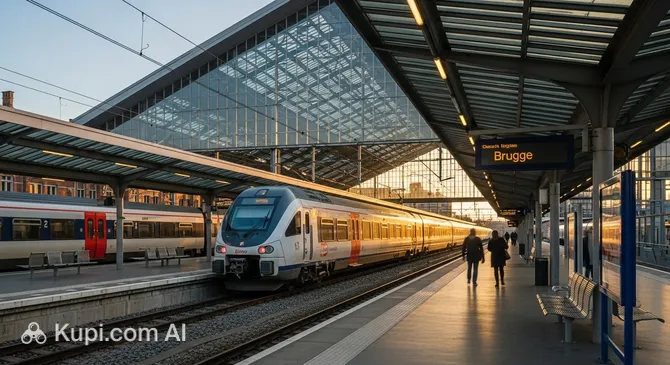
Brugge Railway Station is not just an important transport hub, but also the starting point for exploring one of Europe's most beautiful cities. The station building, with its austere yet elegant appearance, welcomes thousands of tourists and residents daily. The station serves both domestic lines (including directions to the coast and Brussels) and international routes, providing passengers with a high level of service.
Below is the main reference information about the facility:
Navigation within the complex is simple and logical. From the spacious main hall, passengers enter an underground passage leading to the platforms. Digital displays and signs are installed everywhere. It is important to note that the historic city centre is within walking distance, making the station exceptionally convenient for tourists.
Contact Information
To plan your trip, check the schedule, or request assistance, please use the official contact details of Brugge station:
Official website: belgiantrain.be (SNCB) — the main resource for purchasing tickets and checking departure times.
Information service phone: +32 2 528 28 28 (unified support line for Belgian railways, operates daily).
Address: Stationsplein, 8000 Brugge, Belgium.
Opening hours: The station is open daily from 04:30 AM to 01:00 AM (after the arrival of the last train).
Luggage storage: Automatic lockers are available during station opening hours and accept card payments.
Accessibility: The station is fully adapted for passengers with reduced mobility; it is recommended to submit a request for assistance 24 hours in advance.
How to Get There
Getting to Brugge Railway Station is very easy, as it is situated on the edge of the historic centre and serves as the city's main transport hub.
On foot: You can walk from the central Grote Markt square to the station in 15–20 minutes. The route passes through picturesque streets and the famous Minnewater Park (Lake of Love), turning the walk into a pleasant stroll.
Public Transport: Directly in front of the main entrance is a large bus station operated by De Lijn. Almost all city and suburban buses arrive here.
Taxi and Car: A taxi rank is located at the exit of the station building (on the city centre side). For drivers, there is a large paid parking lot (Interparking) and a quick drop-off zone (Kiss & Ride).
Services and Amenities
Brugge station offers a full range of services for a comfortable wait and travel preparation. In the central hall, there are ticket counters with operators, as well as numerous self-service machines for quickly purchasing travel documents.
Available to passengers:
Luggage storage: Automatic lockers of various sizes allow you to leave your luggage and explore the city light.
Connectivity: Free Wi-Fi is available throughout the station (simple authorization required).
Waiting rooms: Equipped rest areas protected from wind and rain.
Sanitary facilities: Paid toilets maintained in a clean condition, including cabins for people with disabilities.
The station also has ATMs and a bicycle rental point, which is particularly popular in Flanders.
Where to Eat
If you are feeling hungry, Brugge Railway Station has several convenient options to refresh yourself before your journey.
Inside the building, there are popular chain establishments such as Panos and Starbucks. Here you can buy fresh sandwiches, traditional Belgian pastries, coffee, and soft drinks. This is an excellent choice for a quick snack; the average cost is 5–12 Euros. There is also a small supermarket (usually Carrefour Express) for purchasing water and snacks.
If you have more time, there are many cafés and restaurants on the station square (Stationsplein) and on the way to the city centre where you can order a full lunch, including famous Belgian waffles and fries.
Station History
The history of railway communication in Brugge began very early: the first train arrived here in 1838, in the presence of the royal couple Leopold I and Queen Louise-Marie. This event became a turning point, connecting the city with Brussels and the coast, and contributed to the tourism renaissance of Brugge.
The current station building was constructed in the late 1930s (completed in 1939) based on the design of architects Van de Velde. It is a protected architectural monument. Despite its historical status, the station has undergone extensive modernization: the underground passage was expanded, platforms were updated, and infrastructure was improved to cope with the growing flow of tourists eager to see the "Venice of the North".
Passenger Tips
For the most comfortable journey through Brugge station, we recommend arriving at the station 15–20 minutes before departure. This will allow you to find the correct track and carriage without rushing.
Useful tips:
Tickets: For trips within Belgium on weekends, use the Weekend Ticket fare — it offers a 50% discount on return trips.
Luggage: If you have arrived for a day trip, be sure to use the luggage lockers so you do not have to carry your belongings over the cobblestones of the historic centre.
Safety: The station is safe, but as in any tourist location, please keep an eye on your personal belongings.
Trains: Listen carefully to announcements: sometimes the departure platform may change a few minutes before the train arrives.