Support

Maun Airport

About the Airport

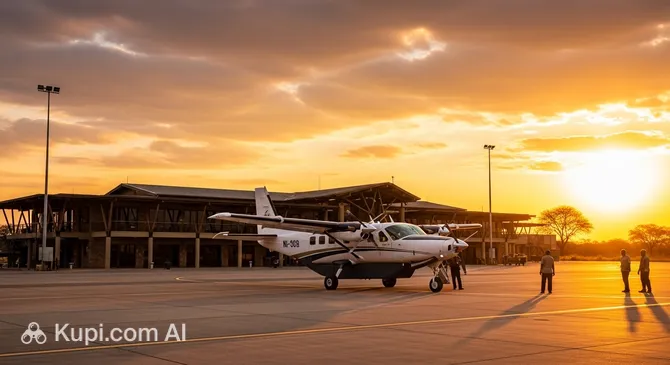
Maun Airport. Source: Kupi.com Binoculars

Maun Airport is not merely an air hub, but a true gateway to the wildlife world of Botswana. Situated on the doorstep of the famous Okavango Delta, it is considered one of the busiest airports in Southern Africa in terms of takeoffs and landings. Its unique atmosphere is created not so much by large liners, but by the small aircraft bustling everywhere and the hum of propellers — it is from here that unforgettable air safaris over protected territories begin. This airport is the first and main point on the route for thousands of travelers striving to see the wonders of the Moremi and Chobe National Parks.

IATA Code MUB
ICAO Code FBMN
City Maun
Distance to center approx. 5 km
Status International
Passengers per year Over 200,000 (estimated)
Popular Airlines Air Botswana, Airlink, Ethiopian Airlines
Schedule Online Board "Maun Airport"

The main feature of Maun Airport is its key role in the country's tourism infrastructure. It serves as the primary base for charter airlines that organize sightseeing flights and transport tourists to the most remote lodges and camps of the Okavango Delta. Despite the relatively small size of the terminal, everything necessary for a comfortable start to your journey is available here: check-in counters, cafes, souvenir shops, and car rental offices. Recent reconstruction has improved the airport's infrastructure, making it more modern and convenient for the growing flow of adventure seekers.

Contact Information

  • Official Website: Maun Airport is managed by the Civil Aviation Authority of Botswana (CAAB). Up-to-date information can be found on their official website www.caab.co.bw, as the airport does not have a separate website.
  • Inquiry Service Phone: +267 686 0238
  • Address: Airport Road, Maun, Botswana
  • Email: There is no direct email address for the airport. For general inquiries, you can contact the CAAB at: caab@caab.co.bw.
  • Social Media: Official social media pages for the airport are not maintained.
  • Lost Luggage Information: For all issues regarding lost or damaged luggage, you must contact the airline representative directly for the flight you arrived on. The airport service does not handle such requests.
  • Passenger Support Contacts: For general information and support, it is recommended to use the main airport inquiry phone number.

How to Get to the Airport

Maun Airport (MUB) is located in the immediate vicinity of the city of the same name, making the journey there quick and simple. Essentially, the airport is situated on the outskirts of Maun, the main tourism hub for departures on safari to the Okavango Delta. You can reach the terminal in several ways, but the most popular among travelers are taxis and organized transfers.

Taxis and Hotel Transfers are the most convenient and common option. A trip from any point in the city will take no more than 10–15 minutes. Taxis can easily be found in the city or ordered by phone. The cost of the trip is low. An even more convenient solution is a transfer, which is organized by almost all hotels and safari lodges. As a rule, it is already included in the cost of accommodation or the safari package, and the driver will meet you at the appointed time.

For those planning to explore the surroundings and national parks of Botswana on their own, car rental will be an excellent choice. Several rental agencies operate in Maun, including those with offices at the airport. This provides freedom of movement, but it is important to remember the specifics of driving on African roads. Parking is available on the airport territory, where you can leave a car for both short and long periods.

As for public transport, regular city buses or trains do not run to the airport. Minibus taxis (known as "combis") circulate around the city, but they follow specific routes and may be inconvenient for tourists with luggage. Therefore, this mode of transport is not recommended for trips to the airport.

Thus, your choice depends on your travel style. For maximum comfort, use a transfer from your lodge. If you need flexibility, take a taxi. Car rental is suitable for independent travelers. Although Maun Airport is the main gateway to the Okavango Delta, for trips to other regions, such as Chobe Park, tourists also use Kasane Airport or the international Victoria Falls Airport.

Terminals and Map

Maun Airport (MUB) is a compact and functional aviation hub serving as the main gateway to the famous Okavango Delta. Its structure is simple and clear, making navigation maximally convenient for travelers. The airport operates one passenger terminal, which services both scheduled regional flights and numerous charter flights for safari tours.

The terminal layout is intuitive. The building is single-story and divided into several key zones. Upon entering the terminal, you find yourself in a general hall with several check-in counters. Representatives of airlines and tour operators are also located here. After check-in, passengers proceed to the security screening zone, followed by a small but comfortable departure lounge. The arrival zone is located in another part of the building and is equipped with a luggage claim belt and passport control counters for international flights.

Since there is only one terminal at the airport, all zones are within walking distance of each other. No transfers, shuttles, or long movements are required — everything is located in one building. This significantly simplifies the transfer process, especially for those arriving on a scheduled flight and transferring to a small plane for a flight to a lodge.

Passing through all formalities usually does not take much time. However, during the peak tourist season, the airport can be quite busy due to the simultaneous departure of several safari groups. It is recommended to arrive at the airport approximately 1.5–2 hours before the departure of a regional or international flight to go through check-in and screening without rushing. For domestic charter flights, arriving one hour prior is sufficient unless otherwise specified by your tour operator.

Airport History

The history of Maun Airport (MUB) is inextricably linked with the development of tourism in Botswana and the transformation of the region into one of the world's premier safari destinations. Initially, in the mid-20th century, it was merely a simple airstrip serving the administrative needs of a remote settlement and the first explorers of the Okavango Delta. It began to acquire the status of a full-fledged airport as the unique ecosystem of the delta attracted more and more travelers.

A key stage in the airport's development was the tourism boom that began in the second half of the 20th century. Demand for air safaris grew, and the old airfield could no longer cope with the flow of small aircraft. This led to gradual expansion: the dirt strip was paved, and the first modest terminal structures and hangars for charter airlines appeared. Maun Airport turned into the main gateway to the Okavango Delta, becoming the starting point for thousands of tourists heading to lodges and camps.

The most significant modernization in the airport's history occurred in the 2010s. In 2016, the construction of a new, modern passenger terminal was completed, radically changing the appearance of the air harbor. The new building, equipped with modern check-in and baggage handling systems, significantly increased throughput and the level of comfort for passengers. Parallel works were carried out to improve the runway and navigation equipment, allowing for the reception of larger regional aircraft.

One of the most interesting facts about Maun Airport is its status as one of the busiest airports in Southern Africa by the number of takeoffs and landings. This record is achieved not by large liners, but thanks to the continuous movement of dozens of light aircraft (such as the Cessna Caravan), which, like flying taxis, transport travelers to numerous airstrips in the very heart of the delta. Today, Maun Airport is a unique place where the spirit of wilderness adventure combines with modern infrastructure, continuing to play a key role in the economy and tourism of Botswana.

Services and Amenities

Maun Airport (MUB), being the main gateway to the famous Okavango Delta, represents a compact but functional terminal oriented towards serving tourists. Here you will find everything necessary for a comfortable start or end to your safari. Several small cafes operate within the airport building, where you can have a snack and drink coffee while waiting for a flight. There are also souvenir shops offering products from local artisans, safari clothing, and books about the wildlife of Botswana.

For a more comfortable wait, lounges may be available at the airport, often associated with the services of specific charter airlines or safari operators. It is recommended to check the possibility of access to such VIP lounges with your tour operator. Wi-Fi is usually available throughout the terminal, although the speed may be modest, and the connection might be paid or time-limited. Special stations and outlets in waiting areas are provided for charging electronic devices.

Travelers can utilize financial services at Maun Airport. There are ATMs and currency exchange points here, which is very convenient for those arriving in the country and needing local currency. In case first aid is required, the airport has a medical point ready to provide basic medical assistance.

The airport is equipped to receive passengers with children — there are mother and child rooms where you can take care of little ones in a quiet environment. Basic conditions have been created for passengers with reduced mobility: ramps and specially equipped restrooms ensure accessibility to the main zones of the terminal. If additional assistance is needed, such as a wheelchair, it is recommended to notify your airline in advance.

There are no hotels directly on the airport territory, however, numerous hotels, lodges, and campsites are located in the city of Maun itself, just a few minutes' drive away. Most of them offer transfer services to/from the airport. regarding business services, such as conference halls or business centers, these are absent at the airport. For conducting business meetings or events, it is better to use the infrastructure of major hotels in Maun.

Where to Eat

Maun Airport (MUB), being the main gateway to the Okavango Delta, offers passengers basic but convenient options for snacks and full meals. It is important to understand that this is a small regional airport, so the choice of establishments is not as vast as in large international hubs. All food outlets are concentrated in the one main terminal building.

In the general zone (landside), accessible before passing security control, the airport's main cafe is located. Here you can have a full lunch or dinner while waiting for a flight or meeting arrivals. The menu usually includes sandwiches, salads, pastries, and several hot dishes, as well as coffee, tea, and soft drinks. This is the best place to try something from the local cuisine, for example, dishes made from famous Botswana beef, if they are on the menu. Prices here are moderate for an airport.

After passing security control (airside), in the departure zone, the choice is more limited. As a rule, a small beverage counter or kiosk operates here, where you can buy drinks, light snacks (chips, chocolate), and something for a quick bite right before boarding the flight. This option is ideal if you have little time left before departure.

Passengers with special dietary needs (vegetarians, vegans, those on a gluten-free diet) should check the availability of suitable dishes with staff in advance, as a specialized menu may be absent. The choice for vegetarians is most often limited to salads or vegetable sandwiches. The operating hours of catering establishments at Maun Airport are directly linked to the flight schedule, so they are open during the operational day but may be closed late in the evening or at night.

Travel Tips

Traveling through Maun Airport marks the beginning of your exciting adventure in Botswana. To ensure everything goes smoothly, use our tips. We recommend arriving at the airport at least 2-3 hours before the departure of international or charter safari flights and 1.5-2 hours before domestic flights. This will give you enough time for calm check-in and passing all formalities, especially during the peak tourist season.

Maun Airport is small but is a lively hub for safari tourism. Check-in and security control procedures here are standard, however, be prepared for queues. Pay special attention to luggage carriage rules, especially if you are transferring to a small plane to a lodge. Most charter airlines require only soft bags (without a rigid frame) and set strict weight limits, usually 15-20 kg per person, including hand luggage. Clarify these requirements with your air carrier or tour operator in advance to avoid the need to repack items.

When checking in for a flight deep into the Okavango Delta, do not hesitate to ask for a window seat. Flights on small aircraft, such as the Cessna Caravan, take place at a low altitude, and truly unforgettable views of winding channels, islands, and wildlife open up from the window. This is your first chance to see the famous landscapes from a bird's-eye view.

For connecting passengers, it is important to clarify in advance whether their luggage will be checked through automatically. When transferring from a major international airline to a local charter, it is often required to collect your luggage and check it in again. Leave a sufficient margin of time between flights in case of unforeseen delays.

Arriving from abroad, you will have to pass standard customs control. Fill out the migration card and be ready to declare goods if necessary. For domestic flights, this procedure is absent. To save time, check in online for your main flight if possible. Options for shopping and food at the airport are few, so it is better to take a light snack and water with you.

In case of a flight delay, the first thing to do is contact your airline representative for up-to-date information. Keep the contacts of your tour operator or lodge at hand to warn them about the change in arrival time. Given the modest size of the terminal, stock up on a book or download movies to your device to brighten up the wait.

Reached the end of the page?

That means the route is fully explored